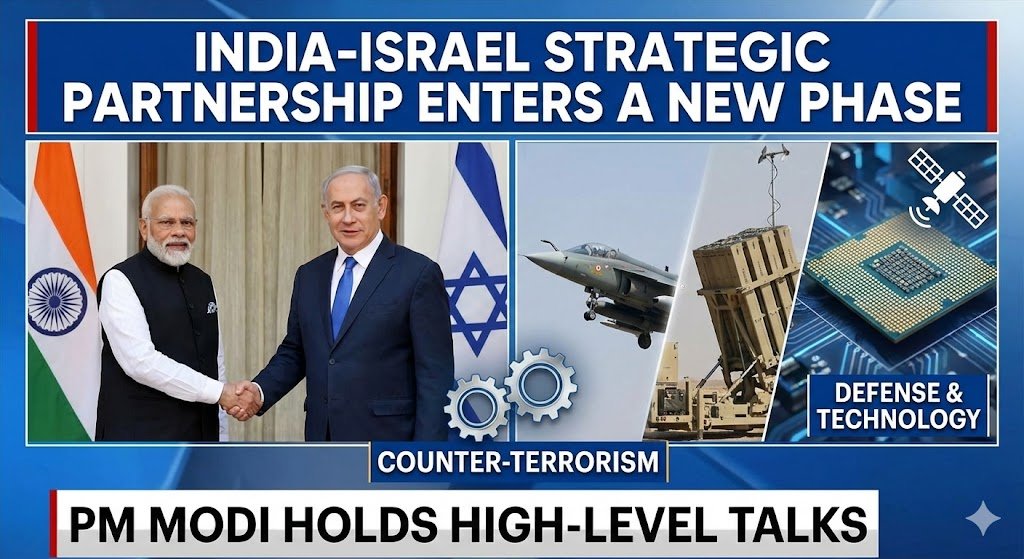
India and Israel have taken another decisive step in strengthening their long-standing strategic partnership, as Prime Minister Narendra Modi and the Israeli leadership engaged in high-level discussions focusing on defense cooperation, counter-terrorism strategies, intelligence sharing, and cutting-edge technology collaboration. The talks come at a time when global security dynamics are rapidly changing, with rising geopolitical tensions, evolving warfare techniques, and the persistent threat of terrorism.
The renewed engagement highlights the growing importance of the India–Israel relationship, which has evolved from limited diplomatic ties into a comprehensive strategic alliance over the past two decades. Observers believe that this phase of cooperation could significantly impact regional stability, defense preparedness, and technological innovation for both nations.
A Relationship Built on Strategic Trust
India formally established diplomatic relations with Israel in 1992, but cooperation between the two countries has expanded dramatically since then. Today, Israel is among India’s most trusted defense partners, supplying advanced military equipment, surveillance systems, missile defense technologies, and cyber-security solutions.
Prime Minister Modi has played a pivotal role in deepening this relationship. His historic visit to Israel in 2017 marked the first-ever visit by an Indian Prime Minister to the country and set the foundation for direct, issue-focused cooperation without third-party mediation.
The latest round of talks builds upon that legacy, reinforcing mutual trust and shared strategic objectives.
Defense Cooperation at the Core
Defense collaboration remained a central theme during the discussions. India and Israel have worked closely on several high-profile defense projects, including missile defense systems, precision-guided munitions, unmanned aerial vehicles (UAVs), and electronic warfare equipment.
According to defense analysts, the talks likely covered:
- Joint development and production of defense equipment
- Expansion of drone and counter-drone technologies
- Missile defense and air defense systems
- Naval surveillance and maritime security
Israel’s expertise in advanced defense innovation and India’s growing manufacturing capabilities under the “Make in India” initiative create a natural synergy. Joint production not only enhances India’s self-reliance in defense but also opens new export opportunities.
Counter-Terrorism: A Shared Priority
Counter-terrorism cooperation between India and Israel is rooted in shared experiences. Both countries have faced prolonged threats from terrorism and asymmetric warfare, making intelligence sharing and tactical coordination critical.
During the talks, leaders reportedly emphasized:
- Real-time intelligence exchange
- Counter-radicalization strategies
- Urban warfare training
- Border security technologies
Israel’s globally recognized counter-terrorism expertise has been instrumental in helping India strengthen its internal security mechanisms. Experts believe that enhanced collaboration in this domain could lead to more proactive threat prevention and improved crisis response capabilities.
Technology and Innovation: The Future Focus
Beyond defense and security, technology emerged as a major pillar of the discussions. Israel, often referred to as the “Startup Nation,” is a global leader in innovation, while India offers scale, talent, and a rapidly expanding digital economy.
Key areas of potential collaboration include:
- Artificial Intelligence (AI) and machine learning
- Cybersecurity and digital infrastructure protection
- Space technology and satellite systems
- Water management and agricultural innovation
Joint research initiatives and startup partnerships could play a crucial role in shaping the next phase of bilateral cooperation. Analysts suggest that deeper technological engagement will also strengthen economic ties and create high-skilled employment opportunities in both countries.
Regional and Global Implications
The timing of the talks is significant. West Asia continues to witness geopolitical instability, while global power structures are undergoing realignment. In this context, the India–Israel partnership carries broader strategic implications.
For India, closer ties with Israel enhance its defense preparedness and strategic autonomy. For Israel, India represents a reliable and influential partner in the Indo-Pacific region.
International observers note that the partnership is not directed against any specific country but is focused on ensuring national security, technological advancement, and regional stability.
Diplomatic Momentum and People-to-People Ties
In addition to strategic cooperation, the relationship between India and Israel is also strengthened by growing people-to-people connections. Tourism, academic exchanges, and cultural interactions have increased steadily over the years.
Thousands of Israeli tourists visit India annually, while Indian professionals contribute significantly to Israel’s technology and healthcare sectors. Educational collaborations and student exchange programs are further enhancing mutual understanding.
Diplomats on both sides believe that strong public engagement reinforces political and strategic alignment.
Economic Cooperation and Trade Growth
Trade and economic cooperation also featured in the broader engagement framework. Bilateral trade between India and Israel has expanded significantly, particularly in diamonds, technology, defense, and agriculture.
Discussions reportedly explored:
- Expansion of bilateral trade agreements
- Investment opportunities in high-tech sectors
- Collaboration in renewable energy and climate solutions
Economic experts suggest that integrating technology-driven innovation with manufacturing and services could unlock substantial growth potential.
Strategic Vision for the Future
The talks reflect a shared long-term vision that extends beyond immediate security concerns. Both countries aim to build a resilient partnership capable of addressing future challenges such as cyber warfare, space security, climate-related risks, and emerging global threats.
Officials familiar with the discussions indicate that follow-up mechanisms and working groups may be established to ensure timely implementation of agreed initiatives.
Expert Reactions
Strategic affairs experts have welcomed the renewed engagement, describing it as a natural progression of an already strong partnership.
“India and Israel complement each other exceptionally well. One brings innovation, the other scale. Together, they can shape security and technology cooperation in the 21st century,” said a senior defense analyst.
Another expert noted that the partnership’s strength lies in its pragmatic approach, focusing on tangible outcomes rather than symbolic gestures.
Conclusion
The latest high-level talks between Prime Minister Narendra Modi and the Israeli leadership mark a significant milestone in India–Israel relations. With defense, counter-terrorism, and technology cooperation at the forefront, the partnership is poised to enter a new and more impactful phase.
As global challenges become increasingly complex, the India–Israel alliance stands out as a model of strategic trust, innovation-driven collaboration, and shared democratic values. The coming months are likely to reveal concrete outcomes from these discussions, further cementing the partnership’s role in shaping regional and global security dynamics.