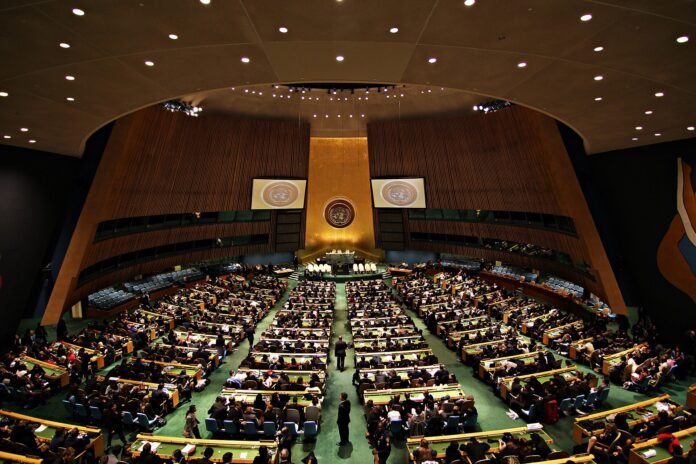
New York, September 26: India used its right of reply at the United Nations General Assembly on Friday to hit back at Pakistan Prime Minister Shehbaz Sharif, calling Pakistan “a regime of the army, by the army, and for the army” and warning that “continued terrorism by Pakistan will have consequences”. The reply came hours after Sharif raised Kashmir and credited US President Donald Trump for ending last year’s India-Pakistan conflict.
Key highlights
- Sharif’s UNGA address raised Kashmir and the Indus Waters Treaty, and thanked Trump for his “timely intervention” in the May 2025 conflict.
- India’s reply was delivered by Petal Gahlot, First Secretary at India’s Permanent Mission to the UN.
- India said Jammu and Kashmir is “an integral and inalienable part” of India and rejected any third-party role.
- India cited Operation Sindoor, launched after the Pahalgam terror attack, as proof that “terrorists will have nowhere to run and nowhere to hide”.
- India also pointed to Pakistan listing Jaish-e-Mohammed chief Masood Azhar as a terrorist only to avoid FATF scrutiny.
What Sharif said
Speaking at the general debate of the 81st General Assembly, Sharif thanked Trump for what he called a “timely intervention” in the four-day India-Pakistan conflict of May 2025, saying it saved “hundreds of millions of lives in South Asia”. He said a “just and fair solution” to Kashmir was needed to prevent future conflict in the region, and referred to the Indus Waters Treaty, which India has held in abeyance since the Pahalgam attack.
Sharif also highlighted Pakistan’s role as a go-between in US-Iran diplomacy, referring to the “Islamabad talks”, and praised Field Marshal Asim Munir for his “relentless efforts”.
India’s reply
Exercising its right of reply later the same day, Petal Gahlot said that “reiterating falsehoods year after year does not make them true”. She described Pakistan’s political system as “a regime of the army, by the army, and for the army”, a pointed reference to the army chief’s central role in Sharif’s speech.
On terrorism, she said India’s “right to defend ourselves against terrorism will be exercised and continued”, and that “Pakistan’s terrorism, deceit and duplicity will neither benefit it nor the world”. Referring to Operation Sindoor, she said India had shown that terrorists would have “nowhere to run and nowhere to hide”.
She rejected Sharif’s Kashmir remarks, saying Jammu and Kashmir is “an integral and inalienable part of my country”, and turned the focus to Pakistan-occupied Kashmir, citing killings and the denial of basic rights in areas such as Rawalakot.
The Trump question
The sharpest difference between the two sides is over who ended the May 2025 fighting. Pakistan has repeatedly credited Trump. India’s position has always been that the ceasefire was agreed directly between the two militaries and that no third party was involved. India’s reply at the UN restated that position.
Why it matters
- Relations remain frozen: the exchange shows there has been no thaw since Operation Sindoor. Earlier this month India summoned Pakistan’s envoy after naval ships collided in the Arabian Sea, and rejected a Pakistan-China boundary commission as “without legal basis”.
- Pakistan’s mediator role: Islamabad is presenting itself as a mediator between Washington and Tehran at a time when the US-Iran conflict is keeping oil prices high — see Iran’s seven-day Hormuz plan.
- Pakistan’s other front: Pakistan is also in open conflict with Afghanistan’s Taliban government (Pakistan strikes 10 sites in Afghanistan).
What happens next
External Affairs Minister S. Jaishankar is leading India’s delegation at this year’s session and is expected, when he addresses the general debate, to set out India’s positions on terrorism, UN reform and the Global South. Pakistan may use its own right of reply after that speech, as the two countries have done in past years.

The International Desk covers world and Asian affairs, diplomacy and conflict, with a focus on what they mean for India. Stories are checked against at least two credible sources before publication.