
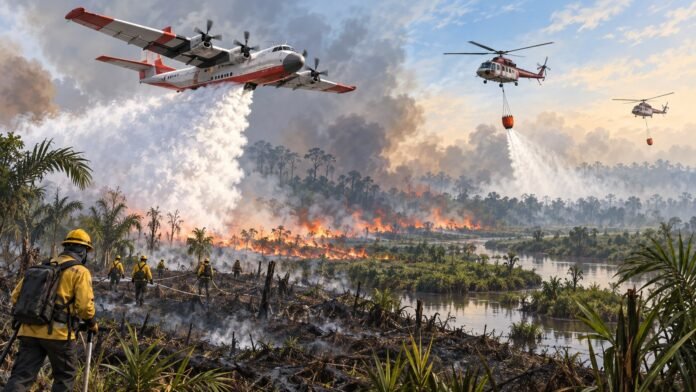

JAKARTA: Indonesia has deployed 64 aircraft and 54,394 personnel in a large-scale response to forest and land fires, according to a government update released on Sunday, September 20.
Cabinet Secretary Teddy Indra Wijaya said the air fleet has been operating since August and includes 55 aircraft coordinated by the National Disaster Management Agency, BNPB, and nine military aircraft. The personnel total combines the military, police, forestry agencies, national and regional disaster authorities, Manggala Agni fire brigades, volunteers and local communities.
The numbers describe resources mobilised for the response; they do not mean that all aircraft were airborne at the same time or that every fire has been extinguished. Indonesia’s government said peatland conditions and the wide distribution of fire-prone areas continue to complicate operations.
What the new deployment figures show
The official statement presents a response operating on several fronts. Aircraft support water bombing, monitoring and other emergency work, while ground teams build fire breaks, reach burning peat and protect communities. Peat fires can smoulder below the surface, making them harder to detect and extinguish than a visible surface flame.
Antara, Indonesia’s national news agency, reported 1,323 high-confidence hotspots as of 11:59 p.m. on September 19, citing the government’s SiPongi monitoring system and satellite inputs including NASA Terra/Aqua, SNPP and NOAA-20.
A hotspot is a satellite-detected thermal signal, not automatically a confirmed fire, casualty count or measurement of land burned. It is useful for directing verification and response, but it should not be presented as a one-to-one count of active wildfires without field confirmation.
Why aircraft alone cannot solve peat fires
Water-bombing aircraft can slow the spread of flames and support crews in difficult terrain. Their effect depends on weather, visibility, water availability and the depth of burning peat. Sustained control also requires people on the ground, local access and repeated monitoring after visible smoke declines.
The scale of the personnel mobilisation therefore matters as much as the aircraft count. Indonesia’s update lists agencies with different roles, from emergency coordination and aviation to forest management, policing and community response. The figures also show why regional preparedness cannot be measured only by the number of planes in the sky.
The Press of Asia previously examined the health risks linked to Indonesia’s wildfire haze, including respiratory illness and exposure affecting communities on Sumatra and Borneo. The latest government figures add a new operational picture of how the response has expanded.
Regional haze risk remains a shared concern
Analysis: Fires in Indonesia can become a cross-border issue when winds carry smoke across maritime Southeast Asia. The severity and direction of any haze episode depend on the location of fires, weather and atmospheric conditions; the deployment announcement by itself does not prove that neighbouring countries currently face the same level of risk.
Readers looking for continuing regional coverage can follow The Press of Asia’s Asia news section. Local health agencies and official air-quality services remain the right sources for immediate public-health instructions.
ASEAN’s regional approach to peatland management recognises that fire prevention, land use, water management and monitoring have to work together. Emergency aircraft are visible and important, but long-term risk reduction depends on keeping vulnerable peat wet, enforcing land rules and supporting communities before a dry-season fire grows.
What to watch next
The next reliable indicators will include changes in confirmed fire locations, air quality, the amount of land affected and government reports on containment. A falling hotspot count can be encouraging, but cloud cover, satellite passes and verification methods can affect the data.
Officials should also clarify how long the current deployment will continue and where resources are being concentrated. Because the government described aircraft use since August, the September 20 statement is best read as an updated cumulative response picture, not a claim that 64 new aircraft arrived in a single day.
For now, the verified development is that Indonesia has committed a major combined force to forest and land-fire operations while difficult peat conditions remain.
People in affected provinces should continue to follow local fire, air-quality and health notices. The national deployment figures are valuable context, but conditions can differ sharply from one district to another and can change with wind, rain and access for ground crews.
Sources: Secretariat of the Cabinet of Indonesia, September 20; Antara report on the deployment and hotspot data.
AI-generated editorial illustration | The Press of Asia