October 20: Japan has launched its Martian Moons eXploration spacecraft on a mission to investigate Phobos and Deimos and return material from Phobos to Earth. The German Aerospace Center, a mission partner, confirmed the successful H3 launch from Tanegashima, while Associated Press independently reported the spacecraft’s separation from its launch vehicle.
Key highlights
- The JAXA-led MMX mission launched at 4:41 a.m. in Japan on October 20.
- The same launch occurred on October 19 in UTC and continental Europe; the dates describe one event.
- The mission includes the German–French Idefix rover and contributions from NASA and ESA.
- Collecting samples and returning them in 2031 remain future objectives, not achievements of launch day.
A launch spanning two calendar dates
DLR’s announcement records liftoff at 21:41 Central European Summer Time on October 19. JAXA’s mission page gives the corresponding local Japanese launch time as 04:41 on October 20. Readers comparing international headlines should not mistake that difference for a postponement or a second launch.
AP reported that officials declared success after the spacecraft separated as planned. That establishes an important first step, but not success of the full sample-return operation. Interplanetary travel, close observations, surface operations and the eventual return to Earth each remain separate engineering tests.
Mission at a glance
| Stage | Purpose | Status |
|---|---|---|
| Launch from Japan | Send MMX toward the Martian system | Completed, mission partner confirmed |
| Observations near Mars | Study Phobos and Deimos | Planned |
| Idefix operations | Examine the surface of Phobos | Planned around 2028–29 |
| Sample return | Bring Phobos material to Earth | Targeted for 2031 |
Timeline compiled from JAXA, NASA and DLR mission descriptions. Future dates are plans and may change as the flight develops.
Why Phobos is the target
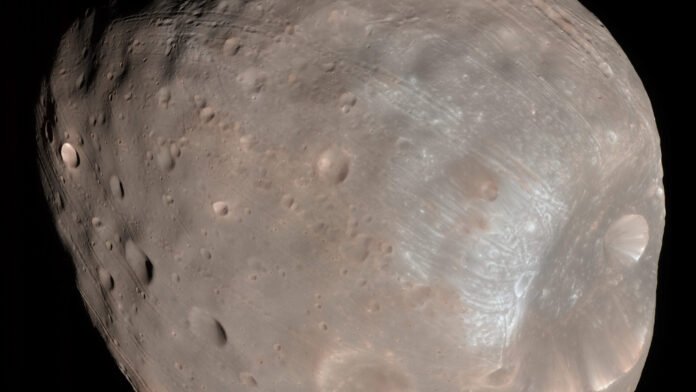
NASA describes MMX as a mission to study both small Martian moons and bring back a sample from one of them. Phobos is the sampling target. ESA explains that scientists still debate whether the moons are captured asteroids or formed from material thrown into space by a major collision involving Mars.
Those possibilities imply different histories. A sample that can be examined in a laboratory could help researchers compare mineral composition, structure and other evidence with measurements made from spacecraft. The objective is to test explanations with material evidence, rather than infer the complete history from the moons’ appearance alone.
Space.com’s mission explainer describes MMX as a major international effort, with communications and scientific hardware contributions from several agencies. The partnership gives an Asian-led mission a wider scientific reach, while also distributing the technical work needed for a demanding return flight.
What the rover adds
DLR said Idefix, developed with France’s CNES, is intended to explore Phobos before the main spacecraft’s sampling operation. Its planned measurements would help characterise the surface and inform the choice of a sampling site. This is a robotic mission: no astronauts are aboard.
The rover and the sample-return spacecraft have related but distinct jobs. A rover can investigate local conditions; a return capsule would make physical material available for more extensive study on Earth. The success of one part should not be used to imply that every later stage is guaranteed.
What to watch
The next useful updates will be spacecraft health reports, navigation milestones and confirmed operational plans from JAXA and its partners. Images taken during the flight should be distinguished from earlier pictures of Phobos and from artists’ concepts of the spacecraft.
For now, the verified development is the launch of a Japanese-led mission with an ambitious destination. The scientific results that could answer how the Martian moons formed will depend on the years of work still ahead.
File photo: Phobos photographed by NASA’s Mars Reconnaissance Orbiter on March 23, 2008, not a photograph from MMX. Credit: NASA/JPL-Caltech/University of Arizona, public domain. Cropped and resized.
Sources
- DLR: MMX mission successfully launched, Idefix rover on its way to Phobos
- JAXA: Martian Moons eXploration mission
- NASA: MMX mission overview
- ESA: Mars moon lander set to launch
- Associated Press: Japan launches spacecraft to mysterious moons of Mars
- Space.com: Inside the science of Japan’s MMX mission

The Tech Desk covers technology, artificial intelligence and cybersecurity. Stories are checked against at least two credible sources before publication.