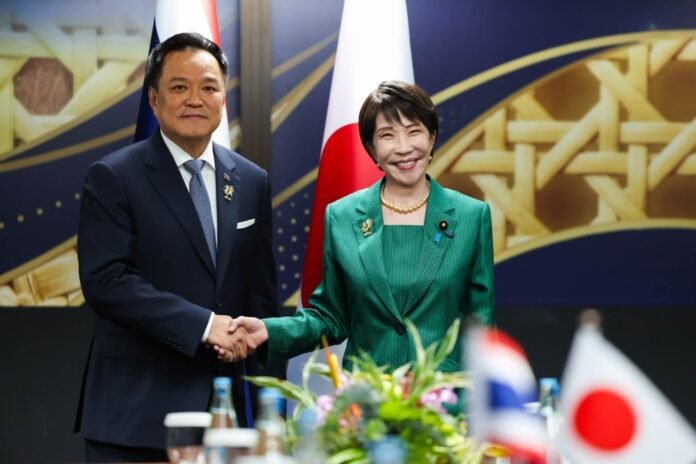
November 18: Japan and Thailand have agreed to advance cooperation in the space industry and energy resilience after their leaders met in Manila on November 17. Japan’s official account also records discussions of security assistance and the implementation of the Thailand–Cambodia ceasefire.
Key highlights
- Sanae Takaichi and Anutin Charnvirakul held a roughly 20-minute meeting.
- The leaders identified space as a field for further economic cooperation.
- Japan called for easing border tensions and resuming logistics operations.
The new economic areas under discussion
The Japanese Foreign Ministry says the meeting linked bilateral energy cooperation to the wider AZEC and POWERR Asia agenda, which includes oil stockpiling. Both leaders also agreed to make progress in new economic fields, including space. The account does not announce a completed satellite project, a launch contract or a funded joint programme.
This distinction is useful for businesses. A political agreement to explore an industry creates an opening for follow-up work, but the commercial opportunity becomes clearer only when the responsible organisations, technical scope, investment terms and procurement route are published.
Security cooperation has a separate track
Japan’s account refers to a March decision to provide Thailand with equipment under Official Security Assistance for the first time. The summit reaffirmed further cooperation. It should not be read as a new announcement that all equipment has been delivered, nor as a collective-defence treaty.
The Prime Minister’s Office publishes the same summit summary as a provisional translation. That provides a cross-check of the Japanese government’s account, although the two official pages are not independent descriptions from both governments. This report confines its account of agreed outcomes to what that record actually states.
Why the Cambodia border issue matters
Takaichi expressed hope for implementation of the ceasefire and the resumption of logistics, according to the ministry. Japan said it would continue supporting efforts to ease tensions. The readout does not itself verify that all border trade has resumed or that every disputed issue has been resolved.
Our analysis: cross-border logistics and energy resilience connect diplomacy with everyday commercial activity, but each requires operational follow-through. A ceasefire commitment, a reopening decision and a shipment moving through a checkpoint are different stages. Treating them as interchangeable would overstate the meeting’s immediate outcome.
At a glance
| Track | What the official account establishes |
| Space industry | Agreement to advance economic cooperation |
| Energy resilience | Bilateral follow-up linked to regional initiatives |
| Security assistance | Further cooperation following the March decision |
| Thailand–Cambodia border | Call for easing tensions and ceasefire implementation |
What to watch
Japan and Thailand mark 140 years of diplomatic relations in 2027, a milestone identified by Anutin in the Japanese readout. Watch for specific projects and official border-operating notices rather than assuming the summit has already delivered those outcomes.
Sources

The International Desk covers world and Asian affairs, diplomacy and conflict, with a focus on what they mean for India. Stories are checked against at least two credible sources before publication.