October 26: Japan’s Joint Staff has confirmed that Japanese, American and Philippine units conducted a South China Sea maritime exercise on October 23. Its October 25 announcement identifies both naval and coast-guard participants, an important distinction when reading descriptions of the activity as a three-country exercise.
Key highlights
- The exercise took place on October 23; Japan released its account on October 25.
- Japan identifies the activity as a Maritime Cooperative Activity.
- USCGC Bertholf participated alongside Japanese and Philippine units.
- The published notice describes tactical exercises without detailing each manoeuvre.
Which ships and aircraft were listed
Japan’s notice names the destroyer JS Kirisame and the US Coast Guard cutter Bertholf. Philippine participants included the navy’s BRP Miguel Malvar, the coast guard’s BRP Gabriela Silang and air-force aircraft. The announcement gives the exercise area as the South China Sea.
The statement frames the activity around cooperation and maritime rights under international law. That is the participating authorities’ stated purpose; the brief notice does not describe a confrontation with another vessel or announce combat operations.
| Organisation | Listed participation |
|---|---|
| Japan Maritime Self-Defense Force | JS Kirisame |
| United States Coast Guard | USCGC Bertholf |
| Philippine Navy | BRP Miguel Malvar |
| Philippine Air Force | C-208B, FA-50 and A-29B |
| Philippine Coast Guard | BRP Gabriela Silang |
Why the coast-guard distinction matters
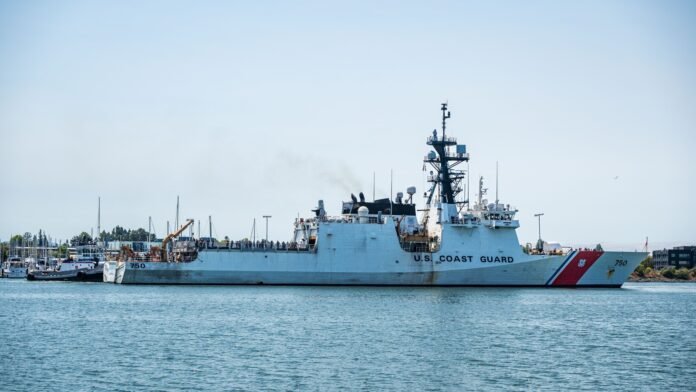
The US Coast Guard’s own Bertholf page identifies it as the service’s first National Security Cutter, homeported in Alameda, California. It lists search and rescue and maritime law enforcement among the ship’s principal missions. Bertholf should therefore not be described as a US Navy destroyer.
The photograph accompanying this report shows that cutter returning to Alameda in August 2025. It helps identify a named participant, but it does not show the October 2026 exercise. The date and location of a photograph matter just as much as the name painted on a hull.
What the public notice does and does not measure
A participant list establishes which units the announcing authority says took part. It is different from a detailed operational account explaining formations, communications procedures, durations or performance against an exercise objective. Japan’s short release supplies the former, not the latter.
That distinction is useful for evaluating claims circulating alongside military imagery. A picture of a ship, a past deployment and a new exercise notice can all be genuine while referring to different dates. They should not be combined into an unsupported account of a particular encounter.
Similarly, one cooperative activity is not by itself a new defence treaty. A treaty, a deployment decision, a training event and an operational response each require their own evidence. The present announcement establishes a specific exercise with a stated date and participants.
The regional significance
The activity brings together different national services in a shared maritime setting. For readers following regional security, the concrete development is that Japan has publicly documented this instance of cooperation, including the ships and aircraft involved.
The published information does not support claims about a new permanent base, a blockade or an imminent armed clash. Assessing those would require separate official decisions and evidence, rather than assumptions drawn from the exercise’s location.
What to watch next
Further participant releases may explain the training sequence or publish imagery from the activity itself. Any follow-up should retain the October 23 event date and distinguish additional detail from a separate operation. This report is based on the published official record, not access to shipboard proceedings.
File photo: USCGC Bertholf returning to Alameda, California, August 10, 2025. Photo: Petty Officer 3rd Class Austin Wiley, U.S. Coast Guard / Wikimedia Commons, Public domain — U.S. federal government. Cropped and resized; not a photograph of the current event. Photo source; Public domain — U.S. federal government.
Sources
- Japan Joint Staff: Japan–US–Philippines multilateral exercise
- US Coast Guard: Bertholf identification and principal missions

The International Desk covers world and Asian affairs, diplomacy and conflict, with a focus on what they mean for India. Stories are checked against at least two credible sources before publication.