October 26: Health ministers are preparing to consider an AI-in-health roadmap at WHO Europe’s October 27–29 meeting in Copenhagen. The proposed 2026–2033 roadmap is on the final day’s agenda. Despite the regional label, the discussion also concerns Central Asian member states, not only countries in the European Union.
Key highlights
- WHO Europe’s committee meets October 27–29 in Copenhagen.
- A draft AI-in-health roadmap is scheduled for consideration on the final day.
- Central Asian countries are part of the WHO European Region.
- A WHO policy roadmap and the EU’s AI Act are different instruments.
What is actually on the agenda
WHO’s published programme puts political and primary-care discussions on day one, governance on day two, and the draft AI roadmap alongside a healthy-ageing strategy on day three. These are scheduled deliberations, not adopted outcomes.
Kazakhstan, Kyrgyzstan, Tajikistan, Turkmenistan and Uzbekistan appear among the region’s member countries. The WHO committee’s geographical reach therefore differs from EU membership. That distinction is essential when describing who participates and what a regional recommendation means.
| Date | Published programme emphasis |
|---|---|
| October 27 | Political discussion and primary health care |
| October 28 | Governance and institutional business |
| October 29 | Technical proposals, including AI and ageing |
Why this is not the EU AI Act
The European Commission describes the AI Act as a legal framework organised around levels of risk. Its official guidance identifies some AI-enabled product safety components and health-related applications among examples requiring particular attention under that framework.
A WHO roadmap is a different policy instrument from EU legislation. A committee discussion does not automatically amend the EU’s law, and EU membership cannot be inferred from participation in WHO Europe. An Asian supplier assessing an actual product must identify the applicable market and rules rather than treating both frameworks as interchangeable.
What useful health-AI governance should make clear
The OECD’s AI Principles offer a reference point on transparency, robustness, safety and accountability. They emphasise meaningful information about capabilities and limitations and appropriate human oversight. These are useful questions for evaluating policy language, not proof that a particular medical product works.
For a health system, a practical starting point is the intended use. An appointment-scheduling tool, a system helping a clinician interpret an image and a product influencing treatment do not necessarily pose the same questions or require the same evidence.
A clear implementation plan would identify responsible institutions, evaluation methods, data safeguards and a way to respond when a system performs poorly. Without those details, an aspiration to use AI says relatively little about how patients or staff experience it.
Questions that matter for Central Asian readers
The first question is how a regional strategy will be translated into national decisions. A common discussion can support exchange of experience, but each country’s health system, institutions and implementation capacity still matter.
The second is what evidence will be public. A procurement announcement is different from a clinical evaluation, and a pilot is different from nationwide deployment. Useful reporting should specify which stage has been reached.
The third is accountability. Who monitors performance, handles complaints and decides whether a tool should be changed or withdrawn? Those operational questions give a reader more information than a broad claim that a hospital has become AI-powered.
What to watch after the meeting
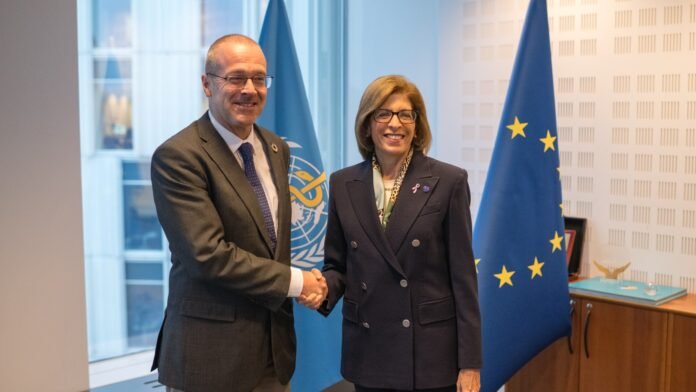
The final adopted text and subsequent national implementation notices will show what progresses beyond the proposal stage. This report sets out the published agenda and the distinction between institutions; it does not report a vote that has not yet occurred. The photograph is from a 2024 Copenhagen meeting, not the forthcoming session.
Related coverage: Japan and South Korea’s AI cooperation talks provide a separate example of the international governance discussions described above.
File photo: Hans Kluge and Stella Kyriakides meeting at UN City, Copenhagen, October 28, 2024. Photo: Pasha Kritchko / © European Union, 2026 / Wikimedia Commons, CC BY 4.0. Cropped and resized; not a photograph of the current event. Photo source; CC BY 4.0.
Sources
- WHO Europe: RC76 programme, member-country links and draft roadmap
- European Commission: EU AI Act and risk-based framework
- OECD: AI Principles on transparency, safety and accountability

The Tech Desk covers technology, artificial intelligence and cybersecurity. Stories are checked against at least two credible sources before publication.