October 26: Lucknow is scheduled to host a two-day Shram Samvad programme on labour-code compliance, welfare and social protection on October 26–27. The Labour Ministry’s advance announcement describes a capacity-building exercise with Uttar Pradesh, rather than a new law or an automatic extension of benefits to every worker.
Key highlights
- The published Lucknow programme covers October 26–27.
- Day one focuses on labour reforms and social protection; day two on implementation and compliance.
- Gig workers, construction workers and digital welfare platforms feature in the agenda.
- Registration, eligibility and actual receipt of benefits remain different stages.
What the published agenda contains
The Labour Ministry said the nationwide 90-day Shram Samvad campaign began on September 28 and covers engagement across 316 districts in all 36 states and union territories. The Lucknow event includes sessions involving ESIC and EPFO, alongside discussion of e-Shram, Shram Suvidha, SAMADHAN and Labour Stack.
The second day is scheduled to examine statutory compliance under the four Labour Codes, with further sessions on employment and pension schemes and child-labour prevention. The announcement provides for open discussions with participants. It does not establish what conclusions those discussions have reached.
Reading the programme without confusing the rules
| Programme element | What it establishes | What still needs checking |
|---|---|---|
| Awareness session | A topic is on the agenda | The applicable notification and guidance |
| Portal discussion | A service is being explained | Which portal handles the actual task |
| Benefit scheme | A programme is referenced | Eligibility, application and approval |
| Open discussion | A route for operational questions | Any subsequent written clarification |
Where e-Shram fits
The National Informatics Centre describes e-Shram as a national database of unorganised workers, including construction and migrant workers, gig and platform workers, street vendors and domestic workers. Its objectives include improving delivery of social-security services and portability for migrant and construction workers.
NIC also describes a Universal Account Number and downloadable card for registrants. A database entry should not be confused with a decision approving every scheme. For a worker seeking assistance, the relevant question is which programme is available and whether its specific conditions are met.
Why platform work needs a separate explanation
The ILO’s study of India’s gig and platform economy discusses social protection and the role of e-Shram in registration. That background is useful because work mediated through a digital platform can raise different questions from a conventional payroll relationship. The study is context, not evidence of a new entitlement announced in Lucknow today.
A useful worker-facing explanation should identify the responsible institution, the application route and what record proves that an application was received. Simply listing several portals together leaves readers unsure where to go for their actual problem.
Practical questions to bring to an outreach session
A worker can ask which service handles registration, which body decides a claim and how to track a pending application. An employer can ask which notification applies to its establishment, the documents required and where a written clarification will be published. These are questions to resolve, not answers supplied by an event announcement.
Keeping the written response, acknowledgement or reference number makes later follow-up easier. Personal documents should be submitted only through the identified official channel, rather than sent to an unverified account advertising help with a government scheme.
What to watch
The next development is a published account of the sessions or practical clarifications from the responsible authorities. Until then, the verified item is the scheduled programme and its agenda. A training event should not be reported as a fresh statutory deadline.
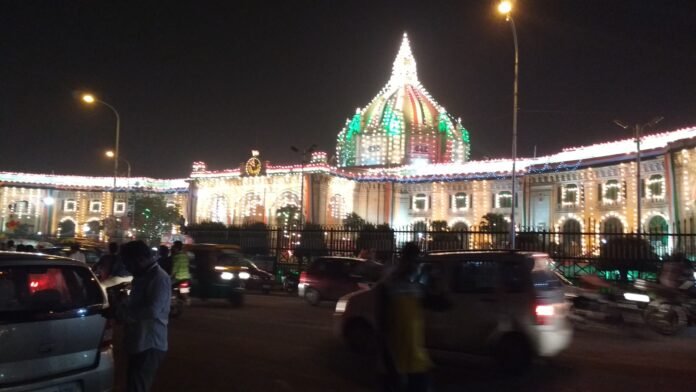
File photo: Vidhan Bhawan in Lucknow, August 15, 2016. Credit: Mohammad Azahar; CC BY-SA 4.0. Cropped/resized for 1600×900. A location illustration, not a photograph of the Shram Samvad programme or its venue. Image source; Licence. Adaptation shared under the same licence.
Sources
- Labour Ministry: October 26–27 Lucknow Shram Samvad programme
- National Informatics Centre: e-Shram database and services
- ILO: Expansion of the gig and platform economy in India

The Business Desk covers markets, the economy, companies and personal finance. Stories are checked against at least two credible sources before publication.