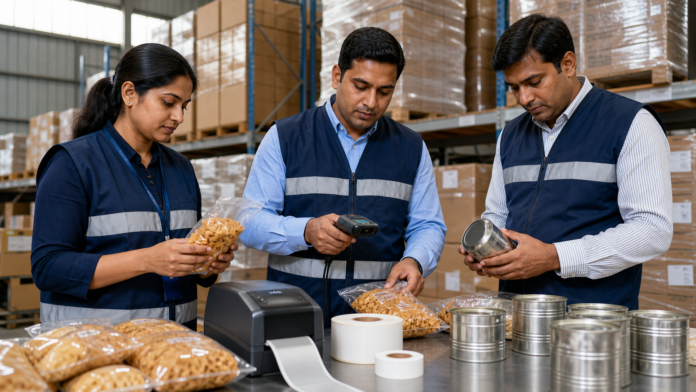
Navi Mumbai, September 1: Maharashtra’s Food and Drug Administration (FDA) has seized packaged food worth about ₹75.52 lakh from a warehouse in Navi Mumbai. Officials allege that the original manufacturing and expiry dates on the products were being erased and new dates printed.
The FDA and the Navi Mumbai Police Crime Branch carried out the joint operation between August 24 and 29 in the TTC Industrial Area at Turbhe. The seized stock included products carrying the names of several popular food and drink brands. That does not mean the brand owners are accused of wrongdoing: the investigation focuses on the warehouse, the relabelling process and the operators in the supply chain.
Key highlights
- Labelled packaged food worth about ₹75.21 lakh was seized.
- Including unlabelled and expired items, the total seizure was put at about ₹75.52 lakh.
- Inkjet printers, thinner and ready-made stickers, allegedly used to change dates and labels, were recovered.
- Manufacturing dates, expiry or use-by dates, ingredient lists and nutrition information were allegedly altered.
- The food licence of Sadhana Enterprises was suspended and an FIR was registered at Turbhe Police Station.
What the reports agree on, and where they differ
| Detail | What reports say |
|---|---|
| Operation dates and place | August 24–29, TTC Industrial Area, Turbhe (consistent across reports) |
| Total seizure value | About ₹75.5 lakh in most reports; one report put the stock at ₹17.52 crore |
| Alleged method | Original dates erased with thinner; new dates and stickers applied (consistent) |
| Action taken | Licence suspended; FIR at Turbhe Police Station (consistent) |
| Cartons and exporters linked | Counts differ between early reports |
Because early reports gave different carton counts and different numbers of linked exporters, The Press of Asia is not publishing a disputed carton count as fact. The total value, operation dates, location, alleged method and the FIR are consistent across several credible reports. One much higher figure of ₹17.52 crore could not be reconciled with the other reports.
Which products were named
Reports linked to the FDA mention chips, noodles, soups, mayonnaise, tea, spices and canned drinks, including packs carrying the names Lay’s, Kurkure, Bingo, Fun Flips, Maggi, Knorr, Hellmann’s, Wagh Bakri, MDH, Thums Up and Limca. The presence of these brand names on seized packs does not show that the brand companies were involved. The investigation has yet to establish whether the products came from the genuine distribution chain, were diverted export stock, were counterfeit, or were gathered from several sources.
How serious is changing an expiry date?
An expiry or use-by date is an important food-safety signal. Some products only lose quality over time, but others face rising risks from moisture, contamination, packaging failure or microbial growth. The safety of a packaged item cannot be judged just by its smell or appearance. Changing manufacturing dates and ingredient labels also breaks traceability: if a consumer falls ill or a recall is needed, it becomes hard to identify the right batch, factory and distribution route. Altered nutrition labels add risk for people with allergies or limits on salt, sugar or other ingredients.
How consumers can check a packet
- Look for rubbing, thinner marks, discolouration or an uneven surface around the printed date.
- Check carefully for a sticker on top of another label, a different font or misaligned printing.
- Do not use the product if the seal is broken, the packet is swollen or it is leaking.
- Take a photo of the batch number and customer-care details.
- Ask for a bill; proof of purchase helps with complaints or refunds.
- Instead of eating a suspicious product, report it to the retailer, the state FDA or FSSAI’s complaint system.
Faded printing alone is not proof of counterfeiting, since transport and handling can damage packaging. But if an altered sticker, overwritten date and damaged seal appear together, it is better to set the product aside.
The FIR and the legal process
According to reports, the FIR was registered under the Food Safety and Standards Act, 2006 and relevant provisions of the Bharatiya Nyaya Sanhita. Licence suspension is a regulatory step; criminal responsibility will be decided through investigation and the courts. At this stage there are allegations against the warehouse operators and associated entities, not convictions. Food samples have been sent for laboratory testing, which can show whether the products were only relabelled or also failed quality and safety standards. Supply invoices, exporter records and transport documents will show where the stock came from and where it was headed.
What it means for ordinary buyers
Consumers trust packaged food on the basis of the printed date, the seal and batch information. If those details are changed, it becomes almost impossible to tell a product’s real age in a supermarket or neighbourhood shop. Enforcement here is about more than the value seized: it is about whether the traceability system can be trusted. For a separate industrial-safety failure, see our report on the Kaushambi factory blast.
What to watch
- Laboratory reports on the seized samples.
- Who owned the seized stock, where it was going, and police action against those named in the FIR.
- Whether the affected batches reached domestic shops or were mainly meant for export. Until a batch-specific recall is issued, calling all products or listed brands unsafe would be wrong.
This article was first published in Hindi and has been translated. The Press of Asia now publishes in English only.

The National Desk covers India's politics, governance, security and public-interest news. Stories are checked against at least two credible sources before publication.