

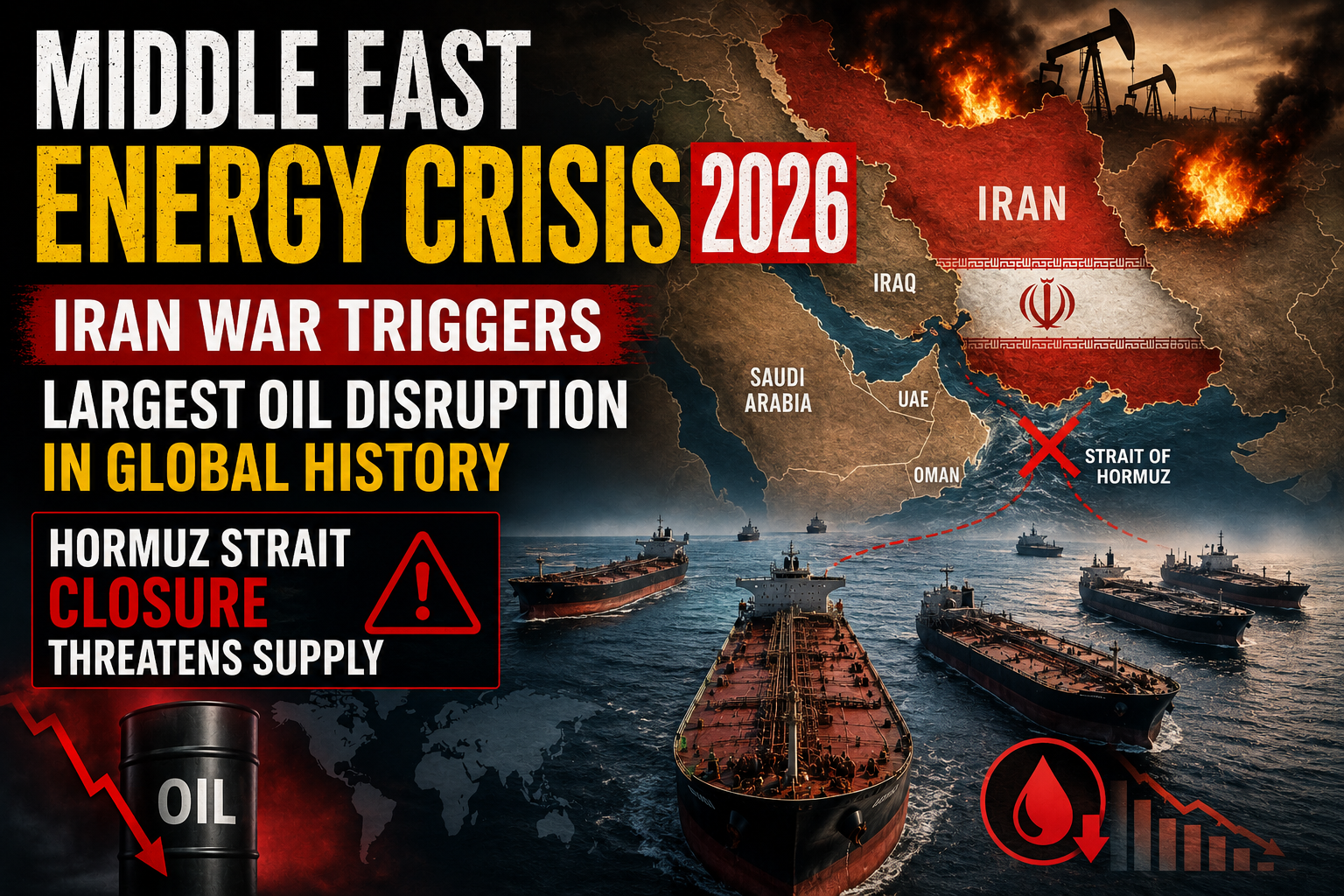
The ongoing conflict in the Middle East has triggered what the International Energy Agency describes as the largest supply disruption in the history of the global oil market, sending shockwaves through energy markets worldwide and threatening to plunge the global economy into a severe energy crisis.
The Hormuz Strait Crisis Unfolds
On March 4, 2026, Iran effectively closed the Strait of Hormuz, a narrow waterway between Oman and Iran that serves as the world’s most critical energy chokepoint. This maritime passage, which handles approximately 20-25% of global oil supply and 20% of liquefied natural gas (LNG) trade, has seen shipping traffic plummet to near-zero levels due to ongoing geopolitical tensions.
The closure came in direct response to military strikes launched by the United States and Israel against Iran on February 28, 2026. Iran’s retaliation has involved targeting energy infrastructure across the Gulf region, interrupting production and prompting precautionary closures at multiple facilities.
Unprecedented Price Surges
Global energy markets have responded with unprecedented volatility. Brent crude oil prices experienced a record-breaking 59% surge within a single month, climbing past $115 per barrel by late March 2026 – a rise steeper than that seen during the 1990 Gulf War. Some reports indicate prices briefly touched $103 per barrel, representing a 38% increase since the conflict began.
European natural gas prices have roughly doubled in recent weeks, while oil prices surged above $85 per barrel in early March, reaching their highest levels since July 2024. The speed and magnitude of these price increases have rattled global markets and raised serious concerns about economic stability.
Production Cuts and Supply Chain Collapse
The largest oil producers in the Middle East Gulf have been forced to deepen production cuts significantly. Saudi Arabia, the world’s largest oil exporter, has slashed its oil production by between 2 million and 2.5 million barrels per day (bpd). Combined, Gulf producers have lowered output by more than 5 million bpd as the de facto halt to tanker traffic has started to affect upstream production.
Oil producers in the region are reducing output as storage fills up in onshore tanks and vessels at sea, with nowhere to ship the product. This unprecedented situation has created a cascading effect throughout the global energy supply chain.
Qatar’s LNG Shutdown
The crisis has extended beyond oil to natural gas markets. Qatar, a major LNG producer and exporter of around 10 billion cubic feet per day, has shut down its production facilities due to drone attacks, cutting 20% of world LNG trade. Qatari producers had shipped most of their LNG to Asia and the European Union, where prices have roughly doubled in recent weeks.
This disruption affects about 20 million barrels per day of oil and petroleum products plus all LNG exports from Qatar and the United Arab Emirates, equivalent to around 20% of global LNG trade.
Global Economic Impact
The disruption is exposing a central vulnerability in the global economy: dependence on fossil fuels flowing through regions affected by conflict. Approximately 16% of the world’s oil supply has been disrupted – double the effects of the 1970s oil shock.
Countries worldwide are experiencing reduced access to the fossil fuels needed to produce power, leading to higher prices and market instability. The crisis is affecting energy security, energy transition investments, and forcing nations to reconsider their energy dependencies.
Geopolitical Tensions Escalate
Despite U.S. President Donald Trump’s attempts to reassure markets with claims that the war will end soon, Iran has vowed not to let a single litre of oil be exported from the Middle East until the United States and Israel stop their military operations. This hardline stance suggests the crisis may persist longer than initially anticipated.
The conflict has highlighted the geopolitical risk premium of fossil fuels and demonstrated how quickly regional instability can translate into global energy insecurity.
Energy Security Implications
The crisis has reignited debates about energy security and the pace of transition to renewable sources. While elevated oil and gas prices are expected to persist for an extended period, many analysts believe the net long-term result could boost investment in renewables and nuclear energy.
As one energy security expert noted, the Middle East crisis is exposing how geopolitical tensions in key production regions can rapidly destabilize global markets, strengthening arguments for diversification away from fossil fuel dependence.
Looking Ahead
Without knowing the duration and possible escalation of the conflict, energy analysts warn that restoring production will take considerable time, while restoring market confidence and trust will take even longer. The world faces the prospect of elevated energy prices for the foreseeable future.
The 2026 Iran war fuel crisis represents a watershed moment for global energy markets, demonstrating the fragility of current supply chains and the urgent need for energy diversification. As nations grapple with supply disruptions, price shocks, and economic uncertainty, the crisis may ultimately accelerate the transition toward more resilient and sustainable energy systems.
For now, the world watches anxiously as one of history’s most significant energy crises continues to unfold, with profound implications for economic stability, geopolitical relations, and the future of global energy security.
Impact on Major Economies
The United States, despite its significant domestic oil production capacity, is not immune to the ripple effects of this crisis. American consumers are experiencing price increases at the pump, with gasoline prices climbing steadily as refineries adjust to the constrained global supply. The Biden administration has been exploring options to tap into the Strategic Petroleum Reserve, though analysts warn this measure provides only temporary relief.
European nations face an even more precarious situation, given their higher dependence on energy imports. The European Union has accelerated emergency meetings to coordinate responses, including potential energy rationing measures and expedited renewable energy deployments. Germany, France, and the United Kingdom are particularly vulnerable, as their industries heavily rely on consistent energy supplies to maintain production schedules.
China and India, the world’s two most populous nations and massive energy consumers, are scrambling to secure alternative supply routes. Both countries have intensified diplomatic efforts with Russia and other non-Middle Eastern producers to compensate for the shortfall. The economic implications for these emerging economies could be devastating, potentially slowing their growth trajectories and affecting billions of people.
Strategic Reserve Releases and Policy Responses
In response to the unprecedented crisis, the International Energy Agency has coordinated a massive release from strategic petroleum reserves across member nations. An estimated 120 million barrels are being released to help stabilize markets, though experts acknowledge this represents only a short-term Band-Aid solution.
Governments worldwide are implementing emergency measures ranging from fuel subsidies to transportation restrictions. Several countries have introduced temporary tax cuts on petroleum products to shield consumers from the worst of the price spikes, though this approach strains already stretched public budgets.
Central banks face a complex dilemma as energy-driven inflation threatens to derail economic recovery efforts. The Federal Reserve, European Central Bank, and other major monetary authorities must balance between controlling inflation and avoiding policies that could trigger recession.
Long-Term Implications for Energy Transition
Paradoxically, while the current crisis causes immediate economic pain, it may accelerate the global shift toward renewable energy sources. The vulnerability exposed by dependence on Middle Eastern oil has prompted renewed calls for energy independence through clean energy investments.
Renewable energy advocates argue that this crisis demonstrates the volatility and geopolitical risks inherent in fossil fuel dependence. Solar, wind, and other renewable technologies, while requiring substantial upfront investment, offer greater energy security and price stability over the long term.
Several countries have already announced expedited renewable energy programs. The European Union has proposed increasing its 2030 renewable energy targets, while the United States is considering additional tax incentives for clean energy projects. These policy shifts, driven by crisis necessity, could reshape the global energy landscape for decades to come.
Market Speculation and Price Volatility
The energy crisis has unleashed unprecedented speculation in commodity markets. Traders and hedge funds are betting on future price movements, adding another layer of volatility to already unstable markets. Some analysts warn that speculative activity is amplifying price swings beyond what supply and demand fundamentals would dictate.
Oil futures contracts for delivery months ahead are trading at historically high premiums, reflecting market expectations that the crisis will persist. This contango situation creates additional costs for refineries and ultimately consumers, as companies must pay premium prices to secure future supplies.
Regulators in major financial centers are considering measures to limit speculative trading and reduce artificial price inflation, though implementing such controls without disrupting legitimate hedging activities presents significant challenges.
Humanitarian Concerns and Social Impact
Beyond the economic and geopolitical ramifications, the energy crisis carries significant humanitarian implications. Developing nations with limited financial resources are facing catastrophic energy shortages that threaten essential services including hospitals, water treatment facilities, and food production systems.
Many countries in Africa, Southeast Asia, and Latin America rely heavily on imported petroleum products and LNG for electricity generation and transportation. The price spikes have made these imports unaffordable, forcing difficult choices between energy access and other critical needs such as healthcare and education.
International aid organizations warn that the energy crisis could reverse years of development progress in vulnerable regions, potentially pushing millions back into energy poverty and undermining sustainable development goals established by the United Nations.