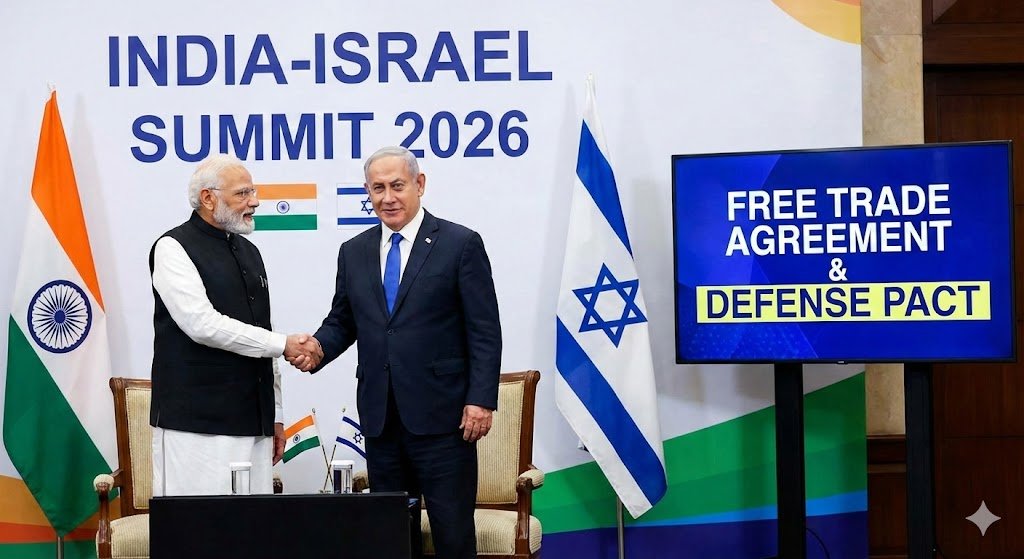
Prime Minister Narendra Modi’s historic two-day state visit to Israel in February 2026 has marked a significant turning point in the bilateral relationship between India and Israel. The visit, Modi’s first to the Jewish state in nine years, resulted in a series of landmark agreements covering trade, defense, technology, and counter-terrorism cooperation, underscoring the deepening strategic partnership between the two nations.
Highlights of Modi’s Israel Visit
PM Modi arrived in Tel Aviv to a warm reception from Israeli Prime Minister Benjamin Netanyahu, reflecting the strong personal chemistry between the two leaders. During the visit, Modi addressed a special plenary session of the Knesset, Israel’s parliament, becoming only the second Indian Prime Minister to do so. In his address, Modi emphasized the shared values of democracy, innovation, and resilience that bind the two nations.
The centerpiece of the visit was the announcement of accelerated negotiations toward a comprehensive India-Israel Free Trade Agreement (FTA). Modi urged the early finalization of the FTA to unlock the enormous untapped trade potential between the two countries. Both sides indicated that a mutually beneficial agreement could be concluded soon, with the next round of negotiations scheduled for May 2026 in Israel.
India-Israel Free Trade Agreement: What We Know
India and Israel have just concluded the first round of FTA negotiations, with both sides engaging in productive discussions covering a wide range of areas including trade in goods and services, rules of origin, intellectual property rights, digital trade, and customs procedures. The first round of in-person talks was held in New Delhi, and the second round has been scheduled for May 2026 in Israel.
According to the Indian commerce ministry, both countries engaged in discussions in a constructive and forward-looking manner, with both sides reaffirming their objective of negotiating a comprehensive, balanced, and mutually beneficial agreement. The negotiations had originally been launched about 15 years ago, with the first round held in New Delhi in May 2010, but had stalled after 2013.
The revival of FTA talks comes against the backdrop of the bilateral investment agreement (BIA) signed between India and Israel in September 2025, which was intended to promote and protect foreign private investments in each other’s territories. Finance Minister Nirmala Sitharaman and her Israeli counterpart Bezalel Smotrich signed the BIA, providing a foundation for the more comprehensive trade agreement now being negotiated.
Defense and Security Cooperation
Defense cooperation remains an important pillar of the India-Israel relationship. Israel is one of India’s largest arms suppliers, providing advanced weapons systems, drones, missile defense technology, and surveillance equipment to the Indian military. During Modi’s visit, both sides agreed to deepen defense cooperation, with a focus on joint development and production of defense technologies.
Modi and Netanyahu also reaffirmed their shared commitment to fighting terrorism, with Modi delivering a strong message from Jerusalem: there is no place for terrorism in the world. Both leaders emphasized the need for international cooperation to combat the growing threat of cross-border terrorism and to hold state sponsors of terrorism accountable.
Country leaders also discussed cybersecurity cooperation, with Israel’s world-renowned cybersecurity sector seen as a natural partner for India as it accelerates its digital transformation. The two countries agreed to expand collaboration in this critical domain.
Technology and Innovation
Israel, often called the Start-Up Nation, and India, one of the world’s fastest-growing technology ecosystems, have natural synergies in the technology and innovation space. During Modi’s visit, leaders discussed expanding cooperation in areas such as agricultural technology (agritech), water management, clean energy, and artificial intelligence.
Israel’s advanced agritech capabilities are particularly relevant for India, which is the world’s second-largest agricultural producer but faces significant challenges in improving farm productivity and water efficiency. Israeli expertise in drip irrigation, precision farming, and water recycling technologies could be transformative for Indian agriculture.
The two sides also discussed expanding academic and research collaboration, with several Indian and Israeli universities and research institutions expected to sign memoranda of understanding to facilitate joint research projects and student exchange programs.
Geopolitical Context: Modi’s Visit Amid Gaza Conflict
Modi’s visit to Israel was not without controversy. It came against the backdrop of the ongoing Gaza conflict, which has drawn widespread international criticism of Israel’s military operations. Several political parties in India, particularly those representing Muslim voters, criticized the visit, arguing that India should take a more balanced approach toward the Israeli-Palestinian conflict.
However, the Indian government maintained that the visit was focused on bilateral relations and was not an endorsement of Israel’s actions in Gaza. India has consistently supported a two-state solution to the Israeli-Palestinian conflict and has called for a lasting peace based on negotiations and mutual recognition.
From Israel’s perspective, Modi’s visit was seen as a significant diplomatic endorsement at a time when the country faces intense international pressure over its Gaza operations. Israeli officials highlighted the visit as evidence that India, one of the world’s most influential nations, continues to value its strategic partnership with Israel.
Economic Significance of India-Israel Ties
Bilateral trade between India and Israel has been growing steadily, reaching approximately $7-8 billion annually in recent years. However, both sides believe that the current level of trade is far below the potential, given the complementary nature of the two economies. An FTA could potentially double or triple bilateral trade over the next decade.
Key sectors where both countries see significant potential include: pharmaceuticals and healthcare, information technology and software services, agricultural technology, diamonds and jewelry, defense and homeland security, renewable energy and cleantech. India is already a major market for Israeli agricultural technology exports, and Israeli companies have been expanding their presence in the Indian healthcare and IT sectors.
Looking Ahead
Modi’s visit to Israel in February 2026 is likely to be remembered as a watershed moment in the India-Israel relationship. The agreements reached during the visit, particularly on the FTA and defense cooperation, have the potential to transform the bilateral relationship and create significant economic and strategic benefits for both countries.
The next few months will be critical in determining the pace of implementation of the agreements reached during Modi’s visit. The next round of FTA negotiations in May 2026 will be closely watched as an indicator of how quickly both sides can move toward a final agreement.
Conclusion
PM Modi’s Israel visit 2026 has set a new benchmark for India-Israel bilateral relations. With the FTA negotiations back on track, deepened defense cooperation, and expanded collaboration in technology and innovation, the India-Israel relationship is entering a new era of strategic partnership. The Press of Asia will continue to monitor and report on developments in this important bilateral relationship.