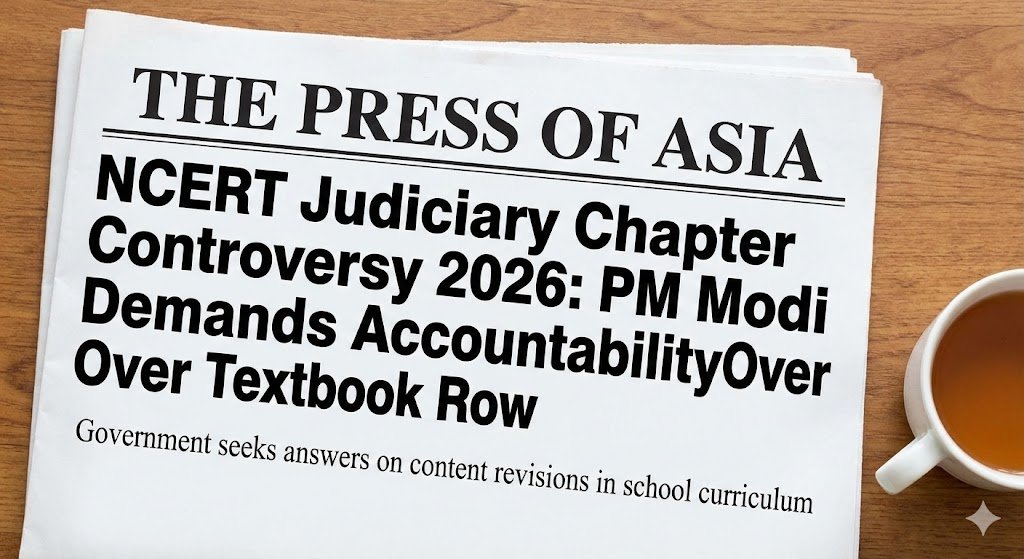
A major political and educational controversy has erupted in India following the revelation of a chapter in an NCERT textbook that appeared to make references to corruption in the judiciary. Prime Minister Narendra Modi has expressed strong displeasure over the matter, demanding that those responsible be held accountable. The episode has sparked a heated national debate about academic freedom, institutional integrity, and the appropriate boundaries of educational content in India.
What Is the NCERT Controversy?
The National Council of Educational Research and Training (NCERT) is India’s premier government body responsible for developing school curricula and textbooks used by millions of students across the country. The controversy centers on a chapter in one of its textbooks that reportedly contained content discussing what it described as corruption in the judiciary. The chapter drew widespread criticism from government officials, legal authorities, and various political parties.
Union Education Minister Dharmendra Pradhan publicly stated that action would be taken against those involved in preparing the controversial chapter. The NCERT chapter referenced judicial corruption in a manner that critics argued was inappropriate for school-level students and could undermine public confidence in India’s judiciary, which is considered one of the pillars of the nation’s democratic framework.
PM Modi’s Reaction
Prime Minister Narendra Modi has been reported to be deeply unhappy with the NCERT textbook chapter on judicial corruption. Government sources indicated that Modi was particularly concerned that such sensitive and potentially prejudicial content had found its way into school textbooks without adequate scrutiny and oversight. The Prime Minister reportedly asked for a thorough review and demanded that those responsible for approving the content be identified and held accountable.
The incident has put Education Minister Dharmendra Pradhan in a difficult position. Pradhan has had to simultaneously defend the government’s commitment to academic freedom while also distancing the administration from the controversial content. In his public statements, Pradhan emphasized that the Centre had no intention of disrespecting the judiciary, and that the matter would be thoroughly investigated.
Judiciary’s Reaction
The Indian judiciary has historically maintained a dignified silence on political controversies, but the NCERT textbook matter has touched a particularly sensitive nerve. Any suggestion of systemic corruption in the judiciary, especially when presented to schoolchildren as factual content, risks both damaging public trust in the legal system and prejudicing young minds against judicial institutions.
Legal experts and senior advocates have pointed out that while judicial accountability is a legitimate topic for academic discussion at the university level, the framing and context of such discussions in school textbooks require extreme care. Young students are still forming their fundamental understanding of democratic institutions, and any content that presents judiciary corruption as widespread without proper qualification and context could be deeply harmful.
Political Reactions Across the Spectrum
The NCERT controversy has predictably drawn sharp reactions from across India’s political spectrum. Ruling party politicians have united behind the government’s position, calling for strict action against those responsible for the textbook content. Several BJP leaders have gone further, alleging that the controversial chapter reflects a broader pattern of anti-establishment bias in certain academic circles.
Opposition parties have taken a more nuanced position. While some opposition leaders have agreed that the content may have been inappropriate for school students, others have used the controversy to raise broader concerns about government interference in educational content. They argue that the Modi government’s response reflects a pattern of seeking to control academic discourse and suppress critical thinking in educational institutions.
NCERT’s Track Record and Previous Controversies
This is not the first time that NCERT has been at the center of a textbook controversy. In recent years, the organization has faced criticism from multiple directions – from those who feel its textbooks are too secular and downplay India’s Hindu heritage, and from those who believe its content is increasingly being shaped by political considerations rather than academic merit.
In 2023 and 2024, NCERT made significant revisions to several textbooks, including removing certain chapters on the Mughal period and modifying content related to the Emergency. These changes generated significant controversy at the time, with critics arguing that historical events were being selectively presented or omitted to align with particular political narratives. The current judiciary controversy adds to this fraught history.
Academic Freedom and Government Oversight
At the heart of the NCERT controversy lies a fundamental tension between academic freedom and government oversight in educational content. India’s education system, like those of many countries, struggles to balance the need for accurate, unbiased information with political and social sensitivities.
Academic experts argue that educational content should be developed through a rigorous, transparent peer review process, free from political pressure. They contend that when governments become too involved in determining what can and cannot be said in textbooks, the result is inevitably a narrowing of intellectual discourse and a diminishment of educational quality.
The government, on the other hand, maintains that it has a legitimate responsibility to ensure that publicly funded educational materials meet standards of accuracy and do not contain content that could be socially divisive or damaging to democratic institutions. The challenge is to exercise this oversight without crossing the line into political censorship.
Implications for India’s Education System
The NCERT judiciary chapter controversy has several important implications for India’s education system. First, it highlights the urgent need for a more robust and transparent content review process within NCERT. The fact that controversial content could make it into a published textbook without triggering alarm bells at earlier stages suggests systemic weaknesses in the editorial and review process.
Second, the episode underscores the importance of greater academic independence for educational bodies like NCERT. If scholars and educators feel that their work is subject to arbitrary political scrutiny, the long-term effect will be self-censorship and a decline in the quality of educational materials.
Conclusion
The NCERT judiciary chapter controversy of 2026 has opened up important questions about the intersection of education, politics, and institutional integrity in India. PM Modi’s strong reaction and the Education Minister’s response suggest that the government takes the matter very seriously. However, the way this controversy is resolved will have long-lasting implications for academic freedom and the independence of India’s educational institutions. The Press of Asia will continue to monitor and report on this developing story.