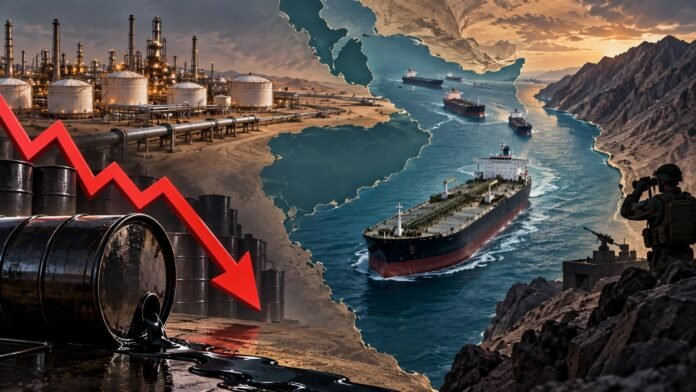
New Delhi/London, September 21: Oil prices slid to an 11-day low on Monday on a partial recovery in crude shipments from Saudi Arabia and hopes of US–Iran diplomacy. But a later report of an unidentified projectile striking a tanker in the Strait of Hormuz showed that the supply risk has not gone away.
At 08:59 GMT Brent crude for November delivery was down $2.12, or 2%, at $101.75 a barrel. The October WTI contract was down $1.96, or 2%, at $98.34, while November WTI was at $94.16. These are time-specific market prices and can change during the trading day.
Key highlights
- Brent: $101.75 a barrel at 08:59 GMT, down $2.12 (2%), an 11-day low.
- WTI: October contract $98.34 (−$1.96); November $94.16.
- Saudi exports: above 4 million barrels a day in September, up from about 2.4 million in August, according to provisional Kpler data.
- Hormuz incident: an unidentified projectile hit a tanker entering the strait; two crew members suffered minor injuries, according to UKMTO.
- Diplomacy: markets weighed the possibility of US–Iran talks during the UN General Assembly.
Later, the UK Maritime Trade Operations Centre said an unidentified projectile struck a tanker entering Hormuz. Two crew members suffered minor injuries and the vessel continued towards port under its own power. It did not say who was behind the attack.
Why oil prices fell
The market focused on signs of a recovery in Saudi export flows. According to provisional Kpler data, Saudi exports returned to above 4 million barrels a day in September, after falling to about 2.4 million barrels a day in August. The final figures may be revised.
| Measure | Figure | Source |
|---|---|---|
| Brent (November), 08:59 GMT | $101.75 (−$2.12, −2%) | Public record |
| WTI (October) | $98.34 (−$1.96, −2%) | Public record |
| WTI (November) | $94.16 | Public record |
| Saudi crude exports, August | About 2.4 million barrels a day | Kpler (provisional) |
| Saudi crude exports, September | Above 4 million barrels a day; a rise of at least 67% (our calculation) | Kpler (provisional) |
After the disruption to Saudi Arabia’s East–West pipeline, more cargoes were sent through Persian Gulf terminals and the Strait of Hormuz. That shift can support exports, but with security threats rising on the same route, the alternative has its own limits.
Investors also watched for a possible meeting between the US and Iran during the UN General Assembly. The political will for a meeting and an actual agreement are different things, so the price fall should not be read as proof of a lasting ceasefire.
Why the Hormuz incident raised the risk
Hormuz has special importance among the world’s main oil shipping routes. The latest incident of an unidentified projectile hitting a ship has brought back risks to insurance, crew safety and ship operations. Minor injuries and the ship continuing its voyage are a relief, but the incident needs to be investigated. It would not be right to blame any country or group before official confirmation of responsibility or the source of the weapon. Market reactions are driven not only by physical supply but also by the fear of possible disruption.
The Press of Asia reported on September 10 that pressure on Asian markets rose as oil went above $100. Today’s fall is the next stage of the same volatility, in which better flows and security threats are setting prices together.
What to watch
- Actual Saudi export loadings and repairs to the East–West pipeline.
- Shipping traffic through Hormuz and any official finding on the tanker incident.
- Official confirmation of any US–Iran talks.
- Futures expiry, which can create a big gap between different months’ WTI prices.
What it means
For a large importer such as India, lower oil prices can ease the import bill and inflation worries somewhat. But Brent is still high, and the rupee, freight, insurance and refining margins can change the domestic effect. Diesel and jet fuel costs reach transport, farming, construction and air travel, so consumers should not expect an immediate, equal fall in retail prices from daily crude moves; government taxes, marketing companies’ policy and expensive stock bought earlier also matter. In short: better Saudi flows and hopes of diplomacy pulled oil down, while the tanker attack shows the security premium can rise again at any time. For more energy and business coverage, see The Press of Asia’s Business section.
This article was first published in Hindi and has been translated. The Press of Asia now publishes in English only.

The Business Desk covers markets, the economy, companies and personal finance. Stories are checked against at least two credible sources before publication.