
November 2: The Reserve Bank of Australia’s Monetary Policy Board meets on November 2–3, with its decision statement and new Statement on Monetary Policy scheduled for 2:30pm AEDT on November 3. The meeting follows September’s increase in the cash rate target to 4.60% and an official inflation release showing annual consumer-price growth of 4.3% in September. The November decision has not yet been announced.
Key highlights
- The decision is scheduled for November 3 at 14:30 AEDT, or 03:30 UTC.
- That is 09:00 in India, 11:30 in Singapore and Hong Kong, and 12:30 in Tokyo and Seoul.
- The starting cash rate target is 4.60%, following the September 29 increase.
- September annual CPI inflation was 4.3%; trimmed-mean inflation was 3.6%.
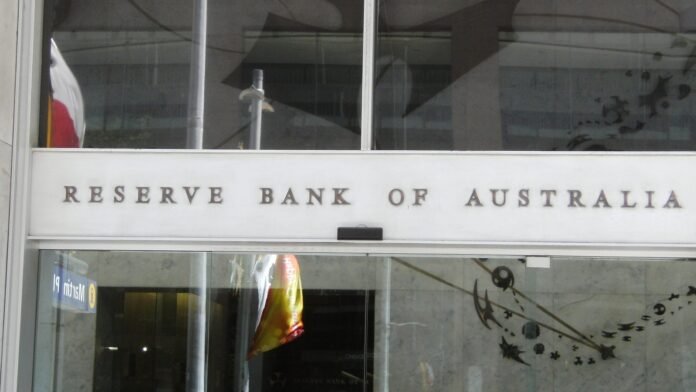
File photo: Reserve Bank of Australia signage in Sydney (November 27, 2008). Credit: Danausi / Wikimedia Commons, Public domain. Cropped and resized by The Press of Asia. Archival institutional photograph, not the November 2026 policy meeting.
What is being released, and when
The RBA’s calendar lists the policy decision statement and the Statement on Monetary Policy for the same 2:30pm release time on November 3. A media conference follows at 3:30pm AEDT. The decision gives the rate outcome; the monetary-policy statement provides the updated assessment and forecasts that help explain the decision.
Readers across Asia should take account of Australian daylight saving. AEDT is UTC+11. A release at 14:30 AEDT is therefore 03:30 UTC, rather than the time that would apply under Sydney’s standard-time offset. The difference matters for anyone planning to follow the announcement live.
At a glance
| Item | Confirmed detail | Why it matters |
|---|---|---|
| Sydney decision time | November 3, 14:30 AEDT | 03:30 UTC |
| India | November 3, 09:00 IST | Decision and monetary-policy statement |
| Singapore and Hong Kong | November 3, 11:30 | UTC+8 conversion |
| Tokyo and Seoul | November 3, 12:30 | UTC+9 conversion |
| Media conference | 15:30 AEDT, one hour after the decision | Separate explanation after the release |
| Policy and inflation baseline | Cash rate 4.60%; annual CPI 4.3%; trimmed mean 3.6% | Figures are not a prediction of the new decision |
The starting point is a 4.60% cash rate target
At its September 29 meeting, the board raised the cash rate target by 25 basis points to 4.60%. Its statement cited elevated inflation, energy-price pressures, domestic capacity constraints and uncertainty around the outlook. The RBA said the September decision was unanimous.
That September statement is the policy background, not a description of the board’s eventual November decision. It would be premature to turn its willingness to tighten further if needed into a claim that another increase has already been decided. The current meeting must be reported from its own official statement when published.
The cash rate target is also different from a household’s mortgage rate, a bank deposit rate or the Australian dollar exchange rate. Those may respond to monetary policy, but they are not set at one common number. Any assessment of the announcement should keep the policy instrument separate from its later effects.
What the latest inflation data show
The Australian Bureau of Statistics reported on October 28 that annual CPI inflation was 4.3% in September, up from 4.0% in August. Its trimmed-mean annual measure was 3.6%, compared with a revised 3.5% in August. The revision matters: comparing the new reading with the unrevised August figure would misstate the change.
Our calculation: the annual headline inflation rate increased by 0.3 percentage points between the August and September reference periods, while the trimmed-mean rate increased by 0.1 point. These are changes in annual inflation rates, not the increase in prices during one month.
Headline CPI includes the full basket, while the trimmed-mean measure is designed to reduce the influence of unusually large price movements. Neither should be described as a guarantee of the next rate decision. Policymakers also consider activity, labour-market conditions, expectations and the projected path back towards their objectives.
Why Asia is watching
Australia’s policy outlook matters to regional businesses through borrowing conditions, currency exposure and demand from an important trading partner. A change in the Australian dollar can affect the local-currency cost of payments, travel or tuition for people elsewhere in Asia. The direction and size of a market move cannot be inferred from the rate headline alone.
Markets can react to the difference between the announcement and prior expectations, as well as to the forecasts and language accompanying it. A decision to leave a rate unchanged can still carry a changed assessment of future risks. A rate increase can likewise produce a different market reaction if it was widely anticipated.
For that reason, this preview does not attach a probability to a hike, cut or hold without a verifiable poll or market measure. It sets out the official timetable and the verified starting data. Readers making financial decisions should use the actual release and their own circumstances rather than treat a news preview as a trading instruction.
What to watch
The main items are the cash rate decision, the inflation and growth forecasts, the board’s assessment of risks and the governor’s explanation at the media conference. The RBA calendar schedules minutes of the November meeting for November 17, providing a later record of the discussion.
Until the November 3 statement is issued, 4.60% remains the last announced target and the September inflation figures remain the latest verified reference used here. The first task after release will be to compare the new decision and forecasts with that baseline, without confusing a forecast, a market expectation and an official outcome.
Sources
- Reserve Bank of Australia: Coming-up release calendar
- Reserve Bank of Australia: September 29 monetary-policy decision
- Australian Bureau of Statistics: Consumer Price Index, September 2026
- Reserve Bank of Australia: Board meeting schedules

The Business Desk covers markets, the economy, companies and personal finance. Stories are checked against at least two credible sources before publication.