November 2: Japan’s embassy in Panama published working-holiday visa guidance on November 1, setting out how eligible Panamanian citizens can apply for a holiday-focused stay of up to a year. Japan’s Foreign Ministry now lists 33 working-holiday partner countries and regions, including Panama with an annual quota of 100 visas. The route permits incidental work to help fund a holiday; it is not designed for applicants whose main purpose is employment.
Key highlights
- The Panama route is for Panamanian nationals resident in Panama.
- Applicants must be aged 18–30 inclusive when they apply.
- Japan’s national guidance lists a 100-visa annual quota for Panama.
- The programme is holiday-first; it is not an unrestricted employment visa.
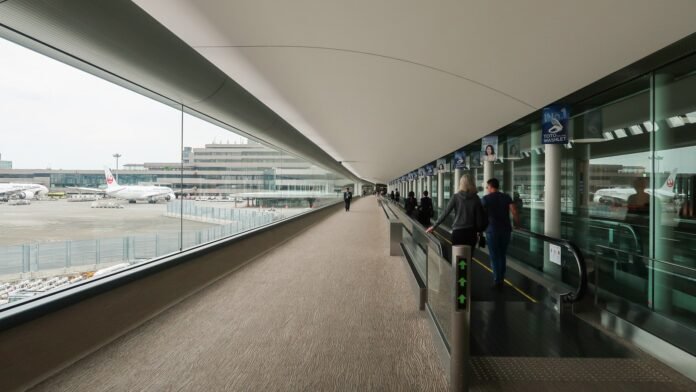
File photo: moving walkways in Terminal 2 at Narita Airport, Japan (May 28, 2018). Credit: Wikipedia user – Wpcpey / Wikimedia Commons, CC BY-SA 4.0. Cropped and resized by The Press of Asia. Archival airport photograph; the people shown are not identified as working-holiday applicants. This adaptation is shared under the same licence.
What the embassy has published
The embassy’s Spanish-language notice explains the purpose of the bilateral programme and lists the documents to submit. It describes temporary work as a way of supplementing travel funds during a holiday in Japan. Applicants whose primary intention is to work are directed to the appropriate employment visa instead.
The notice is dated November 1. Japan’s Foreign Ministry’s national working-holiday page, updated the same day, places Panama alongside Malta and Italy among partnerships initiated in 2026. It lists annual quotas of 100 for Malta, 500 for Italy and 100 for Panama. Those are separate bilateral arrangements, not a shared pool of places.
At a glance
| Item | Confirmed detail | Why it matters |
|---|---|---|
| Panama quota | 100 visas per year | A bilateral cap, not guaranteed availability |
| Application age | 18–30 inclusive | Assessed when applying |
| Main purpose | Holiday, with incidental work | A different route is needed when work is the primary purpose |
| Processing indication | About five working days if documents are satisfactory | Checks can extend the period |
| Japan partner list | 33 countries and regions as of November 1 | Eligibility differs between arrangements |
Eligibility is tied to nationality and residence
The Panama embassy says it can process applications from Panamanian nationals who reside in Panama. Non-Panamanian residents are asked to check whether their own country has a corresponding arrangement with Japan and apply through the relevant Japanese mission. Living in a partner country does not automatically transfer that country’s eligibility to another nationality.
The embassy sets the application age range at 18–30, inclusive. It also requires a valid Panamanian passport, adequate funds, good health and a clean criminal record. Applicants must intend to leave Japan when the authorised stay ends and must not previously have received a working-holiday visa under this route.
The national list is particularly relevant to readers across Asia. South Korea, Taiwan and Hong Kong have established arrangements, with their own detailed conditions and quotas. India is not listed among the 33 partners on the ministry’s November 1 page. The Panama notice therefore does not open this route to Indian passport holders.
What applicants need to prepare
The embassy’s checklist includes a passport, personal identity document, CV, proposed travel plan, explanation of the reason for participating, visa application form and a recent photograph. It also asks for bank statements covering the preceding three months, a medical certificate and a national criminal-record certificate.
Health coverage is another part of the checklist. The notice provides a declaration concerning Japan’s national health insurance or the alternative of international medical insurance valid during the stay. Applicants should use the embassy’s current forms and wording rather than copy a checklist from another working-holiday country.
The financial section distinguishes applicants who already hold return flight tickets from those who do not. It also addresses initial living expenses. Because those requirements affect an individual application, readers should check the complete official wording and their own travel situation instead of treating one quoted balance as sufficient in every case.
Processing and employment limits
According to the embassy notice, applicants can present original documents during its stated weekday consular hours, excluding embassy holidays. It describes approximately five working days for processing where documentation presents no problems, while warning that additional checks or missing documents can extend the period. That is an indicative timeframe, not guaranteed approval.
Places are allocated in order of application until the available quota is reached. Before buying non-refundable travel, an applicant should confirm the mission’s current submission arrangements and whether places remain. This article does not establish how many of the annual places have already been taken.
Both the embassy and the Foreign Ministry distinguish permitted incidental work from prohibited activities. The national guidance excludes work in bars, cabarets, nightclubs, gambling establishments and similar premises. A working-holiday visa is consequently not permission to take any job that is offered.
What to watch
The useful development is a newly published application guide for a specific bilateral route, within a wider Japanese programme that began with Australia in 1980. The route’s value lies in cultural exchange and the opportunity to support a holiday with limited work, rather than an automatic pathway to long-term employment.
Prospective applicants should verify nationality, residence, age, available quota and the current embassy checklist before submitting. Japan’s Foreign Ministry also warns that it does not operate the programmes in cooperation with outside organisations claiming special access to working-holiday visas.
Sources
- Embassy of Japan in Panama: Visa Working Holiday notice, November 1
- Japan Ministry of Foreign Affairs: The Working Holiday Programmes in Japan

The International Desk covers world and Asian affairs, diplomacy and conflict, with a focus on what they mean for India. Stories are checked against at least two credible sources before publication.