
November 2: China’s privately compiled manufacturing survey showed continued expansion in October, offering a different picture from the country’s official factory survey. The RatingDog China General Manufacturing Purchasing Managers’ Index stood at 52.0, against 52.1 in September, according to the S&P Global release issued on November 2. The National Bureau of Statistics had reported an October manufacturing PMI of 49.3 on October 31. Taken together, the releases point to an uneven industrial economy, rather than one clear nationwide acceleration or collapse.
Key highlights
- RatingDog’s October reading of 52.0 remained above the 50 no-change threshold.
- The official NBS manufacturing PMI fell from 50.1 to 49.3.
- The private survey reported faster production but renewed reductions in selling prices.
- PMI readings measure the direction of business conditions, not percentage growth in output.
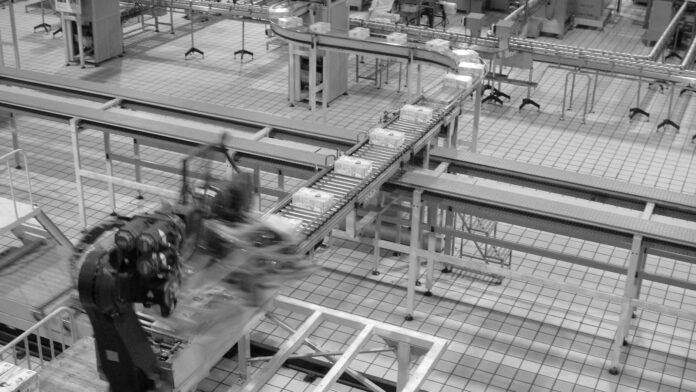
File photo: automated manufacturing equipment in China (May 8, 2010). Credit: Cory M. Grenier / Wikimedia Commons, CC BY-SA 2.0. Cropped and resized by The Press of Asia. Archival industrial photograph; it does not show the October 2026 survey or identify a survey respondent. This adaptation is shared under the same licence.
What the new report establishes
The S&P Global report, sponsored by RatingDog, recorded an eleventh consecutive month of improving manufacturing conditions. Production expanded at its fastest pace since April, while new business increased. Overseas orders also rose, although their expansion slowed from September. That combination matters: firms can produce more while the momentum of export demand becomes less strong.
The report also described a marginal increase in employment and a further rise in outstanding work. It therefore does not support a claim that stronger activity has already produced a broad hiring boom. The headline reading was almost unchanged, and the strength in production sat alongside softer business confidence.
At a glance
| Item | Confirmed detail | Why it matters |
|---|---|---|
| Private headline | 52.0 in October; 52.1 in September | Continued improvement, with little change in the overall pace |
| Official headline | 49.3 in October; 50.1 in September | Conditions moved below the no-change threshold |
| Private panel | About 650 manufacturers | A separate sample, not a replacement for the official survey |
| Prices and jobs | Lower selling charges; marginal hiring growth | Output strength and household or profit gains are different questions |
Why the official and private numbers can diverge
NBS put its headline manufacturing index below 50, with production at 49.8 and new orders at 49.4. Its size breakdown also showed an important distinction: large manufacturers remained marginally above the threshold at 50.2, while medium and small businesses recorded 48.4 and 47.5 respectively. The official release is covered separately in our report on China’s October official PMI.
These are separate surveys, not two revisions of a single statistic. S&P Global’s methodology describes a panel of roughly 650 manufacturers and responses about conditions relative to the previous month. A different sample, response window and weighting can produce a different picture of the same economy. Neither series should be substituted for the other simply because its headline appears more reassuring.
Our calculation: the October headline gap is 2.7 index points, obtained by subtracting 49.3 from 52.0. This is a difference between two diffusion indices. It is not a 2.7% difference in production and does not establish how much faster one group of factories is growing.
Production strength does not guarantee stronger margins
A central warning in the private release concerns pricing. Manufacturers reported lower output charges after an increase in September, citing competition and slower growth in input costs. Export selling prices also fell. More orders can therefore coexist with pressure on the amount a manufacturer earns from each sale.
For buyers across Asia, that creates two questions to ask separately: can a supplier deliver on time, and is its pricing sustainable? The survey reported improved delivery performance, but it does not provide a delivery guarantee for an individual company. Nor does a national index establish the financial condition of any particular supplier.
For employees and policymakers, the limited hiring response is equally significant. A production increase supported by existing capacity, inventory adjustments or efficiency gains can have a different employment effect from an expansion that requires large additions to the workforce. The survey alone cannot determine which outcome will dominate across the wider economy.
What to watch
The next tests are official production, trade and employment releases, followed by the next round of business surveys. Readers should compare changes within each series over time, and keep monthly survey signals separate from year-on-year measures in official statistics. An index above 50 is useful evidence of improvement among respondents, not proof that every manufacturer is doing well.
October’s message is therefore mixed but specific: the private panel reported stronger production and continued orders, while official respondents showed weaker overall conditions. Pricing pressure and modest hiring explain why a positive manufacturing headline need not translate immediately into stronger profits or household income.
Sources
- S&P Global and RatingDog: Manufacturing sector further expands in October
- National Bureau of Statistics: China purchasing managers’ indices, October 2026

The Business Desk covers markets, the economy, companies and personal finance. Stories are checked against at least two credible sources before publication.