November 2: Hong Kong has announced two separate initiatives aimed at putting advanced artificial intelligence to work in finance. The Hong Kong Monetary Authority launched Project SAGE on November 2, while HSBC announced plans for an AI and Emerging Technology Institute expected to begin operations in early 2027. The announcements put governance, identity and practical deployment alongside the promise of automation; they do not mean customers have already been given unrestricted AI agents to manage their money.
Key highlights
- Project SAGE concerns the responsible development of agentic finance, according to the HKMA.
- HSBC’s proposed institute will be based in Hong Kong’s Northern Metropolis.
- HKUST has been selected as HSBC’s anchor academic partner.
- The regulatory initiative and the bank’s research institute are separate projects.
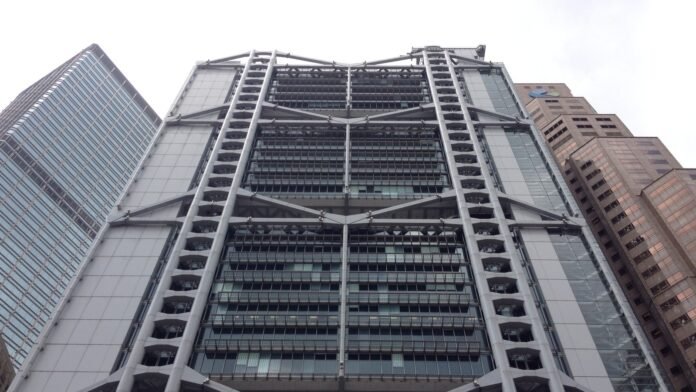
File photo: HSBC’s main building in Central, Hong Kong (May 7, 2016). Credit: 鄒延 / Wikimedia Commons, CC BY-SA 4.0. Cropped and resized by The Press of Asia; adapted photograph licensed under CC BY-SA 4.0. Archival headquarters view, not the proposed Northern Metropolis institute or the November 2026 launch.
What Project SAGE will examine
The HKMA says SAGE stands for Securing Agentic Finance with Governance and Enablement. Its work covers use-case exploration, agent identity, interoperability, and legal and regulatory questions. An expert group brings together financial institutions, technology and professional-service providers, and academics.
The authority identifies possible applications in consumer commerce and payments, business procurement and treasury, and machine-to-machine payments for digital services. These are areas for exploration and validation. Naming a possible use case is different from announcing a fully launched, universally available product.
At a glance
| Initiative | Confirmed announcement | What remains ahead |
|---|---|---|
| Project SAGE | HKMA initiative launched November 2 | Practical use cases, identity approaches and governance work |
| Expert group | Stakeholders assembled to support SAGE | Recommendations and implementation discussions |
| HSBC institute | Northern Metropolis location planned | Operations expected in early 2027 |
| Academic partnership | HKUST selected as anchor partner | Research translated into usable technology |
What HSBC is planning
HSBC’s announcement describes an institute combining research expertise with teams that deploy technology across the bank. Its initial subjects include AI skills, safety and fraud detection, engineering optimisation, post-quantum cryptography and blockchain. The bank says additional technology partners may join later.
The expected early-2027 opening is a timetable for a planned institution, rather than evidence that every research programme is already running. HSBC has not presented these announcements as a guarantee of a particular commercial return, a specified reduction in fraud or a new entitlement for account holders.
Why an AI agent needs more than a login
The practical distinction between a chatbot and an agent is the action being delegated. An assistant might explain an invoice; an agent might be allowed to initiate a payment against it. The second task introduces questions about who gave permission, the permitted amount, the recipient and the point at which the authority expires.
Consider a business allowing an agent to reorder supplies. A useful control would distinguish reading an approved catalogue from committing money, changing a supplier or accepting new contract terms. This is an illustrative governance example, not a description of a product already approved by the HKMA or offered by HSBC.
Identity checks and spending limits also answer different questions. Knowing which agent submitted a request does not establish that its owner authorised that transaction. A secure process needs a record connecting the identity, the instruction and the specific action. That record becomes especially important when several systems participate in one purchase.
The cross-border question for Asia
Financial services frequently involve banks, technology providers and customers operating in different jurisdictions. Interoperability can make a technical message understandable to another system; it does not automatically settle legal responsibility or make one jurisdiction’s permission valid everywhere else.
For regional businesses, the meaningful test will therefore be whether an application can operate within clearly defined authority, produce an audit trail and stop when circumstances change. A demonstration that completes one payment is narrower evidence than a system shown to handle exceptions, disputed instructions and failures reliably.
The two announcements also concern different layers of the technology chain. A research institute can develop tools or skills, while a regulator-led initiative can examine conditions for responsible use. Neither substitutes for the other. Treating both as a single launch would obscure who is accountable for which decisions.
What to watch
The next concrete milestones are published SAGE work, validated applications, clearer identity and responsibility arrangements, and details of the HSBC institute’s opening and research partnerships. Claims about adoption should identify the actual service, its users and its limits.
For customers, the announcements alone do not require a new account, a payment or the sharing of credentials. Readers should distinguish official information about future research from messages advertising immediate access to an unannounced investment or AI banking product. The story is a developing framework and a planned research capability, not an unrestricted transfer of financial decisions to software.
Sources
- HKMA: Project SAGE and the Agentic Finance Expert Group
- HSBC: AI and Emerging Technology Institute announced at Hong Kong FinTech Week

The Business Desk covers markets, the economy, companies and personal finance. Stories are checked against at least two credible sources before publication.