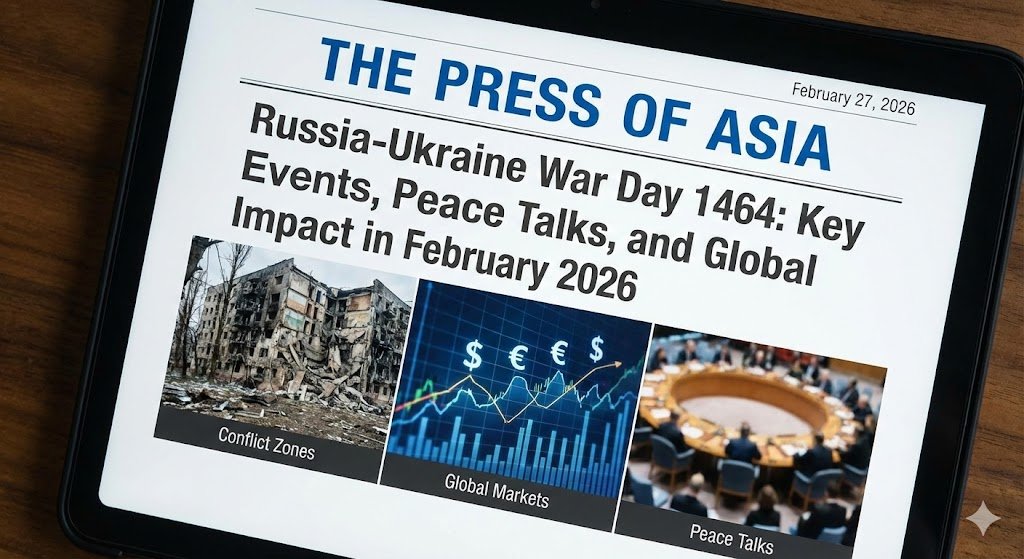
As the Russia-Ukraine war enters its 1,464th day on February 27, 2026, the conflict that began with Russia’s full-scale invasion of Ukraine on February 24, 2022 continues to exact a devastating toll. Despite occasional discussions about ceasefire possibilities, the war shows no signs of imminent resolution, with both sides maintaining their positions and military operations continuing across multiple fronts.
Current Situation on the Ground
The front lines in eastern and southern Ukraine have remained largely static in recent weeks, with both Russian and Ukrainian forces conducting grinding attritional warfare. Russian forces have been exerting pressure along several sectors, particularly in the Donetsk region, where they have been making incremental advances despite heavy casualties on both sides.
Ukrainian forces have been focused on defensive operations while maintaining their long-range strike capabilities. Ukrainian drones and missiles have continued to hit targets deep inside Russian territory, including military infrastructure, fuel depots, and industrial facilities. Russia, in turn, has been conducting large-scale missile and drone attacks against Ukrainian cities and energy infrastructure, causing significant civilian suffering.
Peace Negotiations: Where Do Things Stand?
The question of peace negotiations has become increasingly complex as the war drags on. The United States under the Trump administration has signaled a desire to push for a negotiated settlement, but the terms acceptable to all parties remain deeply contested. Ukraine insists on the restoration of its internationally recognized borders, including Crimea and the Donbas regions occupied by Russia, while Russia seeks recognition of its territorial gains and security guarantees that include keeping Ukraine out of NATO.
European nations, particularly those in Eastern Europe and the Baltic states, remain deeply skeptical of any settlement that would reward Russian aggression. They argue that a peace deal that leaves Russian forces in Ukrainian territory would simply encourage further aggression and undermine the entire post-World War II European security architecture.
The Role of International Mediators
Several countries and international bodies have attempted to play a mediating role, with varying degrees of success. Turkey, which has historically maintained relations with both Russia and Ukraine, has offered its services as a neutral ground for negotiations. China, while maintaining its position of formal neutrality, has continued to provide diplomatic cover to Russia while building its economic ties with both warring parties.
The United Nations has been largely sidelined due to Russia’s permanent seat and veto power on the Security Council. However, UN agencies continue to play a crucial role in providing humanitarian assistance to the millions of Ukrainians affected by the conflict.
Humanitarian Crisis
The humanitarian toll of the Russia-Ukraine war remains staggering. Millions of Ukrainians have been displaced, both internally and as refugees in neighboring European countries. The destruction of critical infrastructure, including power plants, water systems, and transportation networks, has made life enormously difficult for civilians in conflict-affected areas.
The winter months have been particularly brutal, as Russian missile strikes have targeted Ukraine’s energy infrastructure, leaving millions without heat and electricity during some of the coldest months of the year. International humanitarian organizations have mobilized significant resources to provide relief, but the scale of the need continues to outstrip the available assistance.
Military Dynamics and Weapons Supplies
The war has underscored the critical importance of foreign military assistance to Ukraine’s ability to continue fighting. The United States, European Union members, and other Western allies have provided tens of billions of dollars worth of military equipment, including advanced air defense systems, artillery, armored vehicles, and increasingly sophisticated long-range strike weapons.
However, the flow of Western military assistance has not been without complications. Political debates in the United States over the scale and conditionality of aid have created uncertainty, while some European countries have struggled to keep up with the pace of weapons deliveries. Russia, meanwhile, has increased its domestic weapons production and has received significant quantities of ammunition from North Korea and military technology from Iran.
The Nuclear Dimension
One of the most alarming aspects of the Russia-Ukraine conflict has been Russian President Vladimir Putin’s repeated invocations of Russia’s nuclear arsenal. While most analysts believe that Russia’s nuclear threats are primarily intended as coercive diplomacy rather than genuine intent to use nuclear weapons, the possibility cannot be entirely dismissed, and it has constrained Western support for Ukraine in important ways.
NATO allies have been careful not to provide Ukraine with weapons that could be used to strike deep into Russian territory, fearing escalation. Ukraine has repeatedly called for the removal of these restrictions, arguing that it needs the ability to hit Russian military targets that are used to launch attacks against Ukrainian territory.
Economic Impact on Europe and Asia
The Russia-Ukraine war has had profound economic consequences that extend far beyond the immediate conflict zone. European countries have had to manage a fundamental restructuring of their energy supplies following Russia’s use of energy as a geopolitical weapon. The disruption to global grain and fertilizer markets caused by the conflict has had significant effects on food security in Asia, Africa, and the Middle East.
For India and other Asian nations, the war has presented complex economic and diplomatic challenges. India has maintained a policy of strategic autonomy, refusing to condemn Russian aggression while continuing to purchase discounted Russian oil and maintaining economic ties with Moscow. This position has generated some tension with Western allies but has been broadly popular domestically.
Looking Ahead
As the Russia-Ukraine war enters its fourth year, the prospects for resolution remain uncertain. The war has fundamentally changed the security landscape in Europe and has had far-reaching implications for global geopolitics. The outcome of the conflict will shape the international order for decades to come.
Conclusion
On day 1,464, the Russia-Ukraine war remains one of the defining crises of the contemporary world. The human cost continues to mount, the economic consequences continue to reverberate globally, and the diplomatic challenges remain formidable. The Press of Asia will continue to provide comprehensive coverage of this critical conflict and its implications for Asia and the world.