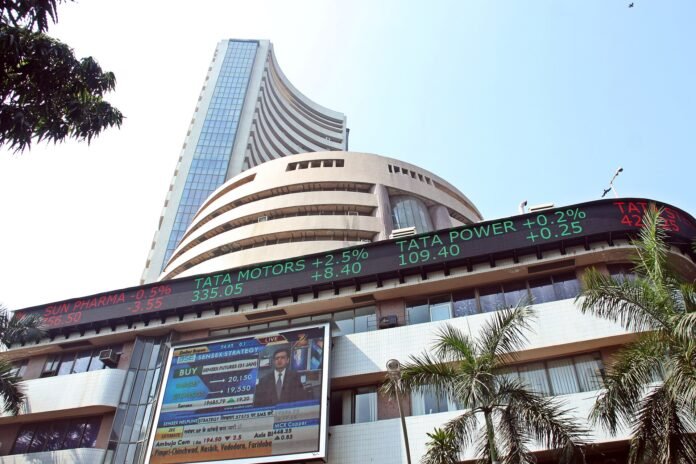
Mumbai, September 28: Indian shares saw heavy selling on the first trading day of the week. The BSE Sensex fell 1,124.02 points (1.52%) to close at 72,771.72, and the NSE Nifty fell 360.25 points (1.56%) to 22,780.25. A sharp rise in crude oil prices and a stalemate in US–Iran peace talks worried investors. Both main indices hit six-month lows.
Key highlights
- Sensex: closed at 72,771.72, down 1,124.02 points.
- Nifty: fell 360.25 points to 22,780.25, a six-month low.
- All sectors red: all 16 major sectoral indices fell; the Nifty PSU Bank index lost about 3%.
- Crude oil: Brent rose to around $107–108 a barrel.
- Foreign selling: foreign institutional investors (FIIs) sold shares worth ₹3,694 crore on Friday.
Why the market fell
Crude oil was the biggest reason for the fall. At 8:06 am UAE time on Monday Brent crude was up 2.61% at $107.04 a barrel and US WTI up 1.96% at $94.22. Brent futures rose about 3.7% during the day to nearly $108. The rise came after US–Iran peace talks stalled. President Trump rejected Iran’s seven-day proposal to reopen the Strait of Hormuz, although he signalled that talks would continue (our report on this).
Brent climbed back above $106 after Friday’s brief relief, and analysts said the rejection of Iran’s proposal had brought the geopolitical risk premium back into crude prices. India imports most of the crude oil it needs, so expensive oil directly puts pressure on inflation, the current account deficit and company profits.
Continued selling by foreign investors added to the pressure. Foreign institutional investors sold shares worth ₹3,694 crore on Friday, and about $1.8 billion has flowed out so far in September. High global bond yields are also pulling money out of riskier markets.
The day in numbers
| Measure | Close / move | Source |
|---|---|---|
| BSE Sensex | 72,771.72 (−1,124.02, −1.52%) | Public record |
| NSE Nifty | 22,780.25 (−360.25, −1.56%) | Public record |
| Nifty Midcap / Smallcap | −1.7% / −1.8% | Public record |
| Market breadth | 1,214 up, 2,905 down, 166 unchanged (about 2.4 losers for every gainer, our calculation) | Public record |
| India VIX | up about 15% to 13.98 (around 1 pm) | Public record |
| Brent crude | $107.04 (+2.61%) at 8:06 am UAE time; near $108 intraday | Public record |
| FII selling (Friday) | ₹3,694 crore | Public record |
Sectors and stocks
The selling was broad-based. All 16 major sectoral indices closed in the red. The Nifty PSU Bank index fell about 3% and telecom 2%, while the energy, infra, FMCG, realty, private bank, metal and oil and gas indices each fell more than 1%. Small and mid-sized stocks were hit harder: the midcap index fell 1.7% and the smallcap index 1.8%.
- Biggest losers: Tata Motors Passenger Vehicles (−3.00%), Adani Enterprises (−2.93%), Jio Financial Services (−2.86%) and Adani Ports (−2.48%).
- Selected gainers: Dr. Reddy’s Laboratories (+1.67%) and Infosys (+0.30%).
The Sensex was already down 971 points by about 1 pm, and the India VIX, seen as the market’s fear gauge, had jumped about 15% to 13.98.
A market under steady pressure
The market has been under pressure for several weeks. Last Friday the Nifty posted its seventh straight weekly loss (full report). The main indices have fallen about 6% over the past seven weeks.
What to watch
- US–Iran talks and crude prices, which will largely set the market’s direction in the coming days.
- Any concrete progress on Hormuz, which could soften oil; a long stalemate could keep the pressure on.
- Foreign investors’ flows and the rupee.
What it means
For India, oil above $105 is a direct cost: it feeds into inflation, the import bill and corporate margins at the same time as foreign investors are pulling money out. In volatile conditions like these, it is wise to avoid panic decisions and to invest only in line with your own risk capacity. This report is for information only and is not investment advice; consult your financial adviser before investing.
This article was first published in Hindi and has been translated. The Press of Asia now publishes in English only.

The Business Desk covers markets, the economy, companies and personal finance. Stories are checked against at least two credible sources before publication.