October 29: Singapore’s latest haze forecast puts the Pollutant Standards Index at 60–90, in the Moderate range, for October 30. The National Environment Agency said on October 29 that showers and the onset of inter-monsoon conditions were expected to help improve the haze situation.
Key highlights
- The October 30 PSI forecast is 60–90, Moderate.
- At 7 p.m. Singapore time on October 29, the 24-hour PSI was 68–77.
- NEA expects lighter, more variable winds to reduce smoke transport towards Singapore.
- More showers are forecast as inter-monsoon conditions develop.
The dated readings and the next-day haze forecast
| Measure | NEA’s October 29 update |
|---|---|
| 24-hour PSI at 7 p.m. SGT | 68–77, Moderate |
| One-hour PM2.5 at 7 p.m. SGT | 14–28 micrograms per cubic metre, Band 1/Normal |
| October 30 PSI forecast | 60–90, Moderate |
| Regional observation | Moderate to dense smoke haze over Kalimantan |
The readings are a timestamped snapshot, not a live display. NEA said showers fell over many areas of Singapore and expected further showers over Singapore, Sumatra, Kalimantan and the surrounding region the following day.
Why the wind change matters
In a separate October 29 advisory, NEA said the weakening Southwest Monsoon was giving way to inter-monsoon conditions. Lighter and more variable winds make smoke from regional fires less likely to be persistently transported towards Singapore. Wetter conditions can also help suppress the haze situation.
The agency’s early-November outlook described moderate to heavy afternoon thundery showers on most days in the first fortnight, with some extending into the evening. Rainfall was forecast to be slightly above the long-term average across most of the island.
How to use the different air-quality measures
The next-day PSI forecast is useful for advance planning. The one-hour PM2.5 reading answers a more immediate question about particle concentration. They are different measures with different time windows, so a “Normal” one-hour reading and a “Moderate” 24-hour PSI can appear together without being contradictory.
For an outdoor event, that means checking the forecast when planning and checking the current official information again closer to the activity. NEA directs readers to its haze website and myENV application for updated readings and the corresponding activity guidance.
NEA also notes that health impact depends on a person’s health status and the length and intensity of outdoor activity. The broad forecast should therefore be read with the agency’s relevant guidance, rather than treated as a personal medical assessment.
Improvement is a forecast, not an all-clear for the region
Local conditions can improve while smoke persists elsewhere. The October 29 bulletin still described haze over Kalimantan. A change in Singapore’s wind and rain conditions does not establish that every regional fire has ended.
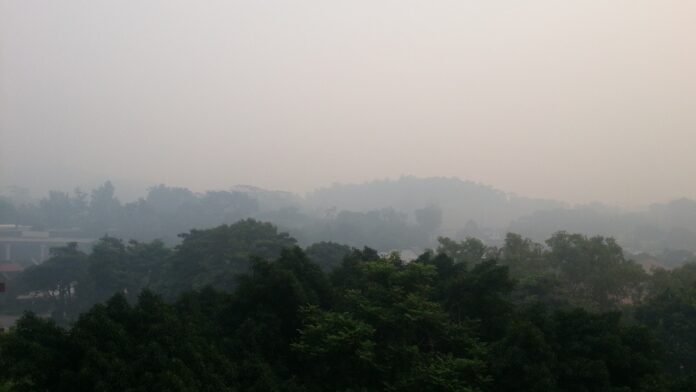
The distinction is also important for travellers comparing information from different countries. Each reading needs its place, measurement and timestamp. A photograph from an earlier haze episode cannot establish what today’s air looks like. The accompanying image is explicitly identified as a 2013 Singapore file photograph.
What to watch
The next NEA bulletin, current one-hour readings and short-term weather warnings will provide more useful planning information than an old screenshot circulating without a date. The October 30 forecast should be replaced with the next official forecast when planning beyond that day.
Sources

The International Desk covers world and Asian affairs, diplomacy and conflict, with a focus on what they mean for India. Stories are checked against at least two credible sources before publication.