SEOUL, November 3: South Korea’s consumer prices rose 2.8% in October from a year earlier, a touch slower than September’s 2.9%, the Ministry of Data and Statistics said on Tuesday. Transport costs, driven by fuel, were up 6.8% and recreation and culture 5.1%, while food prices barely rose — up just 0.5% — after falling 0.5% from September. Inflation excluding food and energy held at 2.8%.
Key highlights
- Headline CPI: 120.73 (2020=100), up 2.8% year on year and 0.2% from September.
- Core CPI excluding food and energy: up 2.8% year on year and 0.4% month on month.
- Transport prices rose 6.8% from a year earlier — the biggest increase among the 12 spending categories.
- Food and non-alcoholic beverages rose only 0.5% year on year and fell 0.5% from September.
- Restaurants and hotels rose 3.0%; furnishings and household equipment 4.0%.
The year so far
| Month (2026) | CPI, year on year | Excluding food and energy |
|---|---|---|
| March | 2.2% | 2.2% |
| April | 2.6% | 2.2% |
| May | 3.1% | 2.5% |
| June | 3.2% | 2.5% |
| July | 2.8% | 2.6% |
| August | 3.1% | 3.4% |
| September | 2.9% | 2.8% |
| October | 2.8% | 2.8% |
Where prices rose
| Category | Weight (per 1,000) | Change on a year earlier | Change on September |
|---|---|---|---|
| Transport | 110.6 | +6.8% | +0.2% |
| Recreation and culture | 62.9 | +5.1% | +0.6% |
| Miscellaneous goods and services | 52.7 | +4.2% | +0.1% |
| Furnishings and household equipment | 45.6 | +4.0% | +0.4% |
| Restaurants and hotels | 144.7 | +3.0% | +0.6% |
| Communication | 46.6 | +2.7% | +1.0% |
| Clothing and footwear | 49.6 | +2.4% | +0.2% |
| Health | 84.0 | +2.1% | +0.5% |
| Housing, water, electricity and fuel | 171.6 | +2.0% | +0.3% |
| Education | 73.9 | +1.7% | 0.0% |
| Food and non-alcoholic beverages | 142.0 | +0.5% | −0.5% |
| Alcohol and tobacco | 15.8 | 0.0% | −0.1% |
Our calculation
- Fuel’s footprint: transport carries a weight of 110.6 out of 1,000 in the index. Its 6.8% rise alone adds roughly 0.7 percentage point to the headline rate — a quarter of October’s 2.8%.
- Eating out vs eating in: restaurant and hotel prices rose 3.0%, six times faster than food bought for home (0.5%).
- No easing underneath: core inflation matched the headline at 2.8%, so the slowdown in October came from food, not from a broad cooling.
What it means
Korea’s inflation has hovered between 2.8% and 3.2% since May, above the Bank of Korea’s 2% target, with energy the main source of pressure as oil prices stay high because of the Middle East conflict. Cheaper fresh food gave households some relief in October, but steady core inflation suggests price pressure has spread to services such as dining out and leisure. That makes it harder for the central bank to cut rates even as it weighs slower domestic demand.
What to watch
- The Bank of Korea’s next monetary policy decision and its inflation forecasts.
- Fuel prices, and whether government fuel-tax measures change.
- November CPI, due in early December.
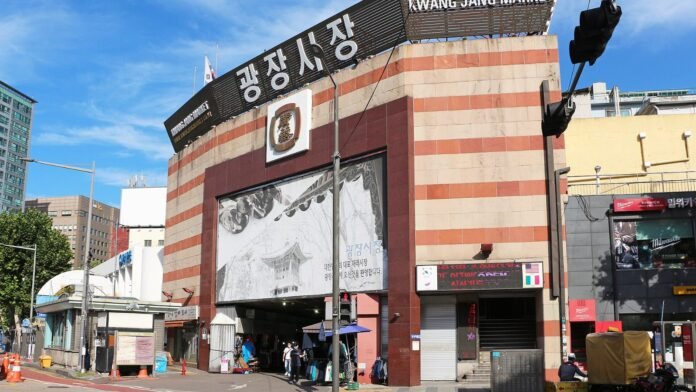
File photo: Gwangjang Market in Seoul, September 2022. Image: Bgag, CC0, via Wikimedia Commons. Photo source · Licence
Sources
- Ministry of Data and Statistics (Republic of Korea): Consumer Price Index in October 2026 (press release, PDF)
- Ministry of Data and Statistics: Consumer price press releases

The Business Desk covers markets, the economy, companies and personal finance. Stories are checked against at least two credible sources before publication.