November 17: More countries have plans to confront antimicrobial resistance, but implementation and access to testing remain major weaknesses, according to new World Health Organization findings. WHO released the assessment on November 16, ahead of World AMR Awareness Week, which runs from November 18 to 24.
Key highlights
- WHO says 173 countries report having national AMR plans.
- Only 22% report both the necessary funding and full implementation.
- The findings draw on country self-assessments, rather than a count of individual patients.
- The 2026 awareness campaign connects human, animal and environmental health.
What the new assessment shows
WHO says 183 countries, representing 94% of its Member States, completed the 2026 Tracking Antimicrobial Resistance Country Self-assessment Survey. However, the agency cautions that a plan does not establish that patients have access to the services it describes.
The release identifies gaps along the pathway from preventing infection to diagnosing and treating it. It says only 36% of countries report national reference laboratories able to diagnose selected important resistant bacteria and fungi, against a global target of 80% by 2030.
At a glance
| Measure | WHO finding |
| Countries reporting national plans | 173 |
| Countries completing the 2026 self-assessment | 183 |
| Reporting funding and full implementation | 22% |
| World AMR Awareness Week | November 18–24, 2026 |
What antimicrobial resistance means
WHO’s campaign guidance explains that AMR develops when bacteria, viruses, fungi or parasites no longer respond to medicines intended to treat them. The problem concerns resistant microbes. It should not be described as the human body becoming resistant to antibiotics.
The distinction also extends beyond antibiotics alone. Antimicrobial medicines include treatments against several types of pathogen. Reports should identify the organism, medicine and evidence involved rather than treat every infection as interchangeable.
Why the One Health approach matters for Asia
This year’s campaign uses a One Health approach, linking the health of people, animals, plants and the environment. WHO calls for participation across government, health care, veterinary services, farming, research and communities. The framework is relevant to Asian health and food systems, but the global figures do not establish the performance of any particular Asian country.
A national assessment would require the relevant country data, budgets and service indicators. It would be misleading to assign the global 22% implementation figure to India, China or another country as if it were that country’s own score.
How to read a country self-assessment
The survey records reported national capacity and policy implementation. That is different from measuring a person’s likelihood of developing a resistant infection. It is also different from an independent inspection of every laboratory or hospital. Those distinctions help explain both the value and limits of the findings.
For accountability, the useful follow-up questions are concrete: whether a plan has a budget, whether testing is available, and how progress is measured. Counting published plans alone cannot answer whether the planned services reach patients.
What to watch
During awareness week, the most meaningful announcements will connect commitments with funding, delivery and measurable access. The WHO findings provide a global warning about the gap between policy and implementation; they do not announce a new local outbreak or establish that a particular treatment has failed in an individual case.
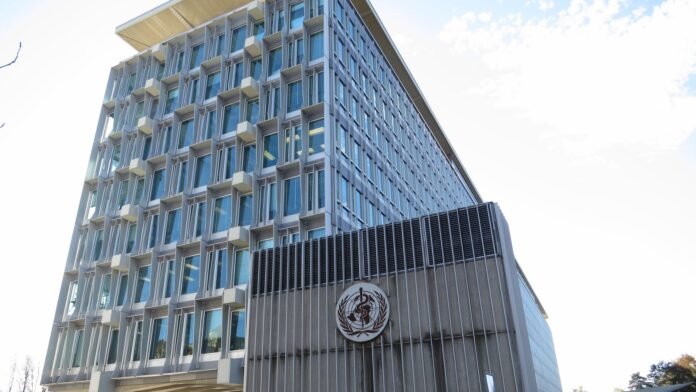
File photo: WHO headquarters, Geneva, October 28, 2013. Thorkild Tylleskar / Wikimedia Commons, CC BY-SA 3.0. Cropped and resized; adaptation retains this licence. Not a photograph of the 2026 launch.
Sources
- WHO: More countries have AMR plans but testing and treatment gaps remain
- WHO: World AMR Awareness Week 2026 and One Health guidance

The International Desk covers world and Asian affairs, diplomacy and conflict, with a focus on what they mean for India. Stories are checked against at least two credible sources before publication.