NEW DELHI, November 9: The share of Indians living in extreme poverty fell from 27.1% in 2011 to 2.6% in 2023, according to the World Bank’s latest Poverty and Equity Brief for India, published in October. The same brief estimates that 496 million people, close to 50 crore, moved above the World Bank’s $4.20-a-day poverty line over those years. Prime Minister Narendra Modi cited the report on Sunday while addressing security forces in Bastar.
Key highlights
- Extreme poverty ($3.00 a day, 2021 prices): 27.1% in 2011 to 2.6% in 2023.
- Lower-middle-income poverty line ($4.20 a day): 57.7% to 16.1% over the same period.
- People lifted: about 496 million above the $4.20 line between 2011 and 2023.
- Where the poor live: a belt from Uttar Pradesh to West Bengal holds about 57% of India’s remaining poor.
- Rural–urban gap (2023, $4.20 line): 19.3% rural against 8.6% urban.
- Caution: the World Bank says part of the recent gain may reflect better survey measurement, and inequality is probably understated.
The numbers
| Measure | 2011 | 2023 |
|---|---|---|
| Extreme poverty rate ($3.00 a day) | 27.1% | 2.6% |
| Poverty rate at $4.20 a day | 57.7% | 16.1% |
| Gini index (inequality) | — | 23.0 |
The World Bank projects the poverty rate at the $4.20 line to fall from 14.2% in 2026 to 12.1% by 2028, and calls these projections indicative. It describes India’s decline as one of the fastest reductions in poverty anywhere, but expects the pace to slow from here.
Who is still poor
According to the brief, the remaining poor are increasingly concentrated among households with less education, fewer assets and no stable job. Most of them still live in villages: in 2023, 19.3% of rural Indians were below the $4.20 line, against 8.6% of urban Indians. About 57% of the poor live in a contiguous belt running from Uttar Pradesh to West Bengal, so the World Bank says further progress depends on creating productive jobs in those states.
The brief also flags pressure in the labour market. Youth unemployment rose from 14.6% to 15.9% between the April–June quarter of 2025 and the same quarter of 2026, with rural young women most affected. In 2023, the median earnings of the top 10% of workers were about 13 times those of the bottom 10%.
How the figures were built
The estimates come from the World Bank’s South Asia Micro Database, using India’s household consumption surveys for 2011–12 and the Household Consumption Expenditure Surveys of 2022–23 and 2023–24. The brief cautions that the large improvement between 2022–23 and 2023–24 may partly reflect better measurement, and that the surveys probably understate inequality.
Our calculation
The World Bank’s 496 million is about 49.6 crore, which matches the “50 crore” figure the Prime Minister used in Bastar. Note the definitions: the World Bank attaches the 496 million to its $4.20-a-day line, while the Prime Minister spoke of people escaping extreme poverty, which the World Bank measures at $3.00 a day. On that stricter extreme-poverty measure, the brief gives rates (27.1% to 2.6%) rather than a headcount.
What it means for India and Asia
- For India: with extreme poverty now low, policy attention shifts to the larger group just above the line, and to jobs, wages and inequality in the eastern states.
- For South Asia: India accounts for most of the region’s population, so its numbers shape South Asia’s poverty trend as a whole.
- For measurement: the World Bank’s own caveats mean the size of the most recent gain should be read with care until more survey rounds are available.
What to watch
- The next round of India’s Household Consumption Expenditure Survey, which will test whether the recent gains hold.
- Quarterly labour-force data on youth and rural female unemployment.
- The World Bank’s next Macro Poverty Outlook for India, which updates growth and poverty projections.
Related: PM Modi celebrates Diwali with security forces in Bastar
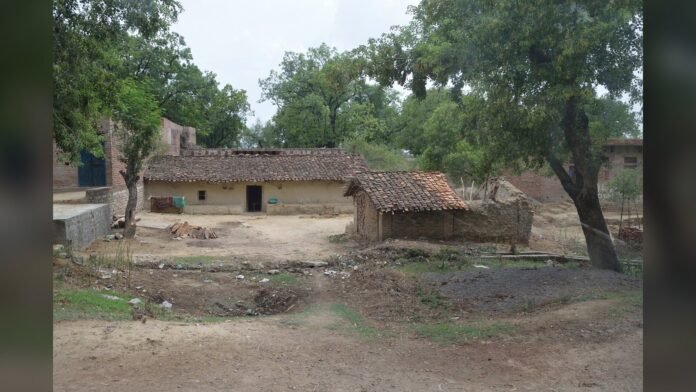
A village in Mau, Chitrakoot district, Uttar Pradesh (file photo, 2014) Image: Biswarup Ganguly, CC BY 3.0, via Wikimedia Commons. Photo source · Licence
Sources
- World Bank: India Poverty and Equity Brief, October 2026
- World Bank: India Poverty and Equity Brief, October 2026 (PDF)
- Prime Minister’s Office (PIB): PM celebrates Diwali with security forces at CoBRA Operations Base, Karanpur, Bastar, November 8, 2026

The Business Desk covers markets, the economy, companies and personal finance. Stories are checked against at least two credible sources before publication.