November 11: South Korea’s exports more than doubled in the first ten days of November, according to preliminary figures released by the Korea Customs Service. Shipments reached US$33.46 billion, up 111.9% from the corresponding period of 2025. The report also records a substantial increase in imports.
Key highlights
- Exports totalled US$33.460 billion in November 1–10.
- Imports reached US$24.710 billion, an annual increase of 45%.
- The recorded goods-trade surplus was US$8.751 billion.
- Average daily exports rose 97.7% after adjusting for working days.
Why the two growth rates differ
The customs agency’s November 11 release compares 7.5 working days this year with seven in the equivalent period of 2025. Its working-day-adjusted measure shows average daily exports of roughly US$4.46 billion. This daily comparison is lower than the increase in total shipments, but still indicates a strong rise.
For a company following orders and supply chains, those measures answer different questions. Total shipments show how much crossed the border during the window. A daily comparison reduces the influence of a different number of trading days. Neither should be relabelled as the other.
At a glance
| Indicator | November 1–10, 2026 |
|---|---|
| Exports | US$33.460 billion; +111.9% year on year |
| Imports | US$24.710 billion; +45.0% |
| Recorded surplus | US$8.751 billion |
| Daily export growth | 97.7%, working-day adjusted |
The customs tables use more precise underlying figures than the rounded headline totals. Readers should retain the agency’s recorded surplus rather than infer extra precision by subtracting shortened billion-dollar figures.
What this means for Asian supply chains
The release offers an early view of goods trade, rather than a completed assessment of November. For regional suppliers, the useful follow-up is whether strong shipments continue through the rest of the month and which products and destinations account for them.
A higher export value does not establish an equivalent increase in physical quantities, company earnings or household income. Similarly, rising imports can accompany different economic activities. The headline totals alone do not identify the ultimate use of everything purchased.
Short reporting windows deserve particular care. A large shipment brought forward or delayed can affect a ten-day comparison more than a full-year result. That is a reason to follow successive releases with consistent definitions, rather than dismiss the figures or project them mechanically.
What to watch
Subsequent customs reports will show how this strong start develops. The key checks are the reporting dates, provisional status and working-day adjustment. A goods-trade surplus is also different from the broader current-account balance, which includes additional flows.
For earlier context, see our report on South Korea’s early-October trade figures. The periods should be compared with their respective calendar adjustments intact.
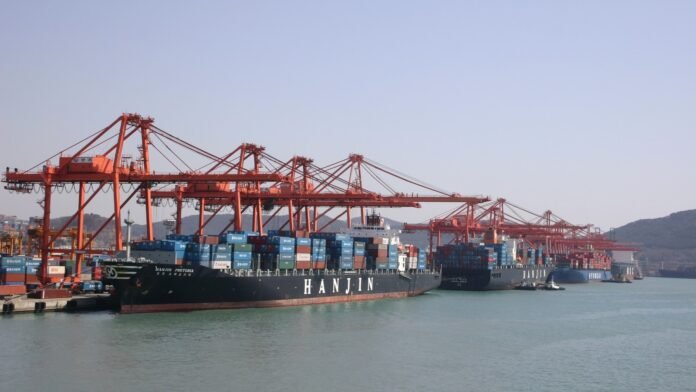
File photo: Busan Container Terminal, South Korea, March 29, 2006. Niels Johannes / Wikimedia Commons, CC BY-SA 4.0. Cropped and resized; adaptation retains this licence. Archival image, not November 2026 shipments.
Sources

The Business Desk covers markets, the economy, companies and personal finance. Stories are checked against at least two credible sources before publication.