October 21: South Korea’s exports more than doubled in the first 20 days of October compared with a year earlier, according to Korea Customs Service figures released on Wednesday. Semiconductor shipments led the advance, Reuters reported, placing the global artificial-intelligence investment cycle at the centre of the country’s latest trade performance.
Key highlights
- Customs figures put October 1–20 exports at US$61.612 billion, up 105.4% year on year.
- Imports reached US$47.117 billion, an increase of 42.8%.
- Reuters reported that semiconductor exports rose 222.5% and accounted for 44.7% of total shipments.
- The figures cover only part of October and should not be presented as the final monthly result.
What the customs figures show
The Korea Customs Service’s English trade-statistics dashboard records US$61,612 million in exports and US$47,117 million in imports for October 1–20. Its year-to-date figures, calculated on the customs-acceptance basis, show exports of US$876,336 million and imports of US$609,409 million through October 20.
These are merchandise-trade figures. They describe goods crossing borders under the customs reporting system, rather than the entire economy’s output or the value of services sold abroad. A strong release is therefore evidence of trade momentum, not a substitute for a gross domestic product report.
At a glance
| Measure | October 1–20, 2026 | Year-on-year change |
|---|---|---|
| Goods exports | US$61.612 billion | +105.4% |
| Goods imports | US$47.117 billion | +42.8% |
| Goods-trade balance | US$14.495 billion surplus | Our calculation |
| Average exports per working day | US$4.74 billion, Reuters reported | +65.9% |
Our calculation: US$61.612 billion minus US$47.117 billion equals a US$14.495 billion surplus for the reported period. This is not South Korea’s current-account balance, which includes additional transactions.
Why the working-day comparison matters
Reuters reported that average exports per working day increased 65.9% to a record US$4.74 billion. That measure is useful alongside the much larger 105.4% headline increase: a partial-month comparison can contain a different number of working days in each year.
The two growth rates answer different questions. Total shipments measure the value recorded across the reporting window; the daily average helps readers compare the pace of business within that window. Neither figure should be silently substituted for the other.
Chips dominate the story
According to Reuters, semiconductor shipments increased 222.5% and represented 44.7% of exports. The agency linked the record chip sales to global investment in artificial intelligence.
The concentration matters as much as the size of the rise. When a major export category accounts for a large portion of shipments, movements in that sector can have an outsized influence on the national headline. A broad export recovery and a chip-led acceleration are not necessarily the same thing; sector-by-sector data are needed to distinguish them.
There is also a measurement caution. A percentage increase in export value does not, by itself, reveal how much came from higher prices, a different product mix or a larger physical volume of goods. The early figures should not be described as showing that the number of chips shipped more than tripled unless quantity data establish that separately.
What this means for Asia’s supply chains
For businesses following Asian manufacturing, the release offers a timely indicator of demand moving through Korea’s export sector. It does not establish that every trading partner or every Korean exporter is experiencing the same conditions.
Buyers and suppliers can use the figures to frame questions about order books, production schedules and delivery capacity. They should still distinguish completed customs shipments from future orders: goods already exported do not guarantee the same pace in the following month.
What to watch
The full-month release will show whether the early strength continues across the remainder of October. Readers should watch the working-day-adjusted pace, the contribution of non-chip industries and any revisions to provisional figures.
The present conclusion is narrower but significant: Korea’s first-20-day goods exports have risen sharply, chips are the dominant driver identified in Reuters’ report, and the final October outcome remains to be established.
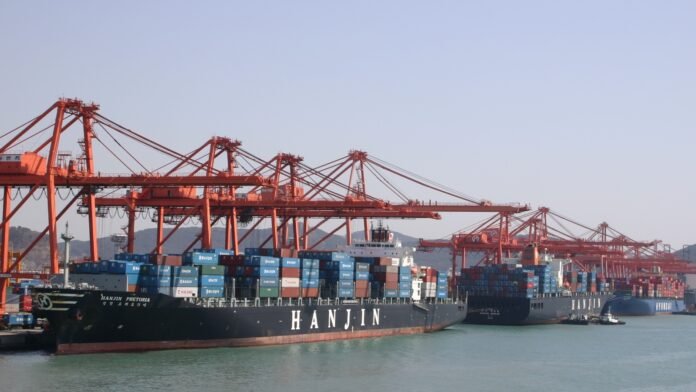
File photo: Busan Container Terminal, South Korea, March 29, 2006. Photograph: Niels Johannes / Wikimedia Commons, CC BY-SA 4.0. Cropped and resized; not a photograph of October 2026 shipments. Image source · Licence.
Sources
- Korea Customs Service: Trade Statistics — October 1–20 clearance results
- Reuters via Business Recorder: South Korea October 1–20 exports surge 105% on record chip sales

The Business Desk covers markets, the economy, companies and personal finance. Stories are checked against at least two credible sources before publication.