October 20: A diplomatic dispute between the Philippines and China has sharpened after Manila summoned Chinese Ambassador Jing Quan over comments Philippine officials interpreted as a threat of force. China’s embassy disputes that interpretation, making the wording and context of the remarks central to the disagreement rather than evidence that either country has announced military action.
Key highlights
- The Philippine foreign ministry summoned the ambassador on October 19.
- Foreign Secretary Ma. Theresa Lazaro conveyed Manila’s objection, according to Reuters and News5.
- News5 reported the embassy’s criticism of selective quotation and over-interpretation.
- A diplomatic summons is not the same as expelling an ambassador or severing relations.
What happened in Manila
Reuters reported on October 19 that the foreign ministry called in China’s ambassador to convey concern about language it said suggested the use of force. News5’s separate account identifies Lazaro as the official who delivered the objection and dates the disputed original statement to October 15.
Manila’s position, as reported by News5, is that such remarks worsen an already sensitive diplomatic atmosphere. The report also says President Ferdinand Marcos Jr. considered the language inconsistent with diplomatic restraint. These are the Philippine government’s assessments, not an independent finding that an attack was being prepared.
Why context matters
News5’s account includes both the ambassador’s assertion about China’s ability to prevail through force and his accompanying statement that China would not use force and wanted peace. It also records the Chinese embassy’s rejection of Manila’s interpretation.
Those elements belong together. Removing the disclaimer would obscure Beijing’s stated position; reporting only the disclaimer would obscure why Manila objected. This report therefore treats the episode as a dispute over diplomatic language and signalling, rather than declaring either side’s interpretation an established fact.
The sequence at a glance
| Date or stage | Reported development | What it establishes |
|---|---|---|
| October 15 | Envoy’s disputed statement | The remark at the centre of Manila’s complaint |
| October 19 | Foreign ministry summons | A formal diplomatic objection |
| Subsequent response | Embassy disputes the interpretation | The two governments disagree over meaning |
| Next stage | Further official communications | Any concrete change in diplomatic relations |
Table compiled from Reuters and News5. The final row identifies what to monitor; it does not predict an outcome.
A summons is a diplomatic step, not an expulsion
In practical terms, calling an envoy to the foreign ministry creates an official channel for delivering a protest and seeking clarification. Readers should not substitute more consequential terms such as expulsion, a break in relations or military escalation without a separate announcement.
The distinction is especially useful when short social-media clips circulate without surrounding remarks. A forceful sentence can attract attention, but the relevant questions remain who said it, when, in what context, how the other government responded and whether either side changed policy.
The wider regional significance
For Southeast Asian audiences, the dispute illustrates how language between governments can become a policy issue in its own right. It can affect the atmosphere for future talks even before any new agreement or operational measure is announced. That is different from proving that a confrontation will occur.
This article is based on published reporting. The Press of Asia has not interviewed the ambassador or independently obtained private diplomatic exchanges, and does not claim to know intentions beyond attributable public positions.
What to watch
Watch for subsequent statements from Manila and Beijing, any clarification of the disputed language and any expressly announced diplomatic measure. Until then, claims that the envoy has been expelled or that hostilities are imminent would go beyond the evidence cited here.
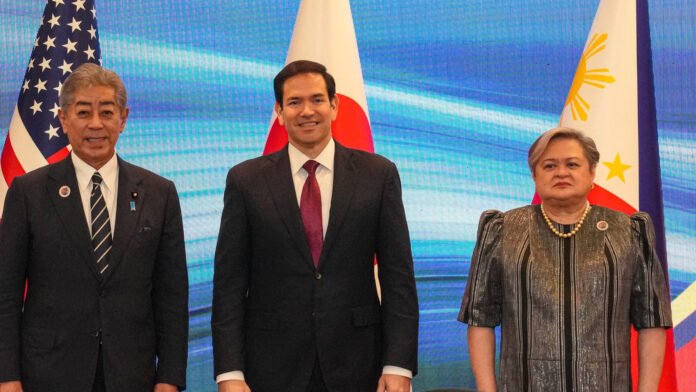
File photo: Philippine Foreign Secretary Ma. Theresa Lazaro, right, with Marco Rubio and Takeshi Iwaya in Kuala Lumpur on July 10, 2025, not the October 19 summons. Credit: Freddie Everett / U.S. Department of State, via Wikimedia Commons. Public domain, U.S. government work. Cropped and resized.
Sources
- Reuters via Interaksyon: Philippines summons China’s envoy over confrontation remark
- News5: Philippines summons Chinese envoy over threat remark

The International Desk covers world and Asian affairs, diplomacy and conflict, with a focus on what they mean for India. Stories are checked against at least two credible sources before publication.