October 20: Defence Minister Rajnath Singh called for coordinated action against terrorism and said regional connectivity must respect sovereignty at the Shanghai Cooperation Organisation’s government-heads meeting in Dushanbe. The meeting also adopted economic and administrative decisions, according to India’s defence ministry, making it important to distinguish Singh’s national position from measures agreed by the wider organisation.
Key highlights
- Singh addressed the 25th SCO Council of Heads of Government meeting in Tajikistan.
- He argued that terrorism undermines economic opportunity as well as security.
- India supported practical cooperation in trade, technology and resilient supply chains.
- The adopted documents include the 2027 budget and an economic cooperation action plan for 2026–2030, the ministry said.
What India said
The Ministry of Defence’s October 20 release says Singh urged members to address the support structures that enable terrorism. He argued for consistent treatment of the issue and respect for sovereignty in connectivity projects. He also invited members to a civilisational dialogue forum India plans to host later this year.
The Indian Express separately reported his appeal for collective action and placed the speech in the context of regional security tensions. Its coverage highlights the emphasis on avoiding double standards. The speech is a statement of India’s position; it should not be presented as evidence that every member accepted all of its arguments.
A government-heads meeting with an economic role
India’s October 18 advance announcement said the gathering would cover trade, investment, connectivity, innovation and cultural exchanges, alongside the organisation’s finances and institutions. That background helps explain why an address about security also dealt with economic opportunity.
The distinction between different SCO meetings matters. This was the Council of Heads of Government, not a new gathering of all heads of state. Describing every SCO event simply as a leaders’ summit can leave readers with a mistaken impression about who attended and what authority each document carries.
Statements and decisions at a glance
| Item | Status in the cited reporting | How to read it |
|---|---|---|
| Action against terrorism | India’s stated priority | A national position, not proof of unanimous agreement |
| Sovereignty in connectivity | India’s stated principle | A standard Singh urged for regional projects |
| 2027 SCO budget | Reported adopted | An institutional decision |
| 2026–2030 economic action plan | Reported adopted | A cooperation framework requiring implementation |
Table compiled from the defence ministry’s releases and Indian Express coverage. It separates advocacy from adopted organisational measures.
Why the economic part deserves attention
Security and commerce can intersect through investment decisions, transport reliability and the ability of businesses to operate across borders. But an action plan is not the same as a financed railway, an operational trade corridor or a signed contract for a private company.
The practical test is therefore implementation. A useful follow-up should identify the responsible institution, a timetable and a measurable project. General commitments alone cannot tell an exporter whether a border procedure has changed or whether a new transport route is available.
Bilateral discussions alongside the meeting
Akashvani News reported that Singh met Tajik Prime Minister Qohir Rosulzoda and Iranian First Vice-President Mohammad Reza Aref on the sidelines. Its account links the Tajik discussion to longstanding ties and people-to-people relations.
These bilateral meetings are separate from the collective documents. A photograph or cordial account of a meeting should not be expanded into a claim of a new defence contract, alliance or security guarantee without an explicit announcement.
What to watch
Watch for detailed implementation of the economic action plan, further bilateral readouts and the programme for India’s dialogue forum. This article uses public releases and independent news coverage; The Press of Asia does not claim access to closed-door discussions or unpublished agreements.
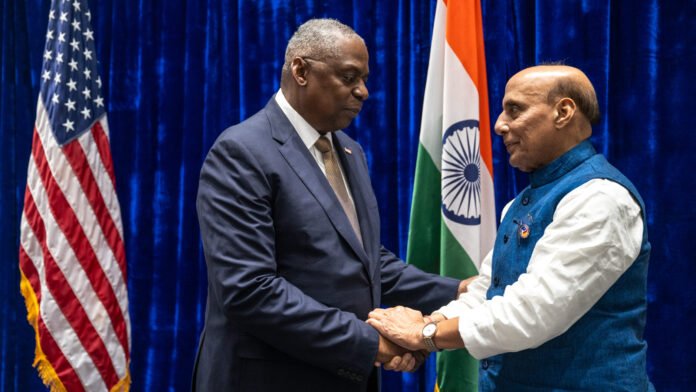
File photo: Rajnath Singh, right, with then U.S. Defence Secretary Lloyd Austin in Vientiane on November 21, 2024, not the October 2026 SCO meeting. Credit: Tech. Sgt. Jack Sanders / U.S. Secretary of Defense, via Wikimedia Commons. CC BY 2.0. Cropped and resized.
Sources
- Ministry of Defence via PIB: 25th SCO Council of Heads of Government meeting
- Ministry of Defence via PIB: India’s delegation and the meeting’s economic agenda
- The Indian Express: Rajnath Singh calls for dismantling the terror ecosystem at SCO
- Akashvani News: Singh meets Tajikistan’s prime minister on SCO sidelines

The National Desk covers India's politics, governance, security and public-interest news. Stories are checked against at least two credible sources before publication.