October 20: South Korea warned of a firm response if North Korea carries out threatened new military measures along the border, while Seoul’s unification ministry separately urged communication to reduce the risk of clashes. The two messages show the distinction between deterrence and diplomacy as tensions rise around the Military Demarcation Line, or MDL.
Key highlights
- Reuters reported Seoul’s response to threats of more tactical weapons and renewed loudspeaker broadcasts.
- Yonhap reported a separate appeal for dialogue and a border-management communication system.
- Kim Yo Jong’s warning followed a dispute over South Korean warning shots and broadcasts.
- A threatened deployment should not be reported as completed without further confirmation.
The military warning
Reuters, carried by CNA on October 20, reported that South Korea’s defence ministry expressed concern about Pyongyang’s proposed additional tactical strike weapons and possible resumption of loudspeaker broadcasts. Seoul described its own warning shots and broadcasts as defensive steps intended to make North Korean troops withdraw after crossing the MDL.
The same report says Kim Yo Jong accused the South of endangering North Korean soldiers working on border fortifications. These accounts reflect conflicting positions. This article does not independently establish the circumstances of each crossing or endorse either side’s description of responsibility.
The parallel request for communication
In a separate October 20 report, Yonhap said Seoul’s unification ministry called on North Korea to refrain from escalating tensions and respond to efforts to resolve disagreements over the MDL. The ministry argued for reconciling positions on the line and establishing a system for peaceful management.
That matters because a military warning and a request for talks are not mutually exclusive. One communicates the possible cost of an action; the other seeks a way to prevent the disputed action or a misunderstanding from becoming a confrontation. Neither, by itself, establishes that the other side will comply.
What is known, and what is not
| Issue | What published reports establish | What they do not establish |
|---|---|---|
| Additional weapons | North Korea threatened further measures | Independent confirmation of a completed new deployment |
| Warning shots | Seoul described defensive responses to crossings | A neutral reconstruction of every border encounter |
| Dialogue | Seoul called for communication | Agreement by Pyongyang to a new mechanism |
| Loudspeakers | Renewal was threatened | Confirmation that broadcasts have resumed |
Table compiled from Reuters/CNA and Yonhap reporting available on October 20. It distinguishes statements, threats and verified actions.
Why careful language matters
The MDL and the wider demilitarised area are not interchangeable labels for every point in a border report. When an account refers specifically to crossing the line, readers should preserve that distinction rather than expand it into a claim about an invasion or a wider offensive.
Likewise, a warning about tactical weapons does not identify a particular weapon’s location, readiness or intended use unless the source provides those details. Public threats can raise concern without allowing an observer to infer an undisclosed operational plan.
The regional significance
For readers elsewhere in Asia, the immediate issue is the risk that competing accounts and warning measures could narrow the room for de-escalation. A functioning communication channel would be meaningful because it could help clarify incidents before public rhetoric hardens further. That is an explanation of the diplomatic purpose, not a prediction that a new arrangement is imminent.
The Press of Asia has not reported from the border or independently inspected military positions. This article relies on the named news organisations’ accounts of official statements.
What to watch
Watch for a documented response to the dialogue request and confirmation of any actual change in deployment or broadcasting. New actions should be distinguished from repeated threats, and any reported incident should be checked for its exact place, date and source before being presented as a fresh escalation.
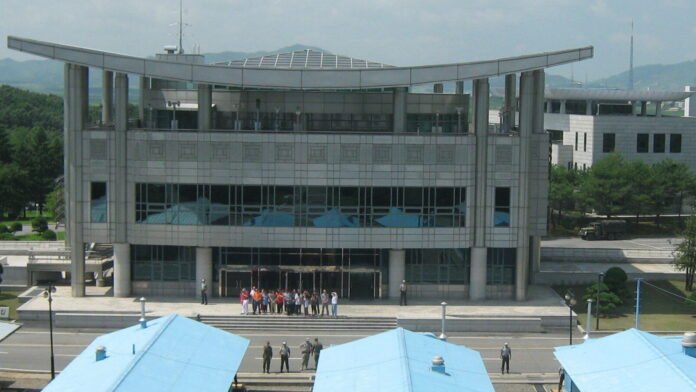
File photo: The Joint Security Area in the Korean Demilitarized Zone, looking south, on July 26, 2012. This does not show the October 2026 incidents. Credit: Jack Upland, via Wikimedia Commons. CC BY-SA 3.0. Cropped and resized.
Sources
- Yonhap: Unification ministry urges North Korea to halt violations and respond to dialogue
- Reuters via CNA: Seoul responds to North Korea’s threatened border measures

The International Desk covers world and Asian affairs, diplomacy and conflict, with a focus on what they mean for India. Stories are checked against at least two credible sources before publication.