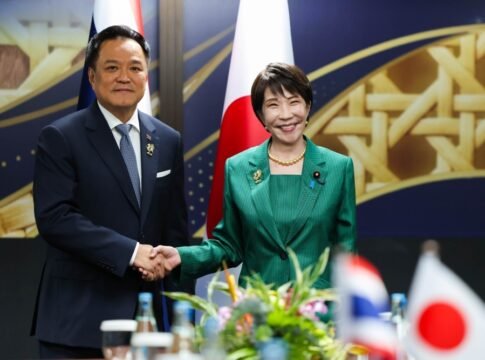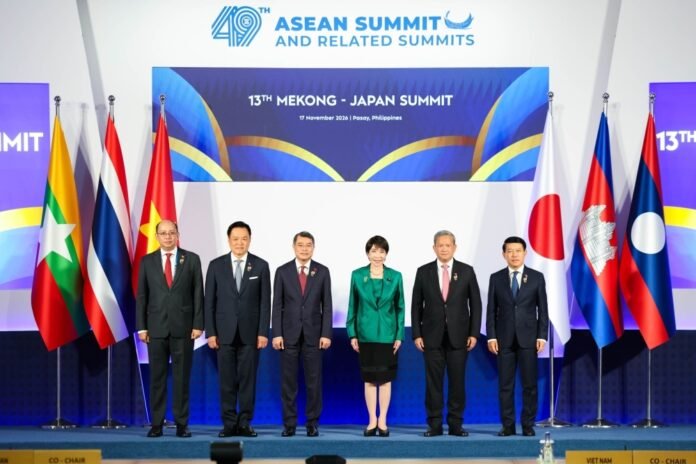
November 17: The Mekong–Japan leaders’ summit resumed in Manila on November 17, putting supply chains, digital connectivity and cross-border crime on the regional agenda. Vietnam’s government said the meeting returned after a six-year gap, while Japan’s foreign ministry confirmed Cambodia would succeed Vietnam as the Mekong co-chair.
Key highlights
- Japan and Vietnam co-chaired the 13th summit in Manila.
- Vietnam proposed a smart supply-chain initiative; a proposal is not a funded project.
- Japan highlighted cooperation against organised fraud and cybersecurity threats.
What the leaders discussed
Japan’s Ministry of Foreign Affairs said Prime Minister Sanae Takaichi and Vietnamese Prime Minister Le Minh Hung led the meeting. Japan outlined cooperation on reliable energy supplies, digital technology and more resilient supply chains.
The ministry also identified organised fraud, natural disasters and cybersecurity as problems that cross national borders. Japan said diplomatic and police authorities would cooperate more closely against organised fraud. These were stated priorities, rather than an announcement that a particular criminal network had been dismantled.
Vietnam’s supply-chain proposal
Vietnam’s government reported that Le Minh Hung proposed a Mekong–Japan Smart Supply Chain Initiative. Its account also highlighted artificial intelligence, digital connections and cooperation on water resources and disaster forecasting.
The Vietnamese account places the summit within a cooperation framework established in 2008 between Japan and five Mekong countries. It said Cambodia would take the regional co-chair role in 2027. The announcement does not by itself provide a delivery timetable or a financing agreement for every proposed activity.
Why the agenda crosses borders
Analysis: a supply chain can be interrupted at a border crossing, an electricity connection or a digital system. That makes cooperation between neighbouring governments relevant even when a factory operates within only one country.
The same logic applies to online fraud: an operation may involve victims, communications networks and financial transactions in different jurisdictions. A summit commitment is an opening for coordination, but its effectiveness will depend on subsequent operational work and measurable results.
At a glance
| Issue | What was discussed |
|---|---|
| Trade and industry | Resilient, digitally connected supply chains |
| Public safety | Cooperation against organised fraud |
| Regional coordination | Cambodia succeeds Vietnam as Mekong co-chair |
What to watch
The next test is whether the proposals become specific programmes with participating agencies, budgets and published milestones. Readers should distinguish an initiative proposed at a summit from an agreement that has already begun delivering results.
Sources
- Japan Ministry of Foreign Affairs: 13th Mekong–Japan Summit Meeting
- Vietnam Government News: Prime Minister co-chairs the Mekong–Japan summit

The International Desk covers world and Asian affairs, diplomacy and conflict, with a focus on what they mean for India. Stories are checked against at least two credible sources before publication.