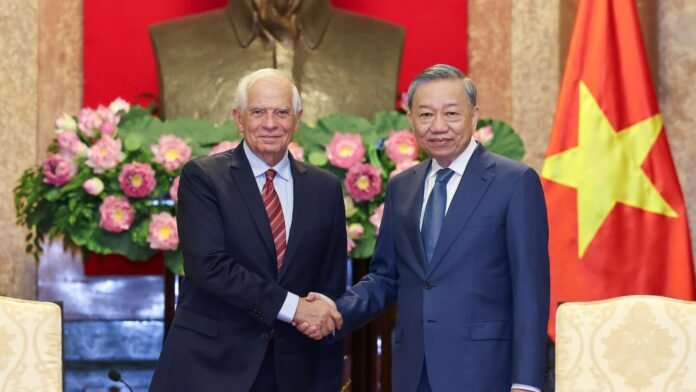
November 17: Chinese President Xi Jinping and Vietnamese leader To Lam met in Shenzhen on November 17 ahead of the APEC leaders’ gathering, with connectivity, energy and artificial intelligence among the priorities in their governments’ accounts. The statements outline areas for cooperation, not a newly completed railway or a final settlement of maritime disputes.
Key highlights
- The leaders met in Shenzhen before the APEC leaders’ meeting.
- China highlighted smart ports and cross-border economic cooperation zones.
- Vietnam’s account emphasised rail and electricity connections and support for hosting APEC in 2027.
What China’s statement says
The Chinese foreign ministry’s account, republished by its embassy in Vanuatu, said Xi called for stronger connections, progress on smart ports and cross-border economic cooperation zones, and cooperation in digital and low-carbon development. He also raised the possibility of collaboration on AI applications.
The same account said the two sides should manage maritime differences and strengthen cooperation. That language acknowledges an issue requiring continued management; it does not establish that their differences have been resolved.
Vietnam’s priorities
Vietnam’s government news service said To Lam discussed transport connections, particularly railways, electricity links and science and technology cooperation. Its account also referred to cooperation on education and Vietnam’s preparations to host APEC in 2027.
China is hosting APEC in 2026, while Vietnam is the next host. Both official accounts therefore connect the bilateral meeting to wider Asia-Pacific economic cooperation. Neither account should be treated as an independent assessment of the other government’s claims.
How to read the announcements
Analysis: border facilities and transport links matter because they can reduce friction between neighbouring production networks. Their real economic effect depends on construction, operating rules, financing and demand—not simply on leaders identifying them as priorities.
AI cooperation is similarly broad. A reference in a diplomatic statement does not specify which technology will be deployed, who will receive access or what safeguards will apply. Those questions need project-level details before businesses can judge the opportunity.
At a glance
| Topic | Status in the statements |
|---|---|
| Smart ports and border zones | Chinese priority for further progress |
| Rail and electricity links | Vietnamese cooperation priorities |
| Maritime issues | Continued management and cooperation |
| APEC | China hosts in 2026; Vietnam follows in 2027 |
What to watch
Watch for detailed transport and energy agreements, implementation schedules and any published project financing. The statements provide a diplomatic direction, while operational commitments must be assessed separately.
Sources
- China Ministry of Foreign Affairs: Xi Jinping meets To Lam
- Vietnam Government News: To Lam holds summit meeting with Xi Jinping

The International Desk covers world and Asian affairs, diplomacy and conflict, with a focus on what they mean for India. Stories are checked against at least two credible sources before publication.