Update (October 17): On September 9, Iran’s Revolutionary Guards said the “prohibited zone” would start roughly near Chabahar and cover part of the Gulf of Oman and the Arabian Sea along the route to Hormuz, with exact coordinates to be announced later. On October 8, Iran and Oman agreed coordinates for Hormuz transit routes (our report). In early October ships were struck in or near the strait almost every day, even as Gulf crude exports recovered towards pre-war levels (our analysis).
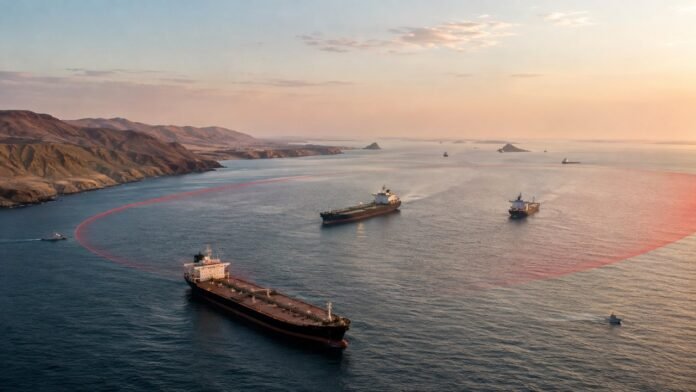
New Delhi/Dubai, September 8: Iran has stepped up its threat to set up a new maritime “exclusion zone” around the Persian Gulf and the Strait of Hormuz. Mohsen Rezaei, secretary of Iran’s Supreme National Security Council, said on Tuesday that economic pressure would be answered with maritime restrictions. The map, legal form and start date of the proposed zone have not been made public, so for now it cannot be treated as an active blockade or a closure of the strait.
Tehran says it will release maps of the restricted area and of a new shipping corridor through Hormuz in the coming days. The threat comes as traffic through the strategic waterway has already fallen sharply because of the war.
Key highlights
- Rezaei repeated on social media the plan for a maritime “exclusion zone” and a changed military posture towards US warships.
- Iran says the zone will extend from the edge of the US blockade into the Persian Gulf.
- According to Rezaei, ships entering the zone could be put on Iran’s sanctions list.
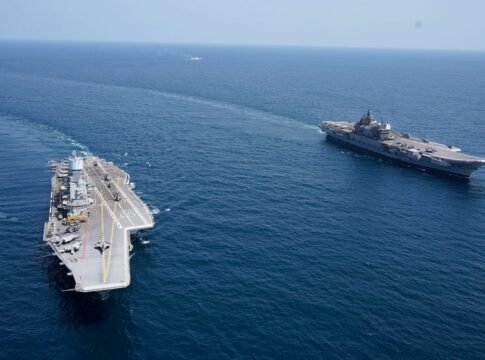
- Iranian state media claimed a Qassem Basir missile was fired at US warships; the US military said its ships evaded the attacks.
- Shipping data showed only about 10 commodity vessels a day passing through Hormuz over ten days, the lowest since May.
What is new
Rezaei told state television on Sunday that the zone would begin where, by Iran’s account, the US blockade begins, and would extend into parts of the Gulf. Any ship entering it would be added to a sanctions list. Tuesday’s message made the same warning sharper in political and military terms. He also said Iran would commit to Hormuz “being open” only once the US stops its attacks and threats.
An exclusion zone is usually an area where one side announces bans on entry, warnings or conditions for action. Iran has not said where the boundaries lie, which ships the rules apply to or what will happen to ships that break them. Until maps and operating rules are issued, shipping companies will find it hard to judge the real risk.
| Claim | Who made it | Status |
|---|---|---|
| A new maritime exclusion zone near Hormuz | Mohsen Rezaei, Supreme National Security Council | Announced; no map, legal form or start date |
| Qassem Basir missile fired at US warships | Iranian state media | Not independently verified |
| US warships evaded the missile attacks | US military | Not independently verified |
| About 10 commodity ships a day through Hormuz | Shipping data cited by | Reported data; lowest since May |
The Qassem Basir claim
Iranian media said an advanced ballistic missile called Qassem Basir was used against US warships. Iran claimed to have “tested” an advanced missile against a US warship, but it was not clear that it was the Qassem Basir. The US military said its warships evaded the missile attacks. Public information does not show that any missile hit a ship or caused damage. The most important confirmed fact is that statements from both sides are raising the risk of a clash at sea.
How far has traffic through Hormuz fallen?
Shipping data showed an average of only about 10 commodity vessels a day through Hormuz over the previous ten days, the lowest since May. Before the war, about a fifth of the world’s oil and liquefied natural gas shipments passed through the strait. With traffic this thin, oil, LNG, freight and marine insurance markets can react quickly to any new warning.
What it means for India
India imports most of its crude oil, and the Gulf is one of its main supply regions. If the proposed restrictions hold up ships further, the immediate effect would not only be on crude prices but also on freight, insurance and delivery times. Higher costs for longer could put pressure on the rupee, the current account and domestic inflation.
That impact is neither certain nor immediate. How much reaches consumers will depend on Indian oil companies’ buying strategy, alternative suppliers, strategic reserves, taxes and retail pricing. For background, see our reports on the US–Iran conflict and its impact on India and the September 7 market report, which recorded the shipping risk premium as a worry for investors.
Why diplomacy has become harder
The threat comes after Iran offered a conditional return to the June ceasefire framework, with no joint announcement of a restored deal. The six-month conflict has been stuck in a cycle of pauses and fresh attacks. On Saturday, US forces struck three Iranian oil tankers, after which Tehran’s language hardened. Iran wants sanctions relief and hopes to charge ships passing through the strait in future, while Washington insists on keeping the waterway open.
What to watch
- The official map of the proposed zone and its start date.
- Shipping advisories, insurers’ terms and the daily number of ships passing through.
- Any verified report of an interception. New missile claims should be treated as fact only with independent evidence or consistent accounts from both sides.
For now, Iran has escalated its threat of new maritime restrictions, but there is no confirmation that Hormuz has been fully closed or that any US warship has been damaged.
This article was first published in Hindi and has been translated. The Press of Asia now publishes in English only.
Sources

The International Desk covers world and Asian affairs, diplomacy and conflict, with a focus on what they mean for India. Stories are checked against at least two credible sources before publication.