
Moscow, September 22, 2026: United Russia, the party aligned with President Vladimir Putin, is on course to control 355 of the 450 seats in Russia’s State Duma, according to preliminary results reported by the Central Election Commission. With more than 95% of ballots counted on September 21, the party had 57.83% of the party-list vote. The figures point to a larger parliamentary majority, but they are not yet the certified final result.
The election took place September 18–20, the first Duma vote since Russia’s full-scale invasion of Ukraine in 2022. The 355-seat projection represents almost four-fifths of the lower chamber. It combines seats allocated from party lists with victories in individual constituencies; 57.83% is the party-list vote share, not its share of all Duma seats.
What the early count shows
The State Duma has 450 seats: 225 are distributed through party-list voting and 225 are decided in single-member districts. The Associated Press reported that United Russia had won 208 district races and was projected to secure 355 seats overall. Reuters, citing the election commission, reported its party-list vote share at 57.83%, compared with 49.8% in the 2021 parliamentary election.
These numbers describe a near-complete count rather than a formally certified allocation. The official totals may be adjusted before final results are announced. A bigger faction would give the Kremlin-aligned party continued capacity to pass legislation in the Duma, but an election result by itself does not announce a new war policy, peace initiative or constitutional change.
Why the conduct of the vote is disputed
Russia’s election took place under restrictions on political opposition and independent media. The European Union said opposition candidates were excluded, including candidates from Yabloko’s federal list, and criticised the absence of an even contest. That is the EU’s assessment; the preliminary figures above are those reported by Russia’s election authorities. Both facts are necessary to understand the result.
The Organization for Security and Co-operation in Europe said in August that Russia had not invited its election observers. As a result, there is no OSCE observation mission providing its own assessment of the September vote. The absence of such a mission should not be mistaken for independent verification of the official count.
Voting in occupied Ukrainian territory
Balloting also took place in Crimea and in Russian-held parts of four other Ukrainian regions. Ukraine and the European Union reject Russia’s claim to those territories. The EU said it would not recognise the election held there or its results, and described voting in occupied territory as contrary to international law. Moscow has treated those areas as part of Russia, a position not internationally recognised by Ukraine and most Western governments.
The disputed territorial vote adds a legal and diplomatic dimension to what is otherwise a domestic parliamentary result. It does not change the internationally recognised borders of Ukraine. For the wider war context, The Press of Asia has reported on recent Russian strikes around Kyiv and the proposed energy truce, as well as planned Zelenskyy–Trump talks in New York.
What happens next?
The next definitive marker is the election commission’s final certified seat allocation. Readers should distinguish the official vote tally from outside assessments of the conditions in which voting occurred. We will update the seat figure if certification differs from the current projection. In the meantime, the near-complete count indicates that United Russia will retain a dominant parliamentary position while scrutiny of the process continues.
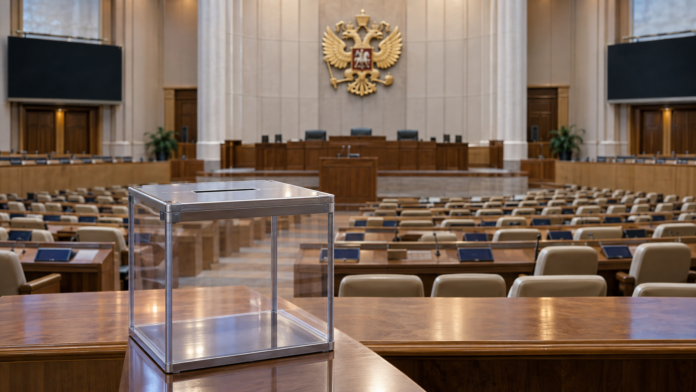
AI-generated editorial illustration | The Press of Asia
Sources / References
- Associated Press, September 21, 2026 — projected seats and election context
- Reuters, September 21, 2026 — commission vote share and seat projection
- OSCE/ODIHR, August 6, 2026 — absence of observer invitation
- Council of the EU, September 21, 2026 — official response to voting conditions and occupied territory