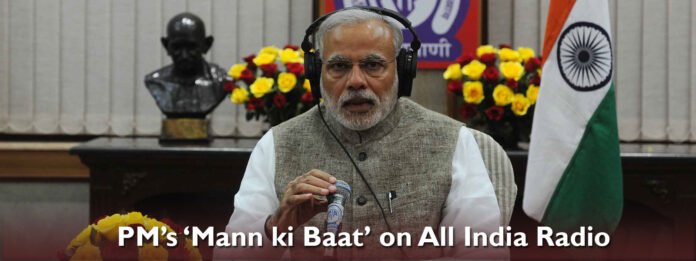
September 27: Prime Minister Narendra Modi used the 138th episode of his monthly radio programme Mann Ki Baat on Sunday to speak about the census, India’s policy against terrorism, Poshan Maah (nutrition month) and young people’s campaign against drugs. Just before the 10th anniversary of the 2016 surgical strikes, he said today’s India follows a “zero-tolerance” policy against terrorism.
Key highlights
- Census: details of 32 crore households have been recorded in the first phase, and 2.6 crore people counted themselves online through self-enumeration.
- Terrorism: he recalled the surgical strikes of September 28-29, 2016, and mentioned Balakot and Operation Sindoor.
- Poshan Maah: he praised initiatives such as Chhattisgarh’s “Har Ghar Munga” campaign and a millet recipe contest in Gujarat.
- Drug-free youth: he praised the pledge against drugs taken by lakhs of young people and asked them to join the campaign in creative ways.
The census as a “collective national duty”
The Prime Minister devoted a large part of the episode to the census. He said details of 32 crore households had been recorded so far in the first phase, and 2.6 crore people had filled in their own details by mobile phone or internet. He called taking part in the census a “collective national duty” and said the reliable data it produces helps in better planning of schemes and welfare programmes, Telangana Today reported.
He gave the example of 83-year-old Purnima Rawat of Mana village in Uttarakhand’s Chamoli district, with whom the count began there. He also mentioned Hardev Singh Rana, who runs a homestay in Bhagori village in Uttarkashi and registered himself digitally. He praised enumerators working in snowbound and remote areas of Ladakh, Himachal Pradesh, Jammu and Kashmir and Uttarakhand.
Useful for you: According to reports, the self-enumeration portal (ec.census.gov.in) is available in 16 languages, including Hindi. It takes about 15-20 minutes, no documents need to be uploaded, and a unique ID is generated on submission. The ID is used when the enumerator visits. Do not share OTPs or bank details in response to suspicious calls or links that use the census name.
Ten years of the surgical strikes: “now zero tolerance”
Ahead of the 10th anniversary of the September 28-29, 2016 surgical strikes on terror launch pads across the Line of Control (LoC), the Prime Minister recalled the operation. He said that earlier, after every terror attack, there were demands for action against Pakistan, but the approach was to wait for time to pass. “Today’s India is following a zero-tolerance policy against terrorism,” he said (translated from Hindi).
Recalling the September 13, 2008 Delhi serial blasts and the 26/11 Mumbai attacks, he cited the surgical strikes, the Balakot air strike and Operation Sindoor as examples of India’s changed strategy. He described the surgical strikes as a major historic success.
| Date | Event | What it was |
|---|---|---|
| September 28-29, 2016 | Surgical strikes | Strikes on terror launch pads across the LoC, after the Uri attack |
| February 26, 2019 | Balakot air strike | Air strike in Pakistan after the Pulwama attack |
| May 7, 2025 | Operation Sindoor | Strikes on terror targets in Pakistan and Pakistan-occupied Kashmir after the Pahalgam attack |
The message came a day after External Affairs Minister S. Jaishankar targeted Pakistan over terrorism at the UN General Assembly (our report on Jaishankar’s UN speech). India also gave a sharp reply at the UN to the Pakistani prime minister’s remarks on Kashmir (read our report). For a longer look at how India’s response to terror attacks has changed, see our analysis.
Poshan Maah: from moringa to millets
“This month of September is dedicated to the fight against malnutrition,” the Prime Minister said (translated from Hindi). He mentioned several initiatives from different parts of the country:
| State | Initiative mentioned |
|---|---|
| Chhattisgarh | “Har Ghar Munga” campaign promoting moringa (drumstick) for nutrition |
| Gujarat | A contest for millet-based recipes in which more than 2 lakh people took part |
| Maharashtra | A joint awareness drive by teachers, anganwadi workers and parents |
| Mizoram | A nutrition-garden campaign linked to the local tradition of selfless service |
He said the effort to promote millets was benefiting farmers as well as nutrition. According to the report, 9 crore beneficiaries are registered on the Poshan Tracker.
The message matters for states such as Maharashtra, where large areas have been declared drought-hit this year because of a weak monsoon. Millets need less water, so they are considered important for both nutrition and farming in dry areas.
Young people’s pledge against drugs
“Lakhs of young people have taken a very important pledge against drugs,” the Prime Minister said (translated from Hindi). He praised the participation of MY Bharat volunteers, the National Service Scheme (NSS), school and college students, and social and spiritual organisations in the drug-free youth campaign. He asked young people to carry the campaign forward through creative means such as songs, slogans and street plays.
What to watch
- How many more households use self-enumeration as the first phase of the census continues.
- Official events marking the 10th anniversary of the surgical strikes on September 28-29.
- The next Mann Ki Baat episode, on the last Sunday of October.
What it means
The 138th episode joined two kinds of themes: a message of security and national resolve, and topics such as the census, nutrition and drug prevention, whose success depends on ordinary people taking part. The long passage on the census shows the government wants digital self-enumeration to succeed at scale. Public trust and the security of the data will both matter for that.
This article was first published in Hindi and has been translated. The Press of Asia now publishes in English only.

The National Desk covers India's politics, governance, security and public-interest news. Stories are checked against at least two credible sources before publication.