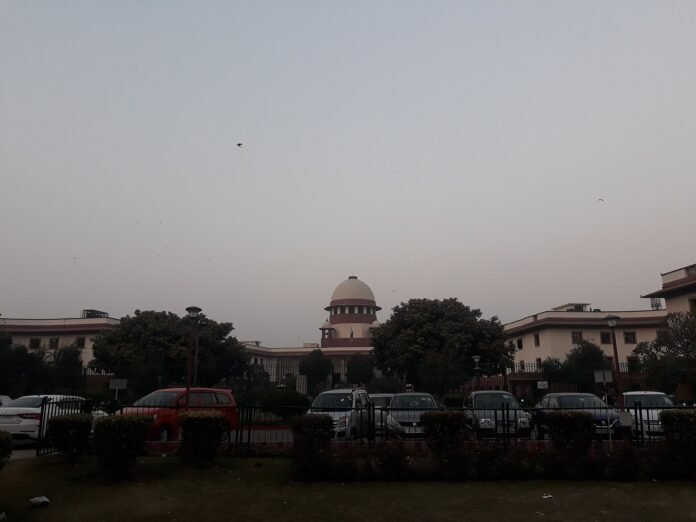
New Delhi, September 28: The Supreme Court on Monday declined to put on hold the new Merchant Discount Rate (MDR) on high-value UPI payments, but asked the Centre, the Reserve Bank of India (RBI) and the National Payments Corporation of India (NPCI) to explain the legal basis for the charge. The 0.4% fee on merchant payments above Rs 2,000 is due to take effect on October 15.
Key highlights
- No stay: The court refused an interim stay, so the October 15 rollout is not blocked for now.
- Notices issued: The Centre, RBI and NPCI have been asked to respond. The Week reports they must file an affidavit on the factual basis for the charge.
- Bench: Chief Justice Surya Kant with Justices Joymalya Bagchi and V Mohana.
- Key question: The bench asked whether the MDR is a tax, a fee or something else, and on what executive authority it is being levied.
- Government’s stand: The Additional Solicitor General said it is neither a tax nor a fee, but a settlement charge among payment players.
What happened in court
The petition, filed by advocate Anjan Datta according to The Week, challenges the decision to start levying MDR on person-to-merchant UPI payments above Rs 2,000. When the matter came up on Monday, the bench pressed the government on the character of the charge. “If not a fee, what is the executive basis for making this expropriation?” the court asked, as reported by The Week.
Appearing for the Centre, Additional Solicitor General N Venkataraman told the court: “It’s not a tax or a fee.” According to Business Today, he described it as a settlement fee among the players in the payment chain, facilitated by NPCI, and said the government earns no revenue from it. He compared it with the costs merchants already bear on debit and credit card transactions.
Justice Bagchi was not fully persuaded. “It’s not a fee, then what is the character?” he asked, Business Today reported. The bench declined to stay the rollout at this stage, issued notices and sought the authorities’ reply before taking the matter further. The reports did not mention a date for the next hearing.
What the new UPI charge is
The charge was announced earlier this month (see our explainer). Its main features, as reported:
- A 0.4% MDR on person-to-merchant (P2M) UPI payments above Rs 2,000, paid by the merchant, not the customer.
- A cap of Rs 300 per transaction, which Business Today says applies to payments of Rs 75,000 and above.
- A flat Rs 5 per transaction for specified essential sectors such as railways, telecom, insurance, fuel and agricultural inputs.
- A 0.02% rate on investment-related payments, also capped at Rs 300, according to Business Today.
- Person-to-person transfers and merchant payments up to Rs 2,000 remain free. The Week reports the charge applies to merchants with monthly receipts above Rs 1 lakh, and that about 96% of transactions fall below the Rs 2,000 threshold.
Why the case matters
Merchant UPI payments have carried no MDR since January 2020, when the government mandated zero charges on UPI and RuPay debit card transactions to push digital payments. That zero-cost model helped make UPI the default way Indians pay, from street vendors to large retailers. The court’s question about the “executive basis” for the new charge goes to the heart of the challenge: whether a levy of this kind can be introduced without clearer legal backing.
For most small shopkeepers the change will matter little, because everyday UPI payments are mostly below Rs 2,000. The bigger impact is on retailers, service providers and online sellers who routinely accept larger payments. Some of them may try to recover the cost through higher prices.
What happens next
With no stay in place, the charge remains on track to start on October 15 unless the court orders otherwise after hearing the government, RBI and NPCI. Merchants should plan on that basis while the legal challenge continues. We will update this story as the case progresses.
Sources
- Business Today: MDR on UPI over Rs 2000: SC refuses stay; issues notices to govt, RBI, NPCI
- The Week: ‘Is it a tax or fee?’ SC asks Centre to explain MDR on UPI payments

The Business Desk covers markets, the economy, companies and personal finance. Stories are checked against at least two credible sources before publication.