October 3: Protests demanding the resignation of Chief Election Commissioner (CEC) Gyanesh Kumar were held in Delhi and Mumbai on Gandhi Jayanti. In Delhi, police detained hundreds of protesters heading for Jantar Mantar, including former chief minister Atishi. At Mumbai’s Shivaji Park, the Cockroach Janta Party (CJP) held a “Jail Bharo” (fill the jails) protest. CJP founder Abhijeet Dipke said there would be another protest in Delhi if the CEC had not resigned by October 10. The Election Commission has already rejected the allegations about the voter rolls.
Follow-up (October 5): Uddhav and Raj Thackeray led a “Virat Garjana Morcha” in Mumbai, and the opposition planned a march to the Election Commission in Delhi on October 6. Read: the Thackeray cousins’ march.
Later (October 10): On the CJP’s deadline day, Dipke was detained on board a plane and hundreds were detained in Delhi: our report.
Key highlights
- Delhi: According to Outlook, protesters said more than 600 people had been detained by the afternoon, while police officials later put the number at about 700.
- Restrictions: Section 163 of the Bharatiya Nagarik Suraksha Sanhita was in force around Jantar Mantar, and several metro stations were closed.
- Mumbai: Police had refused permission for a protest at Shivaji Park, but large numbers gathered anyway.
- Deadline: Dipke announced “Jantar Mantar 2.0” for October 10.
- The Commission’s side: the Election Commission says all decisions, including on the SIR, were taken unanimously by the three commissioners.
What happened in Delhi
Delhi Police had not given permission for a protest at Jantar Mantar. Under Section 163, gatherings of five or more people, processions and sit-ins were banned. According to an Outlook reporter, personnel of the Delhi Police, the Rapid Action Force and the CRPF had sealed the roads, and buses stood ready to take away those detained. A police officer told the magazine the protesters had no permission and that more than 1,000 security personnel were deployed.
| Measure | Figure | Source |
|---|---|---|
| Detained (protesters’ figure, by afternoon) | More than 600 | Outlook |
| Detained (police officials, later) | About 700 | Outlook |
| Detained by 3 pm | More than 500 | Public record |
| Security personnel deployed | More than 1,000 | Police officer, via Outlook |
| Metro stations closed | At least 11 to 12 | Reports differ |
Those detained included former chief minister Atishi, AAP’s Saurabh Bharadwaj, activist Yogendra Yadav, RJD MP Manoj Jha and AISA president Neha Bora. Outlook also named AAP MP Sanjay Singh. Student groups such as AISA, SFI and NSUI, civil society groups and AAP and Congress workers took part. According to Outlook, internet services in the area were also cut for several hours. The available reports did not make clear when those detained were released.
The CJP’s “Jail Bharo” in Mumbai
Mumbai Police refused permission for the protest, citing a 2013 Bombay High Court order and Shivaji Park’s status as a silence zone. The CJP then turned it into a “Jail Bharo” protest. Barricades were put up outside the park and a heavy police force was deployed.
Actors Naseeruddin Shah and Shabana Azmi, singer Vishal Dadlani, Mahatma Gandhi’s great-grandson Tushar Gandhi and representatives of the Shiv Sena (UBT) and the MNS joined the protest. Before it began, Dipke was briefly detained on Marine Drive and later released.
Dipke said the CEC had until October 10. On that day, he said, supporters from across the country would reach Delhi, and if police stopped them from going to Jantar Mantar they would protest wherever they were stopped. The CJP’s Saurav Das said the movement would end only when Gyanesh Kumar resigned.
The protesters’ demands
- The resignation of Chief Election Commissioner Gyanesh Kumar and a criminal case against him.
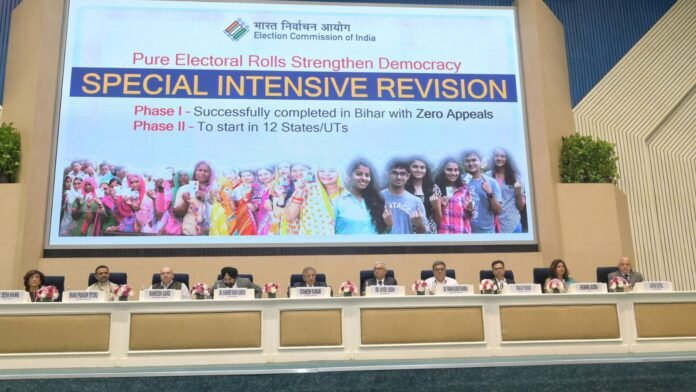
- An investigation into alleged irregularities in the Special Intensive Revision (SIR) of voter rolls, and a halt to the process.
- Withdrawal of the 2023 law on appointing election commissioners and a transparent appointment process.
What lies behind the dispute
The allegation is that Election Commissioners Sukhbir Singh Sandhu and Vivek Joshi objected at least 14 times in 10 months that some decisions, especially on the SIR, were taken without their knowledge. Critics allege that the process removed lakhs of eligible voters from the rolls. These are allegations, and the Election Commission does not accept them.
The Election Commission has rejected the claims. It says the three-member Commission took all decisions, including on the SIR, unanimously. We reported the Commission’s response on September 26.
What to watch
- October 4: a march in Mumbai by the MNS and the Shiv Sena (UBT).
- October 6: a protest by the Congress over the CEC’s resignation.
- October 10: the CJP’s march on Delhi if the CEC has not resigned by then.
- Other states: the CJP has said it will also protest in Goa, Karnataka, West Bengal, Uttar Pradesh, Bihar and Jharkhand.
What it means
The Gandhi Jayanti protests showed both the reach of the movement against the CEC and the authorities’ determination to keep it away from Jantar Mantar. With hundreds detained in Delhi, a defiant gathering in Mumbai and a fresh deadline of October 10, the dispute over the voter-roll revision has moved firmly onto the streets, while the Commission maintains its decisions were unanimous.
This article was first published in Hindi and has been translated. The Press of Asia now publishes in English only.

The National Desk covers India's politics, governance, security and public-interest news. Stories are checked against at least two credible sources before publication.