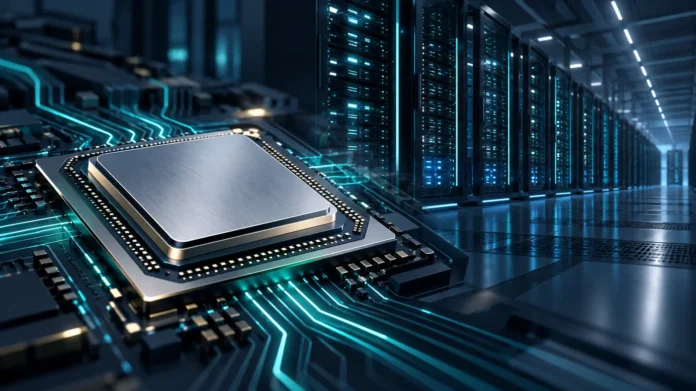
October 13, 2026: Microsoft has introduced Maia 300, the next generation of its custom AI inference system, and announced plans to expand Azure Maia to deployments measured in multiple gigawatts from 2027. The company says Maia will become the primary inference system for its own products and services.
The October 12 announcement by cloud and AI executive Scott Guthrie separates a system already in use from one still to come: Maia 200 is serving production workloads, including Microsoft Copilot; Maia 300 production deployments are planned for 2027.
What Microsoft is claiming
Microsoft expects Maia 300 to deliver 40% more tokens per megawatt than leading GPU-based systems. In a complete configuration containing 96 accelerators, it says the system can provide up to seven times Maia 200’s rack-scale token throughput.
These are company performance claims, not independent test results presented by The Press of Asia. The two comparisons also use different baselines: one refers to GPU-based systems, while the other refers to Maia 200. They should not be combined into a single universal speed-up figure.
Why memory and networking matter
Microsoft’s architecture explanation describes Maia 300 as a platform spanning chips, servers, racks and networking. Its design is aimed at inference workloads such as lengthy reasoning tasks and AI agents that perform multiple steps.
The company describes a chiplet design that separates functions including compute, memory control and input/output. Compute chiplets use TSMC’s N2P process. Eight HBM4 memory stacks provide a stated peak bandwidth of 18 terabytes per second within a 950-watt thermal design power.
Those specifications help explain the emphasis on moving data efficiently. A model needs to access its parameters and working context repeatedly; faster arithmetic alone does not remove every bottleneck. This is an explanation of the design trade-off, not a prediction that every application will achieve the advertised performance.
Inference is different from training
Inference is the work performed when a deployed model generates an answer or completes a task. Training is the process used to build or update the model. Microsoft’s announcement focuses on inference; it should not be read as a claim that Maia 300 will replace all hardware used to train AI models.
Microsoft’s earlier fiscal second-quarter earnings discussion described a fleet containing Nvidia, AMD and Maia hardware. The new announcement makes Maia more central to Microsoft’s own services but does not establish that those suppliers have been eliminated.
What customers should watch
The remaining tests are practical: whether production deployment arrives on schedule, which services run on the system and how efficiency holds up across different models and workloads. Tokens-per-watt measures computing output against power use; it does not measure answer accuracy or user satisfaction.
Microsoft has not, in the announcements cited here, promised a specific across-the-board reduction in customer prices. Better infrastructure efficiency may improve service economics, but pricing and real-world performance remain separate questions.

The Tech Desk covers technology, artificial intelligence and cybersecurity. Stories are checked against at least two credible sources before publication.