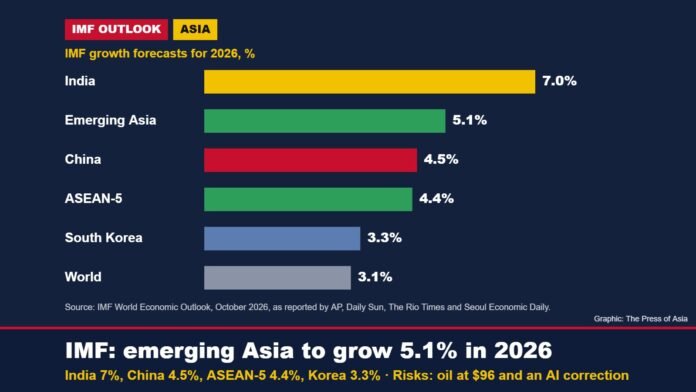
October 14: The International Monetary Fund expects emerging and developing Asia to grow 5.1% in 2026, well ahead of the world economy’s 3.1%, according to its latest World Economic Outlook, released on Tuesday at the IMF and World Bank annual meetings in Bangkok. The Fund raised its forecasts for India, the ASEAN-5 and South Korea, and trimmed China’s slightly, while warning that high oil prices, rising bond yields and a possible correction in AI-related stocks could knock growth off course.
Key highlights
- World growth is forecast at 3.1% in 2026, up from 3.0% in July, and 3.4% in 2027, AP reported.
- China is expected to grow 4.5% in 2026, down 0.1 point from July, and 4.0% in 2027.
- India’s 2026 forecast was raised to 7.0% from 6.4%, keeping it the fastest-growing major economy. We covered the India numbers here: IMF raises India growth forecast to 7%.
- The ASEAN-5 (Indonesia, Malaysia, the Philippines, Singapore and Thailand) was raised to 4.4% from 4.1%, and South Korea to 3.3% from 2.6%.
- The forecasts assume oil averages $96 a barrel in 2026, about 41% higher than last year, and that shipments through the Strait of Hormuz resume by March, AP reported.
The Asian numbers in one table
| Economy | 2026 forecast | Change from previous forecast | 2027 forecast | Source |
|---|---|---|---|---|
| World | 3.1% | +0.1 (from 3.0% in July) | 3.4% | AP; Daily Sun |
| Emerging and developing Asia | 5.1% | Not reported | Not reported | The Rio Times |
| India | 7.0% | +0.6 (from 6.4%) | 7.0% | Daily Sun; The Rio Times |
| China | 4.5% | −0.1 (from 4.6%) | 4.0% | Daily Sun; The Rio Times |
| ASEAN-5 | 4.4% | +0.3 (from 4.1%) | Not reported | Daily Sun |
| South Korea | 3.3% | +0.7 (from 2.6%) | Not reported | Seoul Economic Daily |
| United States (for comparison) | 2.3% | — | 2.3% | AP |
| Euro area (for comparison) | 1.1% | — | 1.2% | AP |
By our calculation, emerging and developing Asia is forecast to grow 2 percentage points faster than the world economy this year, and India 2.5 points faster than China. Of the Asian revisions in the table, three were upgrades and one, China’s, a small downgrade.
Why the Fund is more upbeat on parts of Asia
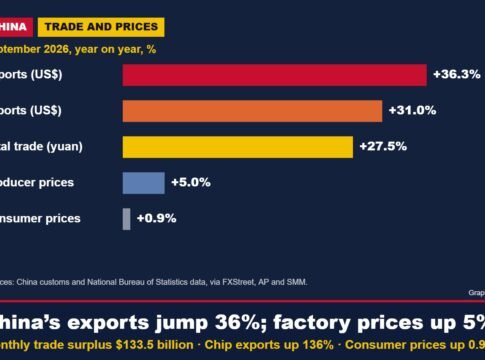
The IMF says the AI boom is offsetting some of the damage from high energy prices, but its benefits are uneven: the United States and China account for more than three-quarters of net demand for AI-related chip imports, AP reported. South Korea’s upgrade reflects strength in chips, Seoul Economic Daily reported, adding that the IMF advised Seoul to save chip-boom tax revenue to build fiscal room for a future crisis rather than spend it immediately. For China, the Fund expects growth to slow from 5% in 2025, with higher oil prices worsening weak domestic demand, according to The Rio Times.
“The outlook is highly uneven,” IMF research director Silvana Tenreyro told reporters in Bangkok, AP reported. IMF managing director Kristalina Georgieva described AI’s effect on jobs as “a slow moving tsunami, but a tsunami nonetheless”.
What could go wrong
| Risk | What the IMF or its officials said | Source |
|---|---|---|
| Oil and energy | Forecasts assume oil at $96 a barrel on average in 2026 and Hormuz shipments resuming by March | AP |
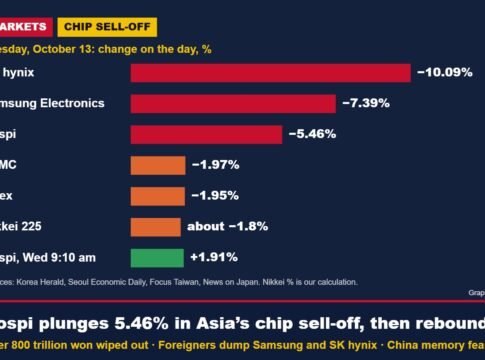
| AI-related stocks | A correction is a risk; South Korea’s Kospi fell as much as 7% on Tuesday before closing 5.5% lower | AP |
| Bond yields and debt | Rising yields and high borrowing costs; countries urged to strengthen public finances | AP |
| Cyber threats | Could disrupt financial systems, deputy director Athanasios Vamvakidis said | AP |
| Middle East and Central Asia | The region is expected to contract in 2026 before growing 6.3% in 2027 | AP |
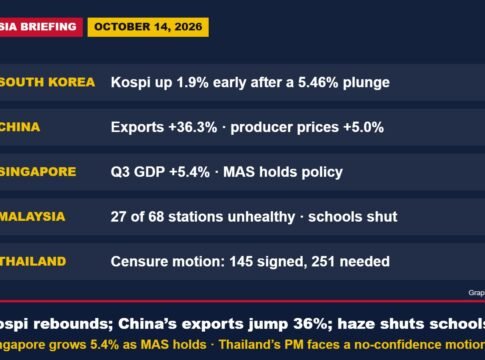
The warning about AI stocks came on the same day Asian markets sold off. South Korea’s Kospi, heavily weighted towards memory-chip makers, closed down 5.46%, and Taiwan’s main index fell 1.95%, as investors questioned how long the AI rally can last.
What to watch
- The IMF’s regional outlook for Asia and the Pacific, which gives country-by-country detail.
- Oil prices and shipping through the Strait of Hormuz, the biggest assumption behind the forecasts.
- China’s third-quarter GDP figures, due later in October, against the IMF’s 4.5% forecast.
- Whether the chip-stock sell-off in Seoul and Taipei turns into a wider correction.
What it means
Asia is still where most of the world’s growth comes from, and the IMF is more optimistic about India, Southeast Asia and South Korea than it was three months ago. But the region’s gains rest on two things it does not control: the price of oil and the durability of the AI investment boom. The day the forecasts came out, the second of those was already being tested in Seoul and Taipei.
Sources
- AP, via ABC News: IMF raises its forecast for world growth this year but warns of risks from AI boom and debt
- Daily Sun: India, ASEAN growth revised up in IMF’s latest world outlook
- The Rio Times: Asia Intelligence Brief, Tuesday, October 13, 2026
- Seoul Economic Daily: KOSPI barely holds 6,000 in warning on chip dependence
- CGTN: IMF raises global growth forecast: China’s wider contribution
- Focus Taiwan: Taiex plunges 960 points as tech stocks hit by heavy U.S. losses

The Business Desk covers markets, the economy, companies and personal finance. Stories are checked against at least two credible sources before publication.