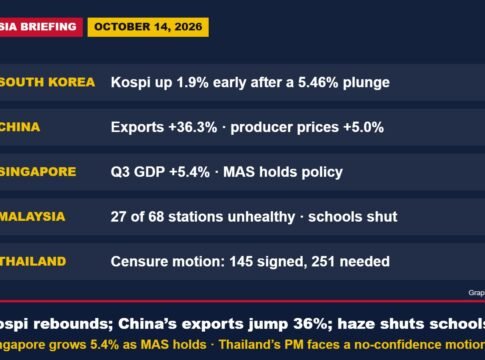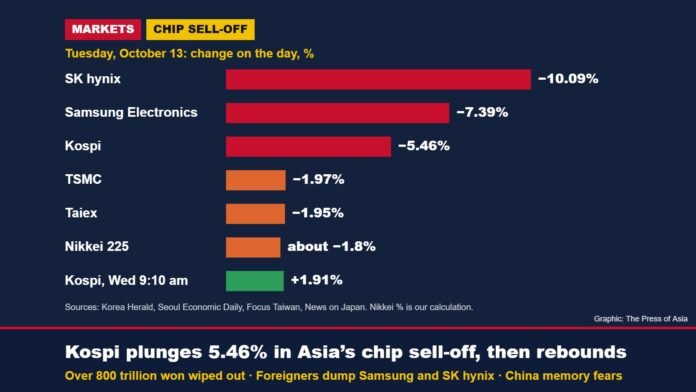
October 14: South Korea’s Kospi rebounded in early trade on Wednesday after a 5.46% plunge on Tuesday that wiped more than 800 trillion won (about $595.5 billion) off the market’s value, as a sell-off in chip stocks spread across Asia. The Kospi closed at 6,035.35 on Tuesday after briefly falling below 6,000, triggering a sell-side sidecar for the first time in nearly two months, the Korea Herald reported. Taiwan’s Taiex fell 1.95% and Japan’s Nikkei 225 about 1.8%. Investors were reacting to worries that Chinese memory-chip maker ChangXin Memory Technologies (CXMT) is closing the gap with Korean rivals, weakness in US chip stocks and doubts about how long the AI rally can last.
Key highlights
- Samsung Electronics fell 7.39% and SK hynix 10.09% on Tuesday, the Korea Herald reported.
- Foreign investors were heavy sellers: the Korea Herald put Tuesday’s net selling at 2.2 trillion won, while Seoul Economic Daily reported 4.53 trillion won.
- The Kospi has lost 13.83% over five sessions from October 6, Seoul Economic Daily reported, after trading above 7,000.
- In Taipei, foreign institutional investors sold a net NT$165.34 billion of shares, the third-largest net sale on record, Focus Taiwan reported.
- On Wednesday the Kospi rose 1.91% to 6,150.70 at 9:10 am, with Samsung up 3.23% and SK hynix up 2.63%, and foreign investors were small net buyers in early trade.
Tuesday’s damage across Asia
| Market or stock | Close on October 13 | Change | Source |
|---|---|---|---|
| Kospi (Seoul) | 6,035.35 | −5.46% (about −349 points, our calculation) | Korea Herald |
| Kosdaq (Seoul) | 837.03 | −1.43% | Korea Herald |
| Samsung Electronics | 232,000 won | −7.39% | Korea Herald; Sunday Guardian |
| SK hynix | 1,443,000 won | −10.09% | Korea Herald; Sunday Guardian |
| Taiex (Taipei) | 48,341.31 | −960.65 points (−1.95%) | Focus Taiwan |
| TSMC | NT$2,490 | −1.97% | Focus Taiwan |
| Nikkei 225 (Tokyo) | About 67,778 | −1,253 points (about −1.8%, our calculation) | News on Japan |
| Topix (Tokyo) | 4,110.67 | +5.86 points | News on Japan |
The pattern was the same everywhere: the biggest falls were in memory and chip-equipment stocks, while the broader market held up better. In Tokyo, the Topix index actually rose as money moved into banks, insurers and other value stocks, and the selling was concentrated in a narrow group of high-priced Nikkei components such as Advantest and Tokyo Electron, News on Japan reported. In Taipei, TSMC alone accounted for about 400 points of the Taiex’s fall; it makes up more than 40% of the market’s value, Focus Taiwan reported.
Why chip stocks fell
- China’s memory push: CXMT reportedly plans server DDR5 chips with a more compact cell design by the end of the year, raising concern that it could squeeze the margins of Samsung and SK hynix, the Korea Herald and Seoul Economic Daily reported.
- Wall Street: Overnight, the Philadelphia Semiconductor Index fell 2.67%, Nvidia 1.3% and Micron 3.9%, the Korea Herald reported.
- AI doubts: Investors are questioning how long AI-related profits can last if competition rises and funding costs stay high; Broadcom’s chief executive compared the AI boom to a casino, investingLive reported.
- Rates and oil: Higher interest rates, oil near $106 a barrel and geopolitical tension added pressure, though analysts told the Korea Herald these alone could not explain the scale of the outflows.
“The outflows are too large to be attributed solely to portfolio rebalancing after the rally,” Heo Jae-hwan of Eugene Investment & Securities told the Korea Herald, adding that foreign selling pressure in Korea was more than three times as intense as in Taiwan relative to market size. In Taipei, Adam Lin of Moore Securities said: “The expanded turnover showed that investors appeared to be panicking and scrambling to trim their positions,” Focus Taiwan reported.
The foreign money leaving Seoul
| Period | Net foreign selling of Korean shares | Source |
|---|---|---|
| Tuesday, October 13 | 2.2 trillion won (Korea Herald) / 4.53 trillion won (Seoul Economic Daily) | Reports differ |
| October so far | Nearly 8 trillion won | Korea Herald |
| September | 21.5 trillion won | Korea Herald |
| First half of 2026 | About 177 trillion won | Korea Herald |
| 2026 to date | 199 trillion won | Korea Herald |
The two Tuesday figures may measure different things, such as the main board alone or including other trades; neither report explained the difference. Even after the sell-off, the Kospi was up about 51% this year as of Monday’s close, and Taiwan’s market more than 70%, the Korea Herald reported. Samsung Electronics had just reported record third-quarter operating profit of more than 107 trillion won, Seoul Economic Daily noted.
Wednesday’s rebound
| Measure | Wednesday morning, October 14 | Tuesday close |
|---|---|---|
| Kospi | 6,150.70 (+1.91%) at 9:10 am | 6,035.35 (−5.46%) |
| Samsung Electronics | 239,500 won (+3.23%) | 232,000 won (−7.39%) |
| SK hynix | 1,481,000 won (+2.63%) | 1,443,000 won (−10.09%) |
| Foreign investors (Kospi, early trade) | Net buyers of 25.2 billion won | Net sellers |
The rebound was helped by bargain-hunting and easing US Treasury yields after New York Fed President John Williams played down the need for more rate rises, Seoul Economic Daily reported. The Sunday Guardian reported later in the morning that the Kospi gave back much of its early gains as foreign selling continued. “For a genuine recovery, the view on memory has to change,” Heo of Eugene Investment & Securities said. Our earlier report on Tuesday morning’s fall: Kospi falls 4% in early trade.
What to watch
- Whether foreign investors return to Korean chip stocks or keep selling.
- US September inflation data and third-quarter results from major chipmakers, which Seoul Economic Daily named as the next tests.
- CXMT’s product launch and any sign that Chinese memory chips are winning server customers.
- The Kospi’s 200-day moving average, which Kiwoom Securities analyst Han Ji-young called key technical support.
What it means
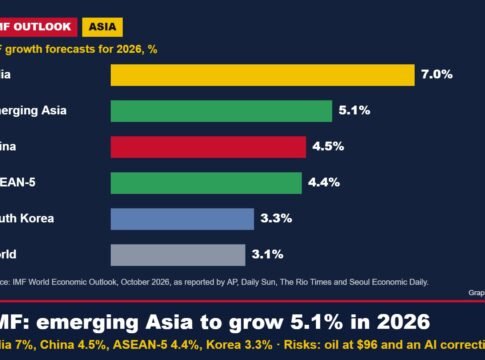
This was not a crash in Korea’s economy, which the IMF has just upgraded to 3.3% growth this year, but a crowded trade unwinding. Seoul’s market depends heavily on two memory makers, and foreign funds that rode the AI rally are now taking money off the table on any hint that Chinese competition or a slowdown in AI spending could hurt margins. Wednesday’s bounce shows buyers are still there; whether the sell-off is over depends on whether the story about memory chips changes. More on the IMF’s Asian forecasts: our table.
Sources
- The Korea Herald: Foreign selloff sends Kospi down 5.5% as chip giants tumble
- Seoul Economic Daily: KOSPI rebounds 1.91% after five-day slide
- Seoul Economic Daily: KOSPI barely holds 6,000 in warning on chip dependence
- Sunday Guardian: KOSPI rebounds 1.8% after 5.46% crash as Samsung Electronics and SK Hynix recover
- Focus Taiwan: Taiex plunges 960 points as tech stocks hit by heavy U.S. losses
- News on Japan: Nikkei falls 1,253 points as AI and chip selloff hits Tokyo
- investingLive: Asia-Pacific market news: Asian equities sold heavily, Kospi down 7%
- KED Global: Kospi tumbles as chip rout deepens, briefly breaking below 6,000

The Business Desk covers markets, the economy, companies and personal finance. Stories are checked against at least two credible sources before publication.