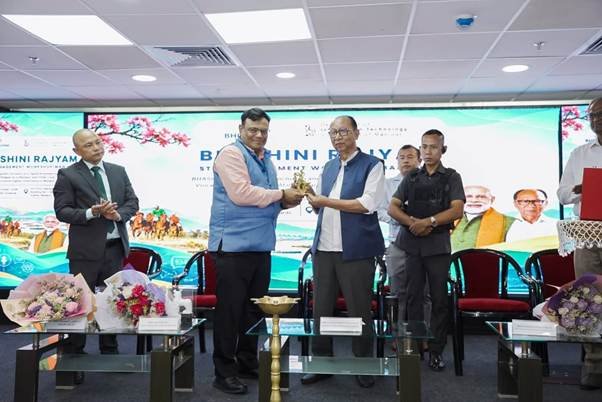
IMPHAL: The Manipur government and the Digital India BHASHINI Division have signed a memorandum of understanding to develop cooperation on language technology and multilingual digital services. The agreement was announced after a BHASHINI Rajyam workshop held in Imphal on October 14, 2026, according to an October 15 government release.
The collaboration will identify priority uses, assess language-data needs and explore integration with government platforms. A live English-to-Manipuri translation demonstration was presented at the workshop. Officials also discussed local expertise and community participation in validating language resources.
What has been announced—and what has not
The Ministry of Electronics and IT announcement describes a partnership and further implementation work. It does not establish a statewide launch date, a published service-by-service rollout schedule or independently measured translation accuracy. The MoU should therefore not be read as confirmation that every public website already supports every language spoken in Manipur.
For residents, the distinction is practical: an announced capability is different from a working service with clear instructions, support and a way to correct mistakes.
How language technology can change a digital service
BHASHINI’s official platform lists services including automatic speech recognition, machine translation, text-to-speech, transliteration and optical character recognition. These address different tasks. A speech-recognition system turns spoken words into text; a translation system changes the language of text; text-to-speech reads written material aloud. Transliteration changes how words are represented in a script and should not be confused with translating their meaning.
Those distinctions help explain why one successful demonstration is not a complete public-service solution. A hypothetical voice-based enquiry may need to recognise a question, understand the relevant service information, translate a response and read it back. Each stage needs checking. This example illustrates a possible workflow; it is not a description of an application already deployed by Manipur under the agreement.
Where local participation fits
Language resources are more than a list of translated words. A usable service needs to handle the way people actually ask questions, pronounce names and describe a problem. Local reviewers can help identify where a fluent-looking answer gives the wrong meaning or uses terminology that residents do not recognise. That is a reason to test with intended users before treating a model as ready for everyday administration.
Separately from the Manipur pact, BHASHINI’s BhashaDaan contribution terms describe ways volunteers can provide prompted voice recordings, transcriptions, translations and labelled images. The terms explain that contributions are intended for language-technology datasets and set conditions on their use. Participation is voluntary; contributors should read the current terms and understand what they are sharing before submitting material.
A contribution platform is not an invitation to upload someone else’s private documents. For an ordinary reader, keeping personal case files, identity details and confidential correspondence out of an experimental translation exercise is a sensible precaution. Testing can begin with public, non-sensitive sample sentences instead.
What developers need to distinguish
BHASHINI’s API documentation explains that integrations may combine speech recognition, translation and speech output, depending on the task. A department adding multilingual support must choose a workflow suited to its users rather than assuming that every tool is interchangeable.
The public Anuvaad translation interface, for example, offers source and target language selection and model-related options. Its existence demonstrates an available translation interface, not proof that a particular Manipur government process has adopted it. Readers should check the responsible department’s own instructions for any official transaction.
Teams could also publish examples of corrected errors and explain which version of a model is in use. That would make user feedback easier to follow over time and help distinguish a temporary demonstration from a maintained public service.
A reader-first test for the eventual rollout
A useful evaluation would start with a simple task: can a resident find the right service, understand the requirements and reach the next step without switching to an unfamiliar language? The test should include unsuccessful attempts as well as completed ones. A system that produces an answer quickly but sends a user to the wrong form has not solved the underlying access problem.
Names, dates, amounts and eligibility conditions deserve particular attention in testing. For consequential applications, residents should compare translated guidance with the authoritative notice or ask the relevant office to clarify an ambiguity. An automatically generated explanation should not be mistaken for a new rule, an approval or a decision on an individual application.
The next useful public updates would identify the first services selected, the languages supported in each, the testing approach and a feedback route. These are editorial benchmarks for assessing progress, not commitments independently confirmed in the announcement. The agreement creates a basis for further work; its value will be clearer when residents can use and evaluate specific services.
Image: BHASHINI Rajyam workshop in Imphal, supplied with the government’s October 15, 2026 release. Credit: Ministry of Electronics and IT / Press Information Bureau. Reproduced with source acknowledgement under PIB’s copyright policy; display resized.

The National Desk covers India's politics, governance, security and public-interest news. Stories are checked against at least two credible sources before publication.