NEW DELHI, October 18, 2026: G7 finance leaders have agreed to tabletop exercises addressing cyberattacks enabled by artificial intelligence, according to Japanese Finance Minister Satsuki Katayama. The plan focuses on rehearsing how financial authorities would respond to disruption, rather than announcing that a particular bank has been attacked.
Reuters’ October 16 report from Bangkok says the minister described approval of work discussed by G7 finance deputies. A Japanese finance ministry official told the agency that simulations would test response protocols and help revise manuals. Private financial institutions could participate depending on the scenario.
What is a tabletop exercise?
Explanation: a tabletop exercise is a structured discussion of how participants would handle a hypothetical incident. It allows them to rehearse decisions, responsibilities and communication without treating the scenario as a real attack in progress.
For example, an illustrative discussion might ask what happens if a critical service becomes unavailable while several authorities receive incomplete information. Who decides whether to isolate a system? Who contacts other jurisdictions? What can customers be told before the cause is established? These examples explain the method; they are not a disclosed G7 scenario.
The value lies in exposing unclear responsibilities before a real crisis. However, a successful discussion is not the same as a successful technical recovery test. Each tests different capabilities, and neither proves that an institution is immune to cyber threats.
How the new plan relates to earlier G7 exercises
The US Treasury’s July 31 account says the G7 Cyber Expert Group completed a cross-border coordination exercise on May 18, 2026. It involved finance ministries, central banks, supervisors and market authorities responding to a simulated attack across G7 jurisdictions.
That work tested improvements in incident response, recovery and crisis communication, building on a 2024 exercise. Treasury also describes a longer-term strategy to make simulations more frequent and consistent.
The May exercise and the newly reported AI-focused plan must therefore be kept separate. One has already taken place; the other is an agreement to conduct further work. Reusing the earlier date as the timetable for the new exercises would misstate the announcement.
Why AI is part of the security discussion
The G7 Cyber Expert Group’s 2025 statement addresses both cybersecurity opportunities and risks from AI, including generative and agentic systems. It calls for monitoring developments and cooperation among authorities, financial institutions, technology firms and researchers.
That is a broader position than saying all AI use is harmful. The policy challenge is to assess changing capabilities while maintaining controls and recovery arrangements. A claim that a model can assist security work does not automatically establish that it can safely be given access to a live financial system.
Why customers should care about operational resilience
The UK Financial Conduct Authority’s resilience guidance explains that disruption can prevent customers accessing accounts or paying bills, with wider consequences for confidence and market functioning. It frames resilience as the capacity to prevent, adapt to, respond to and recover from disruption.
Its guidance expects relevant firms to identify important services, understand vulnerabilities, test their arrangements and prepare communication plans. The FCA also describes 2026 work on frontier AI and cyber resilience. These are UK regulatory expectations and resources, not a statement that identical rules automatically apply to every G7 bank or to Indian institutions.
What a useful exercise should reveal
Our assessment: the most informative result would be evidence that the exercise changed decisions or closed a specific weakness. Counting participants or publishing a general assurance of readiness would tell readers less than a clear account of the lessons and follow-up actions.
A reader assessing future results can ask four practical questions:
- Scope: which services, institutions and authorities were included, and which dependencies were outside the exercise?
- Decision-making: did participants know who could authorise a response when information was incomplete?
- Recovery: was restoration actually tested, or was it only discussed as an assumption?
- Follow-up: were responsibilities and deadlines assigned for changes identified during the exercise?
These are analytical questions, not a description of unpublished G7 assessment criteria. They help distinguish a rehearsal with measurable lessons from a public-relations statement.
What the announcement does not prove
Reuters’ account does not provide a full public timetable, an institution-by-institution participant list or completed results. It does not establish a new loss of customer funds, an ongoing attack on a named bank or a reason for readers to move deposits.
For customers, the immediate relevance is preparation and continuity of essential services. If an actual disruption occurs, use the institution’s established communication channels and verify messages independently; a news story about exercises is not an instruction to share credentials or follow an unfamiliar recovery link.
The next substantive developments would be confirmed exercise arrangements and a credible account of what the simulations demonstrate. Until then, the plan should be reported as preparedness work rather than a guarantee of financial-system safety.
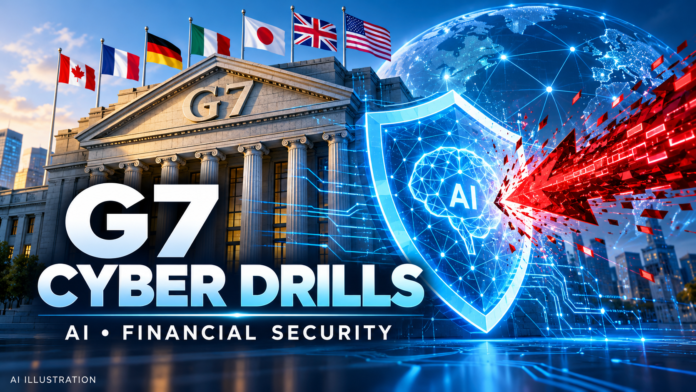
Image disclosure: The G7 bank, shield and threat symbols are an AI-generated conceptual illustration, not a photograph of an attack or a real institution.

The Business Desk covers markets, the economy, companies and personal finance. Stories are checked against at least two credible sources before publication.