October 24: A United Nations climate fund has provisionally set aside $20 million to support Nepal after its devastating August floods, according to reports published on Friday. The allocation is an important step, but it is not evidence that the entire sum has reached affected families or that Nepal’s reconstruction needs have been met.
Key highlights
- The decision concerns $20 million in potential disaster support.
- Reports describing approval must be distinguished from actual disbursement.
- Earlier government estimates put recovery and reconstruction needs at about $4.71 billion.
- The central questions now are the funding proposal, release conditions and delivery to affected communities.
What changed this week
Associated Press reported on October 23 that the Fund for Responding to Loss and Damage had provisionally reserved the money at an emergency board meeting. Nepali officials welcomed the step while stressing that recovery would require much more.
Onlinekhabar’s October 23 report described the decision as approval of a grant and cited a statement from Nepal’s Ministry of Agriculture, Forests and Environment. It said the support was intended for relief, rehabilitation and reconstruction in communities affected by the August 26 floods in the Bhotekoshi and Trishuli basins. These descriptions concern the same emerging funding process, but their wording can leave readers with different impressions of how far it has progressed.
Approval, allocation and payment are separate stages
Climate Home News’s advance report described a motion to provisionally reserve funds and invite Nepal to submit a proposal explaining their use. It said a regular board meeting would then consider the proposal. That procedural account is why the most cautious description is a provisional allocation, with the next decisions and the payment timetable still important.
A useful follow-up must therefore ask three separate questions: has money been reserved, has a specific spending proposal been approved, and has a transfer been made? A positive answer to the first question cannot be used as proof of the third. Families waiting for reconstruction assistance need information about delivery arrangements rather than just the headline amount.
| Stage | Meaning for readers | Evidence to seek |
|---|---|---|
| Provisional allocation | Resources are earmarked for a possible response. | Published board decision and conditions. |
| Funding proposal | The government sets out intended uses and delivery. | A costed proposal and implementation responsibilities. |
| Disbursement | Money is actually transferred. | A release notice or financial record. |
| Community delivery | Assistance reaches intended recipients. | Eligibility rules, expenditure and progress reporting. |
Putting $20 million beside the wider bill
The Kathmandu Post’s October 17 preview, citing government estimates, put initial economic loss and damage at a minimum of $2.69 billion and recovery and reconstruction needs at at least $4.71 billion. These are different measures: damage to assets is not the same calculation as the future cost of rebuilding and recovering. They should not be substituted for one another in a headline or chart.
Our calculation: $20 million divided by $4.71 billion, multiplied by 100, is approximately 0.42%. This compares the provisional support with the earlier reconstruction estimate; it is not a measure of the proportion of households that will receive help, and it does not include other assistance. A small share can still finance useful work, but cannot reasonably be described as the whole recovery package.
The Kathmandu Post also reported that the proposal before the extraordinary meeting distinguished $20 million in potential support from $1.6 million in oversight fees. That was a description of a proposed arrangement before the decision. We have not added those figures together and described the result as a final cash grant to Nepal.
What affected communities need to know next
Onlinekhabar reported that more than 60,000 people in roughly 15,000 households had been directly affected, according to the ministry. Those figures explain the scale of the intended response, but they are not an eligibility list. The article does not infer that each household will receive an equal payment or divide the funding into a fictional per-family entitlement.
Our assessment is that the quality of the next stage will depend on clear priorities, named delivery agencies and transparent reporting. Repairing a road, restoring a damaged public service and providing household assistance involve different decisions. A single aggregate amount cannot establish which of them will be financed first.
What to watch
The most consequential next updates will be the formal proposal, the board’s conditions, an actual release date and a public account of how support is distributed. Until those are available, the decision should be welcomed as a step in a larger process, without converting a provisional funding commitment into a claim that recovery is already funded or completed.
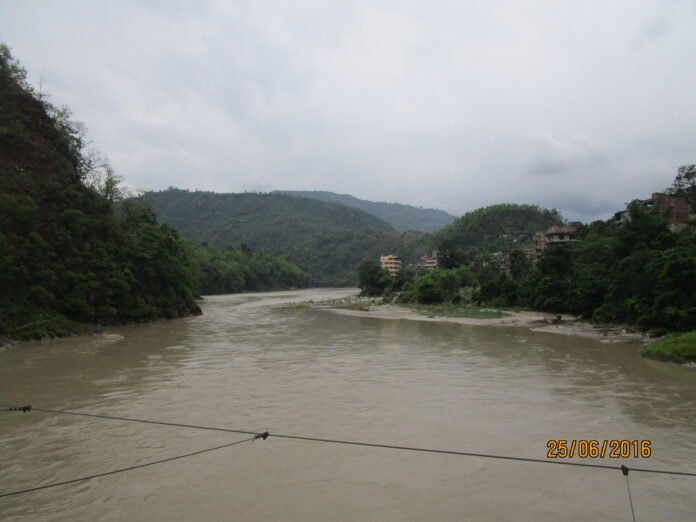
File photo: The Trishuli River at Malekhu, Nepal, on June 25, 2016. Photo: Anup Sadi / Wikimedia Commons, CC BY-SA 4.0. This is not an image of the August 2026 floods or current recovery work. Source · Licence
Sources
- Associated Press: UN climate fund promises $20 million for Nepal flood recovery, far short of billions needed
- Onlinekhabar: Loss and Damage Fund approves $20 million grant for Nepal’s flood recovery
- The Kathmandu Post: Loss and Damage Fund calls extraordinary meeting for October 22 to support Nepal
- Climate Home News: UN’s loss and damage fund set to give Nepal $20m for flood recovery

The International Desk covers world and Asian affairs, diplomacy and conflict, with a focus on what they mean for India. Stories are checked against at least two credible sources before publication.