October 26: India’s consumer regulator has renewed its warning about online walkie-talkie listings that omit essential technical and licensing information. In an October 25 statement, the Department of Consumer Affairs said the Central Consumer Protection Authority imposed a ₹1 lakh penalty on Hogar Technologies and Innovations LLP over misleading advertisements.
Key highlights
- The latest action concerns missing frequency, licensing and approval disclosures, according to the official statement.
- The CCPA reported more than 16,970 non-compliant listings identified and notices to 13 e-commerce entities.
- A seller’s “licence-free” label should be checked against the exact model and applicable Indian requirements.
- Buyers can preserve listing details and use the National Consumer Helpline for grievances.
What the latest action says
The department said the authority had issued final orders against 12 entities, with cumulative penalties of ₹58 lakh. These are totals for the wider enforcement programme, not a single new penalty on one seller.
The statement also acknowledged challenges to some orders or proceedings before judicial forums. Regulatory findings should therefore be distinguished from the eventual outcome of any appeal. This report describes the authority’s published account and does not independently determine the compliance of individual devices.
Why “licence-free” needs a closer look
In an earlier enforcement statement, the department explained that the 2018 exemption rules cover personal mobile radios within the prescribed 446.0–446.2 MHz band, subject to applicable conditions. It also said licence-exempt devices require Equipment Type Approval, or ETA, before import or sale in India.
The Department of Telecommunications’ published legislation list identifies the relevant instrument as G.S.R. 1047(E), dated October 18, 2018. Frequency exemption and equipment approval are different questions: a reference to the former is not evidence that the latter has been satisfied.
The earlier consumer-affairs release described listings advertising a wider 400–470 MHz range and failing to provide required disclosures. That example explains why an attractive product photograph or a broad frequency specification should not substitute for model-specific documentation. It does not establish that every radio with similar styling is unlawful.
Before ordering: a practical checklist
The following is our buyer checklist, rather than a finding that any particular product passes regulatory checks. Ask for written information before payment and retain the response with the invoice.
| Check | What to ask the seller | Why it helps |
|---|---|---|
| Exact model | Full model number and manufacturer | Match the listing, device and paperwork |
| Frequency | Operating band and configured channels | Avoid relying on a vague “licence-free” claim |
| Approval | Applicable ETA details for that model | Keep a traceable basis for the seller’s claim |
| Use conditions | Whether your intended Indian use requires authorisation | Separate sales availability from lawful operation |
| After-sales terms | Invoice, return conditions and grievance contact | Preserve practical options if information is incomplete |
If a document gives a different model name, request clarification rather than assuming it covers the unit being sold. Likewise, a certificate photograph without legible identifying details is not enough for a meaningful comparison. When specifications remain unclear, postponing a purchase is more useful than treating a marketing phrase as permission to operate.
Where buyers can raise a grievance
The National Consumer Helpline’s official portal provides online complaints, status tracking and access through its app, UMANG and WhatsApp. It lists the toll-free number 1915, available from 8 a.m. to 8 p.m.
For a clear complaint record, keep the product URL, dated screenshots, order number, invoice and correspondence. State what the advertisement promised, what information was missing and what remedy you requested. A complaint channel is not a guarantee of a refund or a substitute for the relevant spectrum authorisation.
What to watch
Further official orders and the outcomes of pending challenges will matter more than headline penalty totals alone. For consumers, the immediate task is to verify the device, paperwork and permitted use before purchase. Online availability should not be treated as proof of approval.
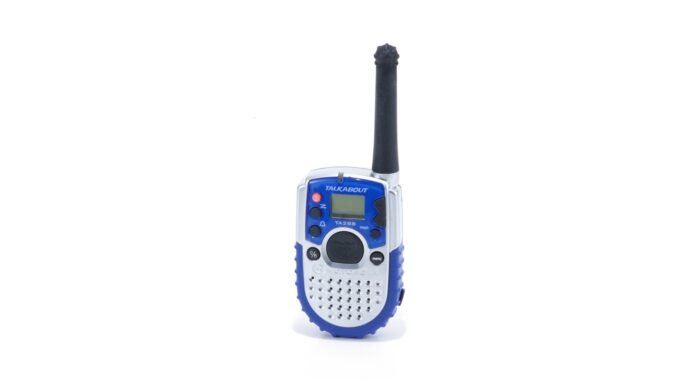
Representational image: Motorola TA288 handheld radio, photographed April 23, 2015. Photo: Aaronwarduk / Wikimedia Commons, CC BY-SA 4.0. Resized and placed on a white canvas; adaptation shared under the same licence. The pictured model is not identified as a product involved in the latest CCPA action, and its appearance does not establish approval in India. Photo source.
Sources
- Department of Consumer Affairs: October 25 CCPA walkie-talkie enforcement update
- Department of Consumer Affairs: Earlier enforcement action and regulatory requirements
- Department of Telecommunications: Subordinate legislation and spectrum exemptions
- National Consumer Helpline: Official grievance channels

The Business Desk covers markets, the economy, companies and personal finance. Stories are checked against at least two credible sources before publication.