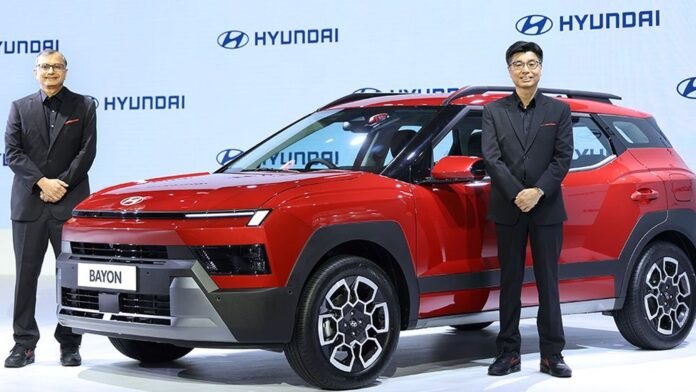
October 26: Hyundai Motor India has launched the Bayon at a starting price of ₹9,99,900 ex-showroom, according to the manufacturer’s launch announcement. The India-spec SUV pairs a 1.5-litre petrol engine with a manual or intelligent variable transmission, while its equipment list places considerable emphasis on connected technology and driver assistance.
Key highlights
- The ₹9,99,900 figure is the starting ex-showroom price, not a universal on-road quote.
- Hyundai lists a 115 PS petrol engine and 143.8 Nm of maximum torque.
- Buyers can choose a six-speed manual or iVT, depending on variant.
- Advanced equipment varies by trim; the full advertised feature list is not a base-model specification.
The confirmed mechanical package
Hyundai’s technical table specifies a 1,497 cc, four-cylinder MPi petrol engine. Peak power is delivered at 6,300 rpm, with peak torque at 4,500 rpm. The launch document lists a 2,600 mm wheelbase and a 4,245 mm overall length. Those are the company’s India specifications; they should not be replaced with dimensions or engine options from a European Bayon review.
| Item | India launch specification |
|---|---|
| Starting price | ₹9,99,900, ex-showroom |
| Engine | 1.5-litre MPi petrol |
| Maximum output | 115 PS; 143.8 Nm |
| Transmission | Six-speed manual or iVT |
| Wheelbase | 2,600 mm |
Which variant should a buyer compare?
The manufacturer lists manual versions from HX2 through HX10, including HX3+, with iVT versions in HX5, HX6, HX8 and HX10. Its announcement describes a generative-AI voice assistant using Perplexity and SoundHound AI, a connected cockpit and driver-assistance systems. These are announced capabilities, not findings from an independent road test.
The useful next step is to request a written, variant-specific equipment sheet. Ask which safety functions, cameras, screens and connected services are fitted to the exact vehicle being quoted. A feature shown in a launch photograph should not automatically be assumed to be included in every price tier.
In particular, Hyundai’s statement that the platform is engineered for five-star Indian safety standards is a design claim. It should not be described as a published independent crash-test result unless a testing agency has separately released that assessment. Driver-assistance equipment also needs to be understood as assistance, rather than permission to stop supervising the vehicle.
Ex-showroom price versus the actual purchase decision
A buyer comparing two quotations should keep the vehicle price separate from registration, insurance, accessories and any service products. Request an itemised quotation and ask which items are optional. This makes a comparison more useful than subtracting two advertised starting prices for vehicles with different equipment.
For a test drive, concentrate on the configuration being considered: manual and automatic choices can lead to different everyday experiences in traffic. Check seating access, visibility, luggage requirements and the operation of frequently used controls. Connected features should be demonstrated with their subscription conditions and network requirements explained.
What to watch
Variant-level availability, written delivery commitments and independently measured safety and efficiency data will make the ownership picture clearer. For now, the launch establishes the starting price and manufacturer specifications. It does not establish real-world fuel economy, a personal delivery date or an all-inclusive purchase cost.
Representational image: India-spec Hyundai Bayon in the manufacturer’s launch image, October 26, 2026. Credit: Hyundai Motor India; Official launch press image — editorial use. Cropped/resized for 1600×900. Manufacturer-supplied launch image; not an independent road test. Image source; Licence.
Sources
- Hyundai Motor India: Bayon launch price and specifications
- Hyundai Motor India: India-spec Bayon unveiling

The Business Desk covers markets, the economy, companies and personal finance. Stories are checked against at least two credible sources before publication.