BENGALURU, November 3: Data from India’s solar observatory Aditya-L1 show that a solar eruption swelled unevenly as it left the Sun, rather than expanding like a simple bubble, scientists at the Indian Institute of Astrophysics (IIA) have found. The finding, published in The Astrophysical Journal Letters, could help forecasters judge when such eruptions will reach Earth, the Department of Science and Technology said on Tuesday.
Key highlights
- The team studied a coronal mass ejection (CME) launched on August 5, 2024 from an active region near the Sun’s western edge.
- They combined spectra from the Visible Emission Line Coronagraph (VELC) on Aditya-L1 with images from NASA’s Solar Dynamics Observatory, and built a 3-D model of the eruption.
- For the first time, the study showed the CME did not expand symmetrically but grew unevenly, taking an asymmetric shape.
- Uneven expansion can change how a CME interacts with the solar wind, and so its speed and arrival time at Earth.
- VELC, Aditya-L1’s main payload, was designed and built by IIA at its CREST campus in Hosakote with ISRO’s support.
How the study worked
| Element | Detail |
|---|---|
| Event | CME of August 5, 2024, near the Sun’s western limb |
| Instrument | VELC on Aditya-L1, observing the corona from 1.05 to 1.5 solar radii |
| Spectral line | 530.3 nm green line from highly ionised iron, tracing plasma at about 1.8 million Kelvin |
| Key signal | Emission shifted both blueward (plasma moving towards us) and redward (moving away) |
| Second dataset | Atmospheric Imaging Assembly on NASA’s Solar Dynamics Observatory |
| Model | 3-D geometric-kinematic model; only an inclined axis with uneven sideways expansion matched the data |
Who did it
The lead author is Saurabh Tripathi, a PhD student at IIA, an autonomous institute of the Department of Science and Technology. Solar astronomer Tanmoy Samanta is the corresponding author and Jayant Joshi a co-author. “Our results show that the CME did not expand uniformly,” Samanta said. Joshi said an eruption’s early shape “can have important implications” for how it meets drag in the solar wind and when it arrives at Earth.
Our calculation
- Time from event to paper: the eruption studied took place on August 5, 2024, a little over two years before the result was announced.
- Mission age: Aditya-L1 was launched in September 2023, a little over three years ago.
- Payloads: VELC is one of seven instruments on the spacecraft.
What it means
CMEs are clouds of charged plasma thrown out by the Sun. When they hit Earth’s magnetic field they can disturb satellites, GPS, radio links and power grids. Forecasts of their arrival depend on knowing their shape and speed. Because VELC measures motion towards and away from the observer, the IIA team says it can help reconstruct a CME’s movement low in the corona without relying only on images from several spacecraft. That could make a single Indian observatory more useful for space-weather warnings.
What to watch
- Whether the method works on other CMEs, which the researchers plan to test.
- More science results from VELC and Aditya-L1’s six other payloads.
- How Indian agencies use the data in space-weather alerts for satellites.
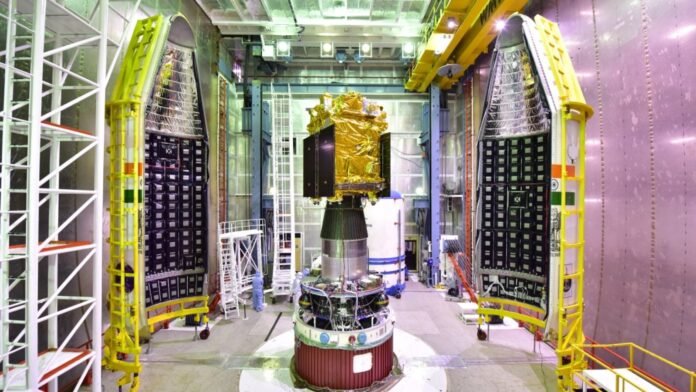
File photo: The Aditya-L1 spacecraft during pre-launch assembly. Image: Indian Space Research Organisation, Government Open Data Licence – India, via Wikimedia Commons. Photo source · Licence
Sources
- PIB (Ministry of Science and Technology): VELC on board Aditya-L1 reveals asymmetric expansion of solar eruption (November 3, 2026)
- The Astrophysical Journal Letters: the IIA study (DOI)

The Tech Desk covers technology, artificial intelligence and cybersecurity. Stories are checked against at least two credible sources before publication.