NEW DELHI, November 6: The Indian Navy’s stealth frigate INS Sahyadri has arrived at Yokosuka Naval Base in Japan for Exercise Malabar 2026, which brings together the navies of India, Japan, the United States and Australia, the Ministry of Defence said on Thursday. In New Delhi, the Navy’s three-day Indo-Pacific Regional Dialogue (IPRD-2026) ended the same day with sessions on ocean governance and the dual-use risks of new maritime technologies.
Key highlights
- Arrival: INS Sahyadri, a guided-missile stealth frigate of the Eastern Fleet, reached Yokosuka on November 4.
- Welcome: the Japan Maritime Self-Defense Force received the ship; Vice Admiral Yagi Koji, Commandant of Yokosuka District, and R Madhu Sudan, Deputy Chief of the Indian Mission, attended.
- Format: a harbour phase of planning and professional exchanges, followed by a sea phase with US, Australian and Japanese units.
- IPRD-2026: the dialogue closed with a special address by Chief of Defence Staff Gen NS Raja Subramani and a valedictory address by Defence Secretary Rajesh Kumar Singh.
| Item | Detail |
|---|---|
| Exercise | Malabar 2026 |
| Participating navies | India, Japan, United States, Australia |
| Indian ship | INS Sahyadri (guided-missile stealth frigate, Eastern Fleet) |
| Venue of harbour phase | Yokosuka Naval Base, Japan |
| Indian policy framework cited | MAHASAGAR (Mutual and Holistic Advancement for Security and Growth Across Regions) |
IPRD-2026 wraps up
The final day of the Indo-Pacific Regional Dialogue, organised with the National Maritime Foundation, covered ocean governance and maritime resilience, with speakers from the University of the Philippines, a former chief of staff of the International Seabed Authority, the Coalition for Disaster Resilient Infrastructure and a Swedish maritime organisation. A closing session looked at artificial intelligence, quantum technologies and other dual-use maritime technologies, and how small and medium navies can adopt them responsibly. Our report on the opening day is here.
Background
Malabar began as a bilateral India–US naval exercise in 1992. Japan later became a regular participant, and Australia rejoined in 2020, making it an exercise of all four Quad navies. INS Sahyadri came to Japan from South Korea, where it concluded a bilateral exercise with the Republic of Korea Navy at Busan earlier this week (our report).
What it means
Holding the exercise’s harbour phase in Japan, alongside India’s own dialogue on Indo-Pacific cooperation, shows how closely India is now working with Quad partners at sea, at a time of conflict in the Middle East and close attention to shipping routes. The exercise improves the ability of the four navies to operate together, which matters for securing sea lanes that carry much of Asia’s trade and energy.
What to watch
- Details of the sea phase once it begins.
- Any joint statement or follow-up from IPRD-2026 recommendations.
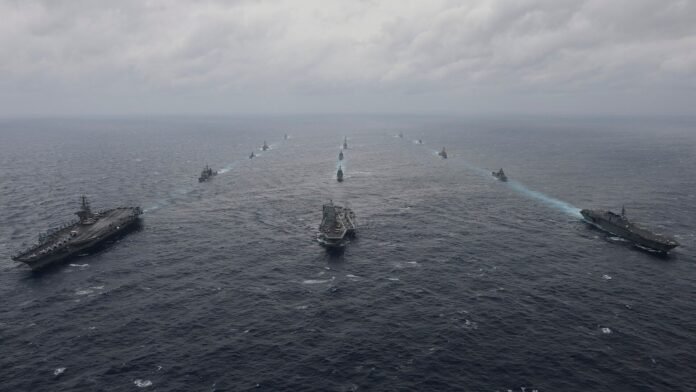
Ships of the Indian Navy, Japan Maritime Self-Defense Force and US Navy during Exercise Malabar 2017 (file photo). Image: U.S. Navy, Public domain, via Wikimedia Commons. Photo source
Sources
- PIB (Ministry of Defence): INS Sahyadri arrives at Yokosuka for Exercise Malabar 2026
- PIB (Ministry of Defence): IPRD-2026 concludes

The International Desk covers world and Asian affairs, diplomacy and conflict, with a focus on what they mean for India. Stories are checked against at least two credible sources before publication.