NEW DELHI, November 7: Stage III of the Graded Response Action Plan (GRAP) is now in force across the National Capital Region (NCR), a day before Diwali. The Commission for Air Quality Management (CAQM) invoked it on November 6 after Delhi recorded a daily average Air Quality Index (AQI) of 382, in the ‘Very Poor’ band, and forecasts from the India Meteorological Department (IMD) and the Indian Institute of Tropical Meteorology (IITM) showed air quality likely to slip into the ‘Severe’ category in the coming days.
Key highlights
- In force: Stage III across the entire NCR from November 6, on top of Stage I (from October 21) and Stage II (from November 2).
- Construction: strict curbs on dust-heavy work such as digging, piling, demolition, brick work, road building and painting; essential public projects are exempt.
- Stone crushers and mining: to be shut across the NCR.
- Old cars: strict restrictions on BS-III petrol and BS-IV diesel four-wheelers in Delhi and in Gurugram, Faridabad, Sonipat, Ghaziabad and Gautam Buddh Nagar.
- Schools: classes up to Class V in hybrid mode in Delhi, Gurugram, Faridabad, Ghaziabad and Gautam Buddh Nagar.
- Offices: state governments are to decide on 50% attendance with the rest working from home.
| Area | What Stage III says |
|---|---|
| Construction and demolition | Strict restrictions on earthwork, boring and drilling, piling, all demolition, open-trench pipe and cable laying, brick and masonry work, ready-mix concrete plants, major welding and gas cutting, painting and varnishing, plastering, tile and stone cutting, road building and major repairs, and loading or unloading of cement, sand, bricks and similar materials |
| Exempt projects | Railways, metro, airports and inter-state bus terminals, national security and defence, hospitals, linear public projects (highways, flyovers, power lines, pipelines, telecom), sewage treatment and water supply |
| Stone crushers and mining | To be closed across the NCR |
| Private cars (LMVs) | Strict restrictions on BS-III petrol and BS-IV diesel or older four-wheelers in Delhi, Gurugram, Faridabad, Sonipat, Ghaziabad and Gautam Buddh Nagar; vehicles adapted for persons with disabilities are allowed for personal use |
| Goods vehicles | Delhi-registered diesel BS-IV or older medium goods vehicles restricted in Delhi; outside-registered diesel BS-IV or older medium and light goods vehicles not allowed to enter Delhi |
| Schools | Classes up to Class V in hybrid mode (physical and online) in Delhi, Gurugram, Faridabad, Ghaziabad and Gautam Buddh Nagar; the choice of online lies with students and parents |
| Offices | States and Delhi to decide on 50% office strength; the Centre may decide on work from home for its staff |
Why Stage III now
The CAQM’s sub-committee on GRAP said Delhi’s air had worsened “due to poor dispersion of pollutants on account of unfavourable meteorological conditions”. It decided unanimously to bring in Stage III to prevent further deterioration, and said all agencies, including the pollution control boards of the NCR states and the Delhi Pollution Control Committee, must enforce Stage I, II and III measures strictly. The actions come from a revised GRAP schedule issued on September 29, 2026.
What citizens are asked to do
- Walk or cycle for short distances and choose cleaner transport.
- Combine short journeys and reduce trips.
- Postpone private gatherings that increase traffic and outdoor exposure.
- Do not use coal or wood for heating; house owners may give electric heaters to security and other staff to stop open burning.
- Follow hybrid classes for primary schools and work from home when instructed.
Diwali and firecrackers
The Supreme Court has allowed only certified green crackers in Delhi-NCR, and only from 6 am to 7 am and 8 pm to 10 pm on November 7 and 8, with the full ban returning on November 9. The court’s conditions are explained in our guide to the green-cracker order. For the festival itself, see our Diwali 2026 guide.
Our calculation
- Delhi’s AQI of 382 on November 6 was 19 points below 401, where the ‘Severe’ band begins.
- GRAP has moved from Stage I to Stage III in 16 days, from October 21 to November 6.
What it means for India and Asia
Delhi’s winter smog is a yearly public health problem that also hits business: construction stops, goods vehicles are kept out and schools and offices switch to hybrid work. Children, older people and those with heart or lung disease are most at risk on high-pollution days. Stubble burning in Punjab and Haryana, which the CAQM has been tracking this month, and calm winter weather tend to make conditions worse around Diwali.
What to watch
- CPCB’s daily AQI bulletin after Diwali night on November 8.
- Whether the CAQM moves to Stage IV, the final stage, if air quality worsens further.
- Decisions by Delhi and the NCR states on 50% office attendance.
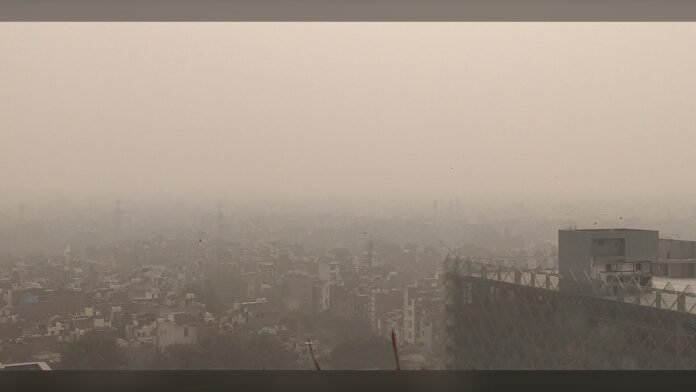
Smog and poor visibility in Delhi in December 2019 (file photo). Image: Prami.ap90, CC BY-SA 4.0, via Wikimedia Commons. Photo source · Licence
Sources
- CAQM: Press release, “CAQM Invokes GRAP III in Delhi NCR”, November 6, 2026 (PDF)
- CAQM: Order dated November 6, 2026, invoking actions under Stage III of the GRAP in Delhi-NCR, with the revised schedule (PDF)
- CAQM: Order dated November 2, 2026, invoking GRAP Stage II (PDF)

The National Desk covers India's politics, governance, security and public-interest news. Stories are checked against at least two credible sources before publication.