HANOI, November 9: Viet Nam will raise regional minimum wages by 7.8% from 2027, lifting the monthly floor in its most developed areas to VND5.7 million, while households have moved to a new five-tier electricity tariff with a 2% cut in average retail power prices that runs until March 2027, according to the government’s news portal. The changes come as Hanoi targets growth of at least 10% next year.
Key highlights
- Minimum wages from 2027: VND5.7 million a month in Region I, down to VND4.04 million in Region IV, a 7.8% rise.
- Hourly minimums: VND27,400 in Region I to VND19,400 in Region IV.
- New power tariff: five consumption tiers for households from November 1, 2026, from VND1,901 to VND3,844 per kWh before VAT.
- Price cut: average retail electricity prices are 2% lower from November 1, 2026 to March 31, 2027.
- Power mix: coal generated 49.7% of Viet Nam’s electricity in January–October 2026; renewables 13.7%.
New regional minimum wages
| Region | Monthly minimum (VND) | Hourly minimum (VND) | Covers |
|---|---|---|---|
| Region I | 5,700,000 | 27,400 | Major urban centres with the highest development |
| Region II | 5,080,000 | 24,400 | Other developed cities and industrial hubs |
| Region III | 4,450,000 | 21,400 | Areas with growing industry and services |
| Region IV | 4,040,000 | 19,400 | Less-developed areas with lower living costs |
Employers must apply the minimum wage for the area where they operate. The four-region system reflects differences in development, living costs and labour markets, with Region I the highest and Region IV the lowest.
New household electricity tariff
| Tier | Monthly use | Price (VND/kWh, before VAT) | Approx. US$/kWh |
|---|---|---|---|
| 1 | 0–100 kWh | 1,901 | 0.072 |
| 2 | 101–200 kWh | 2,289 | 0.087 |
| 3 | 201–400 kWh | 2,894 | 0.110 |
| 4 | 401–700 kWh | 3,456 | 0.131 |
| 5 | Above 700 kWh | 3,844 | 0.146 |
Where Viet Nam’s electricity comes from
| Source (January–October 2026) | Output (billion kWh) | Share |
|---|---|---|
| Coal | 147.78 | 49.7% |
| Hydropower | 73.39 | 24.7% |
| Renewables (solar 24.04, wind 15.37) | 40.72 | 13.7% |
| Gas | 23.28 | 7.8% |
| Imports | 11.77 | 4.0% |
| Total production and imports | 297.4 | +9.8% year on year |
Our calculation
- The top household tariff (VND3,844) is about 2.0 times the lowest (VND1,901), so heavy users pay roughly double per unit.
- At the exchange rate implied by the government’s tariff table (about VND26,400 to the dollar), the Region I monthly minimum of VND5.7 million is about US$216.
- Coal and gas together supplied about 57.5% of Viet Nam’s electricity in the first ten months, against 13.7% from solar and wind.
What it means for India and Asia
- Labour costs: manufacturers comparing Viet Nam, India and other Asian locations will factor in the 7.8% rise in Viet Nam’s wage floor from 2027.
- Energy and industry: like India, Viet Nam still relies on coal for the largest share of its power, even as electricity production and imports rose 9.8% in the first ten months of this year.
- Household relief: the 2% price cut until March 2027 eases costs at a time when consumer inflation in Viet Nam reached 5.09% in October.
What to watch
- Implementation of the new minimum wages from 2027 and their effect on factory costs.
- Whether the 2% electricity price cut is extended beyond March 31, 2027.
- Progress on renewable energy and power supply plans to meet demand through 2030.
Related: To Lam begins official visit to Japan as Viet Nam sets 10% growth goal · Vietnam’s inflation rises to 5.09% in October
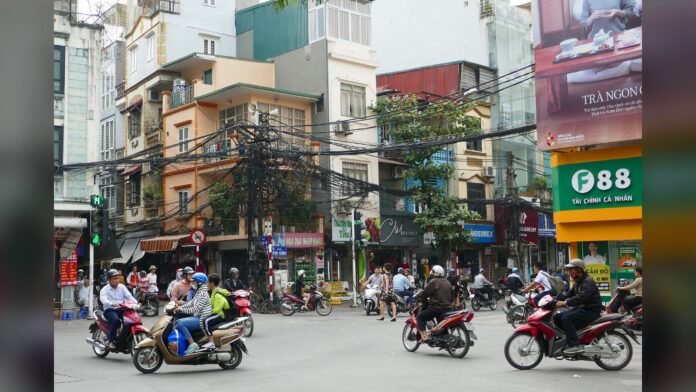
Power lines along a street in Hanoi (file photo) Image: Ji-Elle, CC BY-SA 4.0, via Wikimedia Commons. Photo source · Licence
Sources
- Government of Viet Nam news portal: Regional minimum wages to rise by 7.8 percent from 2027
- Government of Viet Nam news portal: Viet Nam introduces new five-tier household electricity tariff
- Government of Viet Nam news portal: Lawmakers adopt socio-economic development plan for 2027

The Business Desk covers markets, the economy, companies and personal finance. Stories are checked against at least two credible sources before publication.