Update: On September 9, Reuters reported, citing two sources, that SIA would seek tougher terms for any fresh Air India funding, including more say over management, stronger governance rights and commitments to narrow losses. Tata Sons had reportedly approved its pro-rata share of about $1.1 billion, and Temasek would not provide capital itself or intervene in SIA’s decision, according to the report. SIA said its board would evaluate any request carefully; no decision had been reported.
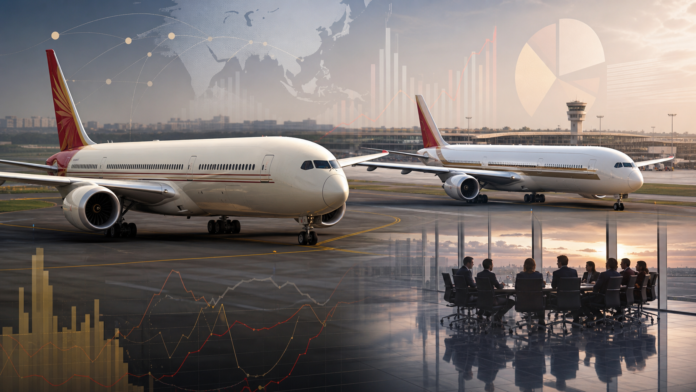
New Delhi/Singapore, August 30: Temasek has backed Singapore Airlines’ (SIA) stake in Air India as a long-term strategic investment. The statement comes as political and investor scrutiny grows in Singapore over reports that Air India has asked its owners, Tata Sons and SIA, for about $1.5 billion in fresh equity.
SIA holds 25.1% of Air India and Tata Sons has control. Temasek, the state investment company, is SIA’s majority shareholder. Any decision to put more money into Air India is therefore not just a question of airline strategy, but also of public money and shareholder accountability in Singapore.
Key highlights
- Temasek executive Juliet Teo, in a letter to The Business Times, said SIA chose India as its second main growth hub outside Singapore.
- Air India has reportedly asked Tata Sons and SIA for about $1.5 billion in fresh equity, Reuters reported.
- Air India and Air India Express together lost about $2.33 billion in the year to March 2026, more than double the previous year.
- Temasek’s letter did not say how much SIA or Temasek would put into the new request.
- A Workers’ Party MP in Singapore said Temasek funds should not be used to prop up Air India.
What Temasek said
In her letter to The Business Times, Temasek senior executive Juliet Teo said SIA had chosen India as a second major centre for long-term growth outside its Singapore hub. India is one of the world’s largest and fastest-growing aviation markets, so a direct stake gives SIA more strategic access than a codeshare or partnership alone. The letter described Air India’s transformation as a complex, multi-year process in which fleet renewal, operational integration, fuel prices, geopolitical disruption and closed airspace can make results uneven, and said Temasek supported SIA’s strategy. It did not say how much would be invested in the new $1.5 billion request: supporting a long-term strategy and approving a specific capital proposal are two different decisions.
The $1.5 billion request
| Item | Figure | Note |
|---|---|---|
| SIA’s stake in Air India | 25.1% | Since the Vistara merger in November 2024 |
| Tata Sons’ stake (our calculation) | 74.9% | The remainder |
| Reported equity request | About $1.5 billion | From both owners (Reuters) |
| SIA’s pro-rata share (our calculation) | About $377 million | 25.1% of $1.5 billion |
| Tata’s pro-rata share (our calculation) | About $1.12 billion | 74.9% of $1.5 billion |
| Loss, Air India and Air India Express, FY to March 2026 | About $2.33 billion | More than double the year before |
Our calculation: if the two owners invested in proportion to their stakes, SIA would put in about $377 million and Tata about $1.12 billion. The reported request is equal to roughly 64% of the airline group’s loss for the last financial year. If one shareholder invested less than its share, its stake could be diluted, depending on the deal terms; no such structure has been confirmed.
Air India is spending heavily on refurbishing its fleet, new aircraft, technology systems, training and service improvements, so a need for new capital is not surprising. The basic question for investors is when cash burn will fall and when the transformation will produce lasting operating returns.
What SIA gets from Air India
SIA has no large domestic market at home; its growth has historically relied on connecting long-haul and regional passengers through Singapore. The Air India stake gives it access to India’s domestic network and direct international traffic from Indian cities, along with board representation, strategic oversight and direct exposure to Indian aviation growth. In July, answering investor questions, SIA said Air India had made progress on customer experience, fleet, network and operations, but acknowledged serious risks: fuel costs, the weak rupee, supply-chain constraints, the closure of Pakistani airspace and the 2025 crash of Air India Flight 171.
Why the losses are so large
Refurbishing old aircraft, expanding the wide-body fleet and integrating two large airline systems is expensive, and global delays in new aircraft deliveries affect capacity planning and maintenance costs. The closure of Pakistani airspace to Indian carriers has made some western routes longer and costlier, and the US–Iran conflict has added airspace disruption and fuel volatility. Such shocks can stretch a turnaround timeline even when passenger demand is strong. On the other side, rising incomes, new airports and demand for international travel give India’s aviation market long-term revenue potential.
Why there is opposition in Singapore
Workers’ Party MP Kenneth Tiong said Temasek’s funds should not be used to support Air India. The criticism centres on SIA’s minority stake, which does not give it full control while its share of losses and future funding obligations could be large. Temasek’s answer rests on its ownership approach: it wants portfolio companies to make strategic moves for long-term competitiveness. Shareholders will still expect SIA’s board to set out clear limits on capital, return targets and downside risks. For Indian readers, the debate matters because Air India’s reliability, fares, route expansion and service quality may depend on this funding. See also our HDFC Bank leadership report for other corporate news.
What to watch
- A formal decision by SIA’s board, which says it will weigh any additional capital request against its other needs and Air India’s strategy.
- Air India’s next financial disclosures on operating losses, debt, passenger yields and unit costs.
- Customer-facing targets such as fleet refurbishment and on-time performance.
- The funding split between Tata Sons and SIA, and any change in ownership.
What it means
Temasek’s backing gives SIA strategic cover, but it does not answer the specific $1.5 billion question. Air India has a large market, a global brand and room to expand, but also record losses, integration complexity and external shocks. India–Singapore economic ties make this more than an ordinary airline investment; for the wider regional context, see our report on Prime Minister Modi’s Central Asia visit.
This article was first published in Hindi and has been translated. The Press of Asia now publishes in English only.
Sources
- CNA: report on Temasek’s support for SIA’s Air India investment
- The Business Times: Temasek supports SIA’s long-term strategy (letter by Juliet Teo)
- The Business Times (Reuters): report that Air India is seeking about US$1.5 billion from its owners
- The Business Times: report on SIA defending its Air India investment
- Khaleej Times (Reuters): Singapore Airlines to seek tougher terms for any fresh Air India funding

The Business Desk covers markets, the economy, companies and personal finance. Stories are checked against at least two credible sources before publication.