October 21: Images of burning barricades, damaged shops and police confronting crowds in France and Italy have prompted a question for Indian readers: why has a comparable, simultaneous wave not appeared across India in the same way? The question is worth examining, but its strongest version—“all of Europe is burning while India has escaped”—goes beyond the evidence. Europe is not a single protest zone, and India is not free of economic pressure or public dissent.
Analysis by Rajnish Kumar
This analysis compares verified reporting and published economic indicators. It is not based on interviews at the demonstrations, an original protest-counting exercise or a statistical study proving why people in one country protested and people elsewhere did not. The distinction matters: differences in outcomes can suggest explanations without establishing one exclusive cause.
Key highlights
- France and Italy have experienced serious unrest, but peaceful demonstrations, strikes, rioting and looting should not be treated as interchangeable.
- Energy costs, housing, public services and political disputes interact differently in each country.
- India’s growth outlook and food-support arrangements offer reasons to examine economic resilience, not proof of immunity from unrest.
- India’s own September inflation figures show that household pressure remains real.
- The useful lesson is to strengthen living standards, responsive institutions and lawful public debate—not to declare one society permanently safe and another irretrievably broken.
First, what is happening in Europe?
Reuters’ October 20 explainer traced France’s immediate crisis to student grievances that expanded into a wider movement over living costs. It reported local curfews after a weekend of riots, with restrictions affecting parts of several cities. The reporting describes a serious public-order crisis, but local restrictions are not the same as a countrywide shutdown.
Italy’s response has also hardened. The Associated Press reported on October 20 that the government approved security measures after unrest in Milan. Those measures and their implementation should be assessed separately from the underlying grievances. A government’s decision to strengthen enforcement does not, by itself, explain why a demonstration began or prove that every participant committed an offence.
Le Monde’s October 20 reporting described unrest and demonstrations in several other European countries, including Belgium, Spain and Portugal, against differing combinations of economic and political pressures. Its account is a reason to investigate common stresses. It is not evidence that every European country is experiencing the same intensity, the same organisers or the same demands.
A video of violence can be entirely authentic and still be an incomplete guide to the surrounding society. It may show one street during one hour. The responsible comparison asks how widespread the event was, how long disruption lasted, what happened elsewhere and whether the people causing damage were representative of the wider demonstration.
Protest is not automatically a sign of national collapse
Peaceful assembly is one way people seek a change in policy. A strike, a student march, a confrontation with police and opportunistic looting involve different conduct and require different descriptions. Combining all four under a single label hides the distinction between a demand and the methods used to express it.
This does not minimise violence. Arson and attacks can endanger residents, workers, protesters and emergency services. It means that accurately identifying violence is more useful than attributing it to everyone visible in a crowd. Authorities also need to distinguish peaceful participants from people committing offences if enforcement is to remain credible.
The same standard should apply to India. A peaceful Indian protest cannot be defended as democratic participation while every European demonstration is described as social collapse. Nor should European protest automatically be celebrated while comparable Indian dissent is dismissed. A consistent editorial test looks at conduct, evidence and the response of institutions, rather than the nationality of the crowd.
Energy and household budgets: a shared shock, different transmission
At its October 16 European briefing in Bangkok, the IMF said the region had withstood the initial impact of the Middle East war better than feared, partly because renewable energy had reduced reliance on imported fossil fuels. It nevertheless warned that prolonged high energy prices would weigh on the economy and that euro-area inflation could remain above target until 2028.
The IMF also identified competing demands on public budgets, including defence, health and pensions, alongside debt and financing costs. That assessment is more nuanced than a claim that Europe has simply failed: it recognises resilience in one area while identifying pressure in others.
For households, the political effect of an economic shock depends on where it appears. Higher transport costs, an unaffordable rent renewal, reduced public services and a school without adequate resources can produce different grievances even if they share a wider inflationary background. A national average cannot capture every family’s experience.
The mechanism is important for India too. A country can absorb part of a price shock through public spending or administered arrangements, but the cost does not vanish. It may appear in a budget, in a company’s finances, in taxes, in borrowing or later adjustments. Resilience should therefore be judged by how effectively costs are managed and distributed, rather than by assuming there are no costs.
What growth forecasts tell us—and what they do not
The IMF’s October 2026 World Economic Outlook data put projected real GDP growth at 7% for India, 0.4% for France and 0.8% for Italy. These are forecasts, not final realised annual outcomes, and the IMF’s country-specific reporting conventions must be kept in mind. In particular, India’s figures are reported on a fiscal-year basis.
The gap points to different growth environments. It does not measure national happiness, the quality of every job or the probability that a protest will turn violent. Faster growth can create more room for rising incomes and public investment, while still leaving some people behind. Slower growth can sharpen arguments about who should bear an adjustment without making unrest inevitable.
| Indicator or institution | What the checked evidence says | What it cannot prove alone |
|---|---|---|
| IMF growth outlook | India 7%; France 0.4%; Italy 0.8% in the October 2026 projections | That growth differences caused the protest pattern |
| India’s September CPI | 5.54% headline inflation; 7.74% food inflation, provisional official figures | That Indian households are unaffected by higher prices |
| Foodgrain support | Cabinet approved five years of free grain for about 81.35 crore eligible beneficiaries from January 2024 | That every household receives it or that it covers all living costs |
| Local curfews in France | Official travel advice identifies local restrictions | That the entire country is closed |
A fair comparison should also avoid ranking societies using a single number from different periods. A forecast for one economy, an inflation release for another and a viral clip from a third do not form a matched dataset. They can provide context, but they cannot carry the weight of a sweeping causal conclusion.
India’s food safety net is a real buffer, with limits
India’s Cabinet announced in November 2023 that free foodgrains would continue for about 81.35 crore beneficiaries under the Pradhan Mantri Garib Kalyan Anna Yojana for five years from January 1, 2024. The official announcement also described portability under One Nation One Ration Card.
A basic grain entitlement can reduce the portion of an eligible household’s budget needed for staples. Portability is relevant when a family member moves for work. These are concrete mechanisms worth examining when discussing how households manage stress.
However, the programme’s existence is not evidence that it prevented a specific protest. That stronger claim would require research connecting actual receipt, household circumstances and political behaviour. A policy can be useful without every favourable national outcome being attributed to it.
Nor does grain support pay every bill. Rent, transport, healthcare, education and foods outside the entitlement remain part of a family’s budget. Administrative coverage and delivery also matter: an announced entitlement and an individual household’s experience are related questions, not identical ones. A credible account of resilience should explain both the support and its boundaries.
India has not escaped inflation
The Ministry of Statistics and Programme Implementation’s September 2026 release reported provisional consumer-price inflation of 5.54% year on year, compared with 4.83% in August. Food inflation was 7.74%, against 5.97% a month earlier. Rural headline inflation, at 6.08%, was higher than the urban figure of 4.88%.
Our calculation: The rise from 4.83% to 5.54% is 0.71 percentage points. The food-inflation increase from 5.97% to 7.74% is 1.77 percentage points. These are changes in annual inflation rates, not claims that prices rose by those amounts during a single month.
The figures are a useful corrective to the idea that India is insulated from the pressures affecting other societies. They also show why headline growth and household experience need to be discussed together. An economy can expand while a family faces a tighter monthly budget.
Whether that pressure produces a local complaint, an electoral response, collective bargaining or a large demonstration depends on additional factors. Prices alone do not dictate political behaviour. Treating the absence of a particular type of televised unrest as proof that no grievance exists would ignore those other channels.
Jobs and expectations matter alongside the price level
The World Bank’s January 2026 announcement of its India partnership framework said around 12 million young people enter the country’s labour market each year. It placed private investment and employment at the centre of the next phase of growth.
That scale creates both an opportunity and a continuing test. The question is not only how quickly output grows, but whether opportunities are accessible, productive and reliable enough for people planning their lives. A young person can recognise national progress while remaining concerned about the job available to them.
Expectations can also change as education and aspirations rise. A comparison focused only on immediate street violence can overlook quieter dissatisfaction about mobility, recruitment, working conditions or the cost of entering a profession. Those are questions for reporting and policy attention before they become a crisis.
This is why resilience is better treated as an ongoing capacity than a permanent national characteristic. Countries sustain it through institutions that respond to problems, not by assuming that a favourable growth projection settles all social questions.
India’s own protest history prevents an absolute claim
India has experienced large demonstrations over economic policy. The Associated Press reported in February 2024 that farmers seeking guaranteed crop prices attempted to march towards New Delhi and encountered barricades and tear gas. That is a historical example, not a claim that the same event is happening today.
Its relevance is straightforward: India’s record cannot support the assertion that economic grievances never generate mass mobilisation. The appropriate question is how specific movements emerge, how negotiations proceed, how authorities respond and how peaceful assembly is protected while violence is addressed.
Article 19 of India’s Constitution protects speech and peaceful assembly, subject to its constitutional framework of restrictions. The distinction between lawful dissent and unlawful conduct is therefore not merely an editorial preference; it is central to discussing public life accurately. This article is a general analysis, not advice on the legality of a particular gathering.
Political organisation, timing and evidence gaps
Similar economic grievances do not automatically produce simultaneous movements. People need ways to organise, a shared demand, a perceived opportunity to influence decisions and some confidence that participation is worthwhile. A dispute can remain local or connect with others; a particular event can become a catalyst without being the sole cause.
Those are plausible analytical mechanisms, not findings that this article has measured for October’s events. Establishing their relative importance would require interviews, reliable participation data, a timeline and comparison with places where mobilisation did not occur.
The same caution applies to claims about policing. Low visible disorder might reflect effective prevention, successful negotiation, a smaller protest, different tactics or restrictions on assembly. Without evidence, it is not possible to select one explanation and present it as settled. Counting broken windows alone would not measure the quality of democratic governance.
Do not replace economic analysis with collective blame
AP’s October 20 fact check warned against unsupported attempts to blame France’s immigrants for the riots. That warning is relevant to the wider comparison: a person’s religion, origin or immigration status cannot be inferred from a violent clip, and a crowd cannot be assigned a collective motive without evidence.
Where police identify suspects or prosecutors file charges, those developments should be reported with proper attribution and the presumption that allegations require adjudication. They do not justify treating millions of people who share a background as responsible for an offence.
An explanation built around collective blame also misses the policy questions supported by the reporting: living costs, housing, services, expectations and institutional response. Those questions remain important regardless of who tries to exploit an incident politically.
What India can learn without copying Europe’s problems
The first lesson is to address pressure early. Affordable essentials, credible employment opportunities and reliable public services are not simply economic indicators; they shape whether people feel problems can be resolved through ordinary institutions.
The second is to keep channels for peaceful grievances open. Negotiation and transparent explanations can help distinguish a manageable policy dispute from a confrontation. Public order and the right to peaceful dissent should not be treated as mutually exclusive goals.
The third is to judge social protection by delivery and outcomes. Announcing support is different from ensuring that eligible people receive it, understand it and can use it when they move. Measuring those outcomes is more valuable than using welfare figures as a slogan.
The fourth is informational discipline. Old footage should carry its date. Local restrictions should retain their geographical limits. Forecasts should be labelled as forecasts. These habits help readers make decisions and reduce the possibility that an overseas crisis becomes a vehicle for misleading domestic claims.
The conclusion: resilience is a responsibility, not a guarantee
India has economic strengths and public-policy buffers that deserve serious examination. It also has inflation, employment challenges and its own history of protest. France, Italy and other European countries face serious pressures, but that does not make an entire continent a uniform scene of collapse.
The evidence supports a more useful conclusion than “Europe burns, India is safe”: societies experience shared shocks through different economic structures, expectations and institutions. India’s task is to preserve and improve the mechanisms that help people cope, while taking emerging grievances seriously.
No single factor checked here proves why the precise protest pattern differs. That is a limit of the evidence, not a reason to avoid comparison. A careful comparison can identify risks and possible buffers without claiming that unrest is inevitable in Europe or impossible in India.
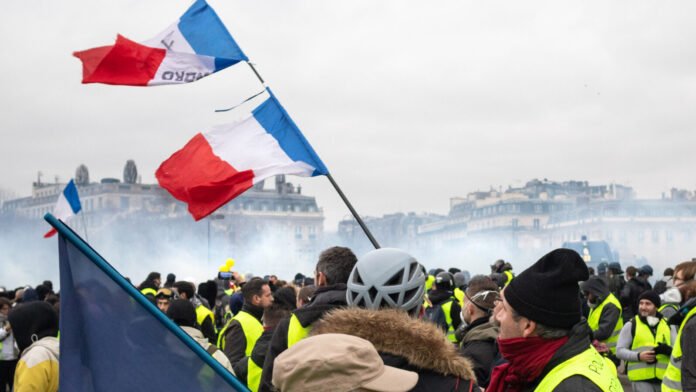
File photo: Yellow Vest demonstrators in Paris on January 12, 2019. Photograph: Olivier Ortelpa / Wikimedia Commons, CC BY 2.0. Cropped and resized. Historical context only; this does not show the October 2026 demonstrations. Image source · Licence.
Sources
- Reuters: France in turmoil — what might follow a weekend of riots?
- Associated Press: Italy approves security measures after Milan unrest
- Le Monde: Social unrest spreads across Europe amid energy prices and a housing crisis
- IMF: European Department press briefing, October 16, 2026
- IMF: October 2026 World Economic Outlook — real GDP growth
- MoSPI via PIB: September 2026 Consumer Price Index release
- PIB: Free foodgrains for 81.35 crore beneficiaries for five years
- World Bank: New India partnership puts jobs and private investment at the centre of growth
- Associated Press: Police use tear gas against Indian farmers marching to New Delhi, February 13, 2024
- India Code: Constitution of India — Article 19
- Associated Press Fact Focus: Unsupported claims about immigrants and France’s riots

Rajnish Kumar is the Founder and Editor-in-Chief of The Press of Asia, an independent digital news platform based in Jhusi, Prayagraj, Uttar Pradesh, India. With expertise in digital journalism, SEO, and online media management, Rajnish is dedicated to delivering accurate, fact-checked, and timely news coverage across India and Asia. He covers topics ranging from national politics and economy to technology, sports, and world affairs.