October 21: Travellers heading to France should check local curfew orders and transport information following the October 17 demonstrations, according to updated Australian and Canadian government travel advice. For readers travelling from Asia, the distinction is important: the checked advisories describe localised security measures and possible disruption, not a nationwide closure of France.
Key highlights
- Australia’s Smartraveller update, dated October 20, warns that further demonstrations may occur.
- Canada’s October 19 update says curfews apply in certain municipalities and advises checking with local authorities.
- Both governments advise avoiding demonstrations and following official instructions.
- A travel advisory is not evidence that a particular flight, train or tourist attraction has been cancelled or closed.
What the official advice says
Smartraveller says large-scale demonstrations took place across France on October 17 and may continue. It warns that authorities may impose partial, localised curfews and advises avoiding demonstration areas and locations with substantial police activity.
The Australian page retains its overall recommendation to exercise a high degree of caution. Readers should not interpret that wording as a new “do not travel” instruction: those are different advisory levels. The update should be read in full, including the reasons attached to the overall rating.
What Canada has added
Canada’s advisory says demonstrations in several cities have disrupted public services and transportation, with incidents of vandalism, looting, arson and clashes. It says security forces have used tear gas in some cases.
The Canadian government specifically tells travellers to establish whether their municipality is subject to a curfew. Its advice also includes monitoring local media, preparing to adjust journeys and expecting heightened security. A restriction in one municipality should not be presented as though it applies automatically to every French city.
Before travelling: what to verify
| Question | Where to verify it | What not to assume |
|---|---|---|
| Does a curfew cover my location? | Current local authority or prefecture notice | That another city’s hours apply |
| Is my flight or train operating? | The airline or rail operator’s live service notice | That a protest warning means all services are cancelled |
| Can I reach my accommodation? | Local transport information and the accommodation provider | That an old video shows today’s access conditions |
| Which consular guidance applies to me? | Your own government and embassy | That another country’s visa or assistance rules apply to your passport |
Why this matters for readers in Asia
A journey from an Asian city may include an airport transfer, a connecting train and travel through more than one municipality. Each stage can be affected differently. Checking the final destination alone may miss a local restriction along the route; assuming the entire itinerary has failed can also be misleading.
The Australian and Canadian pages provide independently published official assessments, but they are issued for their own nationals. This report does not attribute a new advisory to India, China or another Asian government without checking that government’s notice.
What to watch
Local orders can change, and the date and geographical scope of each notice matter. Travellers should check close to departure and again before local journeys, using the most recent official information.
The verified position is that demonstrations and local safety measures require attention. Neither advisory cited here establishes that France is universally inaccessible, nor does either guarantee that an individual route will remain unaffected.
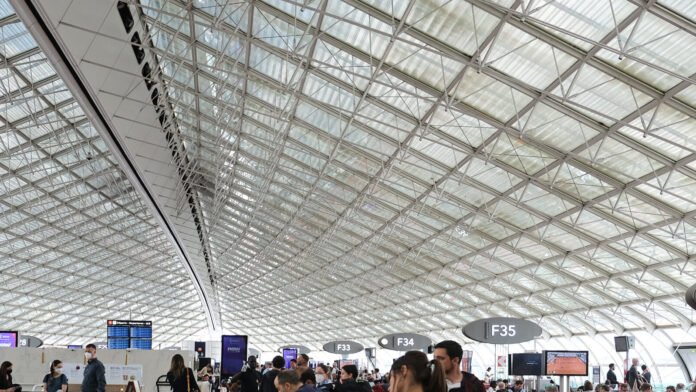
File photo: Paris Charles de Gaulle Airport, Terminal 2F, May 28, 2022. Photograph: kallerna / Wikimedia Commons, CC BY-SA 4.0. Cropped and resized; not a photograph of October 2026 disruption. Image source · Licence.
Sources
- Australian Government Smartraveller: France travel advice and safety
- Government of Canada: France travel advice — demonstrations update

The International Desk covers world and Asian affairs, diplomacy and conflict, with a focus on what they mean for India. Stories are checked against at least two credible sources before publication.